The U.S. Department of Energy announced $2.7 billion in contracts this week to strengthen domestic uranium enrichment.
Energy Secretary Chris Wright said the investment aims to restore "a secure domestic nuclear fuel supply chain capable of producing the nuclear fuels needed to power the reactors of today and the advanced reactors of tomorrow."
Three companies received $900 million contracts: American Centrifuge and General Matter for high-assay low-enriched uranium (HALEU) production, and Orano Federal Services to expand conventional low-enriched uranium capacity.
A fourth company, Global Laser Enrichment, received $28.5 million to continue developing next-generation laser enrichment technology, DOE said — and that company has ties to Wyoming.
Wayne Heili, a Casper-based uranium industry veteran, said the announcement signals opportunity for the state's uranium producers.
"The fuel supply chain starts with domestically produced uranium, and Wyoming is a leader in that capacity," Heili told Cowboy State Daily.
Heili said that Global Laser Enrichment is partially owned by Cameco, which has operations in the Powder River Basin.
GLE is jointly owned by Australian company Silex Systems (51%) and Cameco Corporation (49%), according to Silex's corporate disclosures.
Cameco Resources operates the Smith Ranch-Highland uranium facility near Glenrock, historically the largest uranium production operation in the United States, according to company filings.
Nima Ashkeboussi, vice president of government relations and communications at GLE, told Cowboy State Daily that Wyoming uranium could feed the company's enrichment process.
"Uranium can come from anywhere, including Wyoming," Ashkeboussi said.
He added that GLE is already in discussions with developers of next-generation reactors — including TerraPower, the company building Wyoming's first advanced nuclear plant near Kemmerer.
"It includes the Natrium reactor,” said Ashkeboussi.
Laser Explained
While the three $900 million contracts went to companies using conventional centrifuge technology, the $28.5 million award to GLE supports what Ashkeboussi called a first-of-its-kind approach.
"This is a third-generation uranium enrichment technology," Ashkeboussi said. "It is not deployed anywhere commercially in the world. We would be the first entity anywhere in the world to commercially deploy such technology."
Traditional uranium enrichment works by spinning uranium gas at extremely high speeds in centrifuges, using centrifugal force to separate the slightly lighter uranium-235 atoms from the heavier uranium-238, according to the U.S. Nuclear Regulatory Commission.
The only commercial enrichment facility currently operating in the U.S. is Urenco's New Mexico plant, which supplies about a third of the domestic demand.
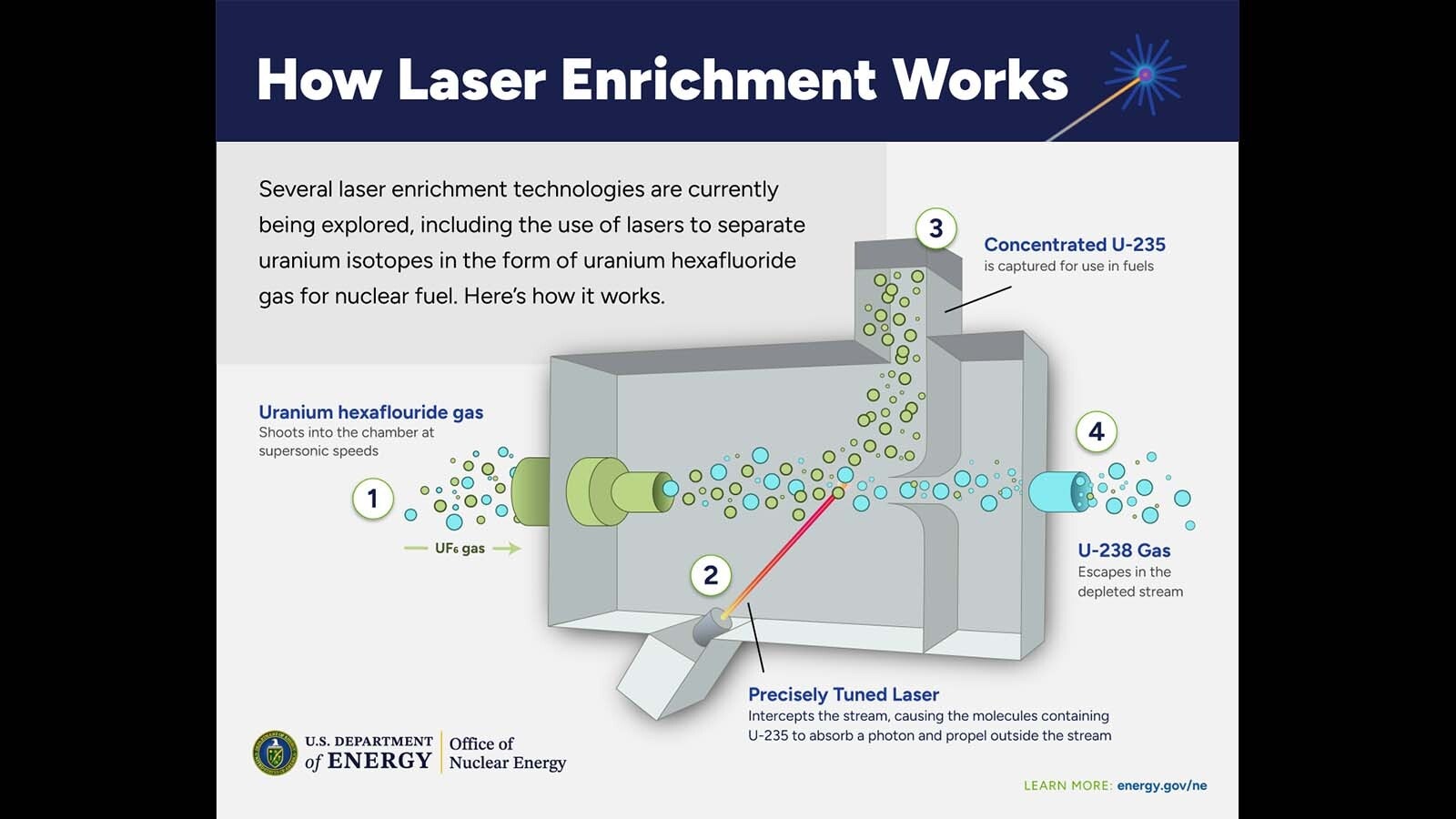
Laser enrichment takes a fundamentally different approach, and Ashkeboussi explained how the process works.
"We have a specifically tuned laser beam, which wavelength specifically attracts or excites the uranium-235 isotope that separates it from the uranium-238 isotope," he said. "That's a very efficient, very selective process to separate the different uranium isotopes that are needed to run nuclear power plants."
The result, he said, is that "we can enrich more efficiently than current technologies."
GLE uses SILEX technology — Separation of Isotopes by Laser EXcitation — exclusively licensed from Australian inventor Silex Systems.
According to Silex's website, the technology offers "inherently higher efficiency and throughput resulting in lower enrichment costs" and a "smaller environmental footprint than centrifuge and diffusion plants."
The company completed large-scale demonstration testing and achieved Technology Readiness Level 6 in October 2025, according to a GLE press release, meaning the technology has been proven at a scale beyond laboratory conditions.
"Our headquarters and our demonstration plant is in Wilmington, North Carolina," Ashkeboussi said. "Our future commercial plant will be in Paducah, Kentucky. We are currently with the Nuclear Regulatory Commission right now licensing that facility."
Ashkeboussi said GLE anticipates receiving its NRC license in the first quarter of 2027, followed by a multi-year construction project on a greenfield site.
The company's schedule has it "coming into commercial production in 2030," he said.
He emphasized the fuel would be used for "strictly pure commercial electricity generation — not defense needs."
Security Concerns
The recently announced investment from DOE comes as the U.S. works to reduce dependence on Russian nuclear fuel.
About 27% of enriched uranium used in the U.S. comes from Russia, which controls around 44% of global enrichment capacity, according to analysis published in February 2025 by the Atlantic Council, a Washington, D.C.-based nonpartisan think tank focused on international affairs and security policy.
Congress banned Russian uranium imports in August 2024 with the Prohibiting Russian Uranium Imports Act, though waivers allow continued imports through 2028 while domestic capacity expands, according to analysis from The National Interest, a bimonthly foreign policy magazine published by the Center for the National Interest.
"So we got to do something about that,” Curtis Roberts, vice president of communications for Orano USA, told Cowboy State Daily.
Roberts explained how the recent infusion of DOE money is supposed to help establish a more robust domestic supply chain for nuclear fuel.
And that Wyoming uranium could flow into the new enrichment infrastructure his company is building with its $900 million contract.
Electric utilities purchase uranium from mining operations, he said, then send it through the enrichment process before it reaches fuel manufacturers who create the ceramic pellets that power reactors.
"The president's executive order states that the primary focus is standing up a completely U.S. fuel cycle," Roberts said. "And so the mining, the conversion, enrichment, the fuel manufacturing, and the reactors themselves."
That focus, he said, "could and should prompt more interest in developing those uranium resources here in the U.S. and maybe specifically Wyoming."
The enrichment facilities now infused with federal dollars won't be built in Wyoming. Orano's Project IKE will rise in Oak Ridge, Tennessee, Roberts said.
General Matter and GLE both plan facilities at the former Paducah Gaseous Diffusion Plant site in Kentucky, according to a DOE Office of Environmental Management announcement.
American Centrifuge Operating, a subsidiary of Centrus Energy, operates in Piketon, Ohio, according to company disclosures.
Roberts said those facilities will need uranium from somewhere.
"The connection for you all would be that uranium has got to come from somewhere out of the ground," he said. "And you all have certainly had that. In fact, we were at one time part of one of your uranium mines there."
Wyoming contains the largest uranium reserves in the United States, according to the U.S. Energy Information Administration. Companies including Ur-Energy and Uranium Energy Corp. operate in-situ recovery mines across the state.
Cameco's Smith Ranch-Highland facility, though currently on standby, has produced 23 million pounds of uranium since 1975 and maintains a licensed capacity of 5.5 million pounds annually, according to Cameco's corporate filings and annual reports.
David Madison can be reached at david@cowboystatedaily.com.