
Nearly 500,000 books, including 60 written by Wyoming authors Michael and Kathleen Gear, were illegally downloaded and used to train an artificial intellegence platform owned by a company named Anthropic.
Anthropic describes itself as an “AI safety and research company working to build reliable, interpretable, and steerable AI systems.”
In June, the courts had determined that Anthropic’s large language model (LLM) training was "fair use,” and that it could legally scan books bought lawfully.
The lawsuit against Anthropic, therefore, focused on the illegal downloading and use of pirated books, according to Daven Hansen of Author Alliance.
The case focused on Anthropic’s downloading and storage of files from LibGen and PiLiMi, two known shadow libraries that are still in existence.
Anthropic ultimately offered a settlement of $1.5 billion to resolve the copyright lawsuit brought against Anthropic by authors who claimed that it used their works without permission to train its AI models.
This settlement is significant, according to the Gears, but is not enough to protect authors who are losing their voices to machines.
“Anthropic settled the case because pleading guilty to using titles from sources that infringed on copyright meant they didn't have to chance a ruling that any use of copyrighted material to train AI was in infringement,” the Gears said. “Ultimately, with the coming of AI, human authorship may be a thing of the past in the next couple of years as programs become more talented.”
The settlement is the largest copyright resolution in U.S. history and sets a precedent for how AI companies must acquire data legally, but does not govern how they train their AI programs.

$1.5 Billion Not Enough
“The $1.5 billion settlement is not enough to cover anything for these authors,” Kathleen said. “If you divided this out by all of the authors, you might get 75 cents per book.”
She explained that although Anthropic has agreed to pay $3,000 per pirated book, publishers are getting half the payout, and then you must deduct attorneys' fees and other costs.
The other issue is that the pirated sites are still up and available for people to illegally download more books.
“I believe that Anthropic was going to win the lawsuit because the judge was leaning toward saying that AI is so incredibly innovative and valuable to humanity that copyright doesn't matter,” Kathleen said.
Rather than risk losing, Anthropic agreed to settle, but authors who accept the payment, like the Gears, can never sue the company again for stealing their books.
The Gears say that they have no true option but to accept these terms.
“At least we are making a statement,” Kathleen said. “They stole our books and getting 75 cents a book is better than getting nothing.”
The Theft Of Humanity
In the days before AI, the Gears said that they could sue for damages when their copyrighted books were stolen.
These damages included a cease and desist order, money that the copyright thieves made off the Gears' stolen books, attorney's fees and payment for any related damages.
“These rules were universally enforced, at least in the Western world,” Michael told Cowboy State Daily, admitting that their books were regularly stolen in China, Hong Kong and Singapore.
These rules that once protected authors do not apply to AI.
“With the new AI, it's the Wild, Wild West,” Michael said. “What AI does is to look at incredible amounts of data and then process it for what is average like in statistical terms, mean, median and mode.”
For authors, this means that it will take thousands of examples of a topic, such as love, from thousands of authors the AI has learned from and then homogenizes these unique voices as data.
The AI then uses the highest frequency of words that authors would use in an AI generated paragraph.

Kathleen Gear has spent countless hours creating and sharing her author voice. With her husband and co-writer, Michael Gear, the pair have produced a combine 88 books and 60 of those books were stolen by Anthropic, an AI company who used their books to illegally train their AI program how to write and “think.” (Courtesy Michael and Kathleen Gear) 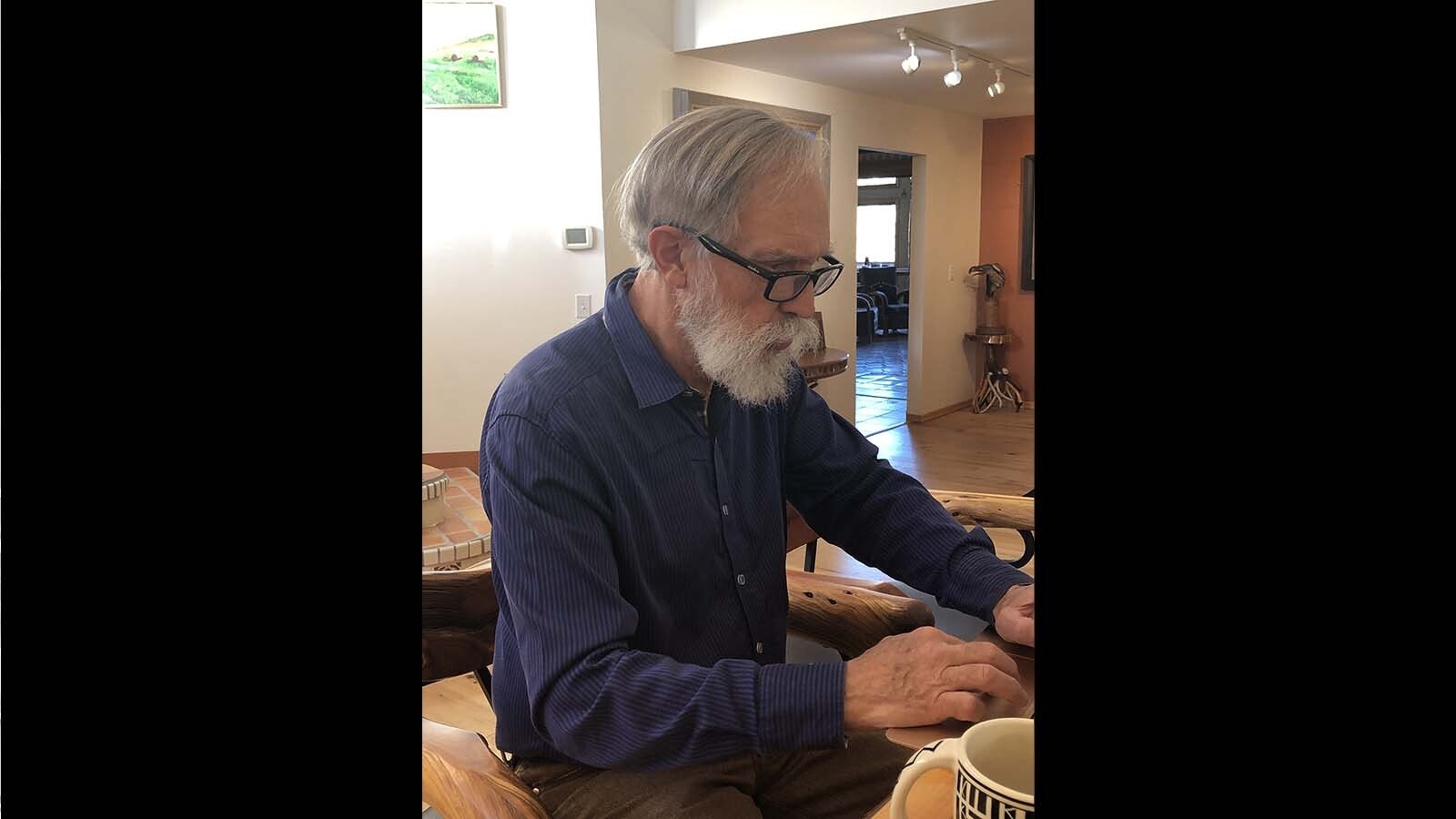
Michael Gear has been writing for over 40 years and he and his wife, Kathleen, have written a combined total of 88 books, many of which have landed on the New York Bestselling list. Gear has had his voice stolen by an AI company who is now paying him for using his books illegally but will be allowed to continue to scan and use books to train their AI programs. (Courtesy Michael and Kathleen Gear) 
Sixty of 88 books written by Michael and Kathleen Gear had been illegally downloaded and used by Anthropic to train their AI program how to write using the authors’ personal voices. While the couple received a settlement for the illegal use of their books, Anthropic can still legally scan and use their books to train their robots to think like them. (Courtesy Michael and Kathleen Gear)
Stolen Voices
“AI is becoming so smart that it is learning how to document an author's distinctive voice,” Kathleen said.
As the Gears work through the paperwork to make their claim against Anthropic for illegal use of their books, they are sounding the alarm that authors are an endangered species.
The couple said that their industry is in danger of being replaced by robots and that publishers are celebrating this change.
“Alfred Knopf, a publisher in the early 1900s, started having problems with his cantankerous authors,” Michael said. “He made the statement that publishing was a wonderful business if only you could get rid of the authors. Here we are, almost 100 years down the road and publishers can do that.”
Programs today can create an AI author, and by using AI programs, they can generate novels written in a human author's voice but with totally fictitious imitation authors which the publishers then don’t have to pay a human for.
“We’ve written 88 novels now, so it isn't like we're just a novice trying to figure this all out on our own,” Michael said. "There's also something that's a little insulting and really depressing about all of this, because Kathleen and I have spent our lives developing the talents to be able to write great books."
This insult was felt keenly when one of their publishers asked the couple to start using AI so they could churn out a new book every two weeks.
“This is bull crap that destroys an author's voice,” Kathleen said. “That is absolutely terrifying.”
The Gears said that they will continue to write but are already working on ways to protect themselves from theft and their readers from being deceived.
This includes trademarking their name so if their name is stolen, they can at least fight back. The Gears can do this step as established authors but worry about those writers that are just starting or only have a few published stories.
Kathleen has personally seen this happen on Amazon with her own sister, K. S. Jones, who was getting congratulated from friends on her new book.
The only problem was that Jones had not yet released her new book and discovered that Amazon had a book on their site with her name and bio, but it was not a true Jones’ book.
“My sister writes under a pretty common name,” Kathleen said. “Amazon says, oh, whoops, we made a mistake. That's an AI generated book that stole your name and your bio.”
Amazon took Jones' name and bio down, but the book remained for sale.
“Copyright is now irrelevant,” Kathleen said. “What Anthropic did that they admitted was illegal was going to those pirated sites and downloading the pirated books so they could use them to train their large language models.”
Michael said that AI companies claim that within a few years, or less, they will have thousands of new books with an authors’ unique voice generated by AI.
Unless your name is trademarked, the AI companies can put your name on the books and sell the books legally.
“With AI pirating, in the next two or three years, books written by real authors will probably be a boutique business run by small presses for readers who specifically want only human generated material,” Michael said. “I say this after 40 years in this business where every prognostication of doom and gloom has been proven wrong.”
Jackie Dorothy can be reached at jackie@cowboystatedaily.com.