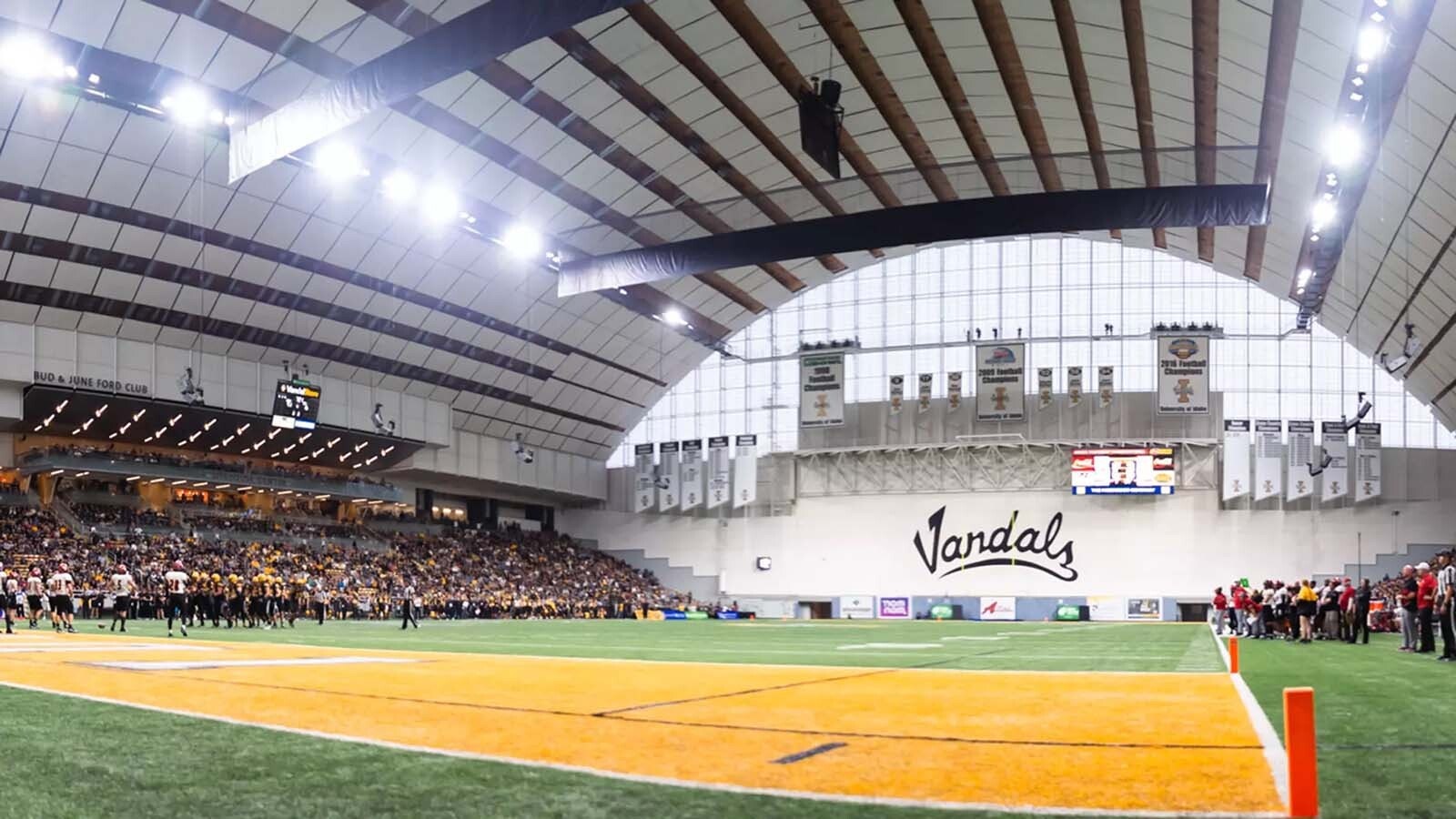
The University of Idaho won the Famous Idaho Potato Bowl in 2016, beating Colorado State University in a wild game.
The Vandals' starting quarterback was Matt Linehan, whose father Scott was a longtime college and NFL coach. After the victory, the elder Linehan held up a sign: “Say No to FCS.”
It didn’t matter.
The Vandals two years later dropped out of the Football Bowl Subdivision to the Football Championship Subdivision — the second tier of Division I football — anyway. The U of I is the only university in history to do so voluntarily.
“If you’re going to hold out for tradition, you’re gonna get disappointed,” Dennis Patchin told Cowboy State Daily.
Patchin is the voice of Idaho Vandals football and basketball programs and has been a television and radio sports reporter just over the state border in Spokane, Washington, for 40 years.
“Because the powers that be have decided tradition doesn’t mean anything in college athletics,” he said. "It’s all about the mighty dollar.”
Rise Of NIL
Patchin watched Idaho rise through the FCS ranks, then leap up to Division I football's top tier in the FBS, play in a couple bowl games, then stumble through years of mediocrity before the inevitable fall.
Idaho and Boise State University left the FCS and Big Sky Conference at the same time, he noted. But while Boise State parlayed early success into a national brand, Idaho struggled to gain traction.
“Boise was able to monetize that with an alumni base, but more importantly, the city of Boise,” Patchin said. “It was just a better market for the transition.”
The Vandals found themselves adrift.
After the Mountain West Conference declined to invite them, Idaho bounced from the Western Athletic Conference to the Sun Belt Conference to a year as an independent with only four home games.
“And then Idaho was kind of in the wilderness,” Patchin said. “No conference wanted them. Mountain West didn’t want them. The WAC didn’t have football anymore. The Sun Belt didn’t want them.”
What does that mean for Wyoming, another program in a small television market trying to compete in an era of high-dollar TV revenue sharing and Name, Image and Likeness (NIL) deals?
“If you don’t have a league and you’re not relevant in the FBS, what are you hoping to do?” Patchin said, adding that, “Wyoming’s got a problem, like many schools.”
“They’re in a smaller media market," said Patchin. "They don’t have a lot of interest in their program outside their geographical region, and there simply isn’t enough people that are going to drive that meter to make you attractive to a league for television revenue."
Idaho tried everything before dropping down — fundraising pushes, facility upgrades — but “there just wasn’t the financial wherewithal to make that push,” Patchin said.
Today, Idaho operates without an established revenue sharing fund to pay players.
“And there’s nothing wrong with it, and there’s a lot of proud people that went to that university and should be well proud of their time at that university, but we don’t live in the same world we lived in 10 years ago,” he said.
Wyoming, he warned, risks a similar fate.
“Wyoming is unfortunately maybe one of those teams — unless something happens — they’re going to be like Idaho was in the FBS,” Patchin said.
When Idaho finally made the decision to relegate itself into the FCS, it cost the university.
“Idaho alienated some of their boosters by dropping from the FBS level to the FCS level,” Patchin said.
The transfer portal has only accelerated the problem.
“If Wyoming stays at the FBS level, you will never hang another banner of a player’s number in the rafters ever again,” he said. “Because anybody who’s good enough to have that number be retired or be honored won’t be there for their junior and senior year. They’re going to transfer somewhere to get money.”
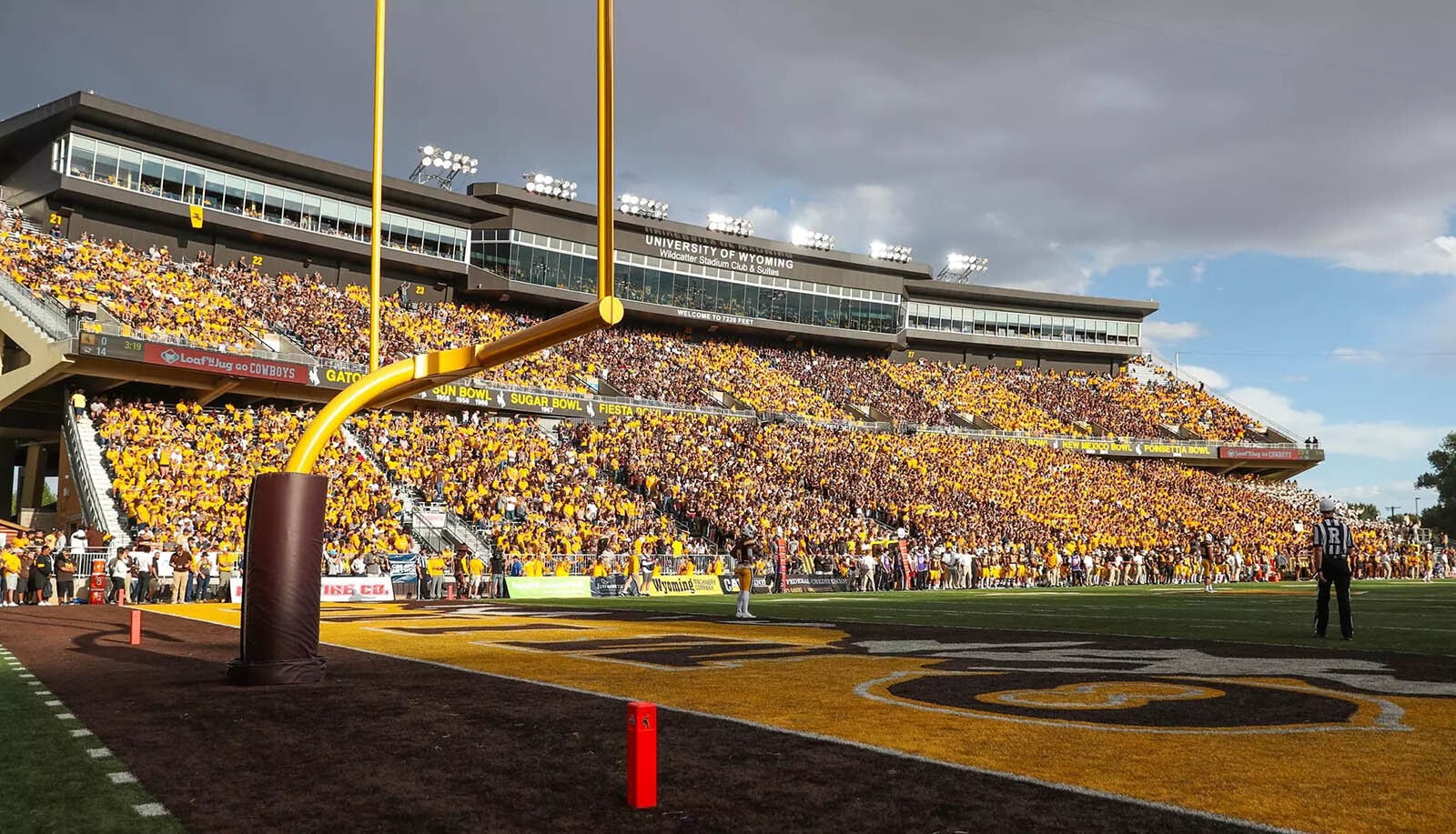
Patchin said he believes that even Josh Allen, Wyoming’s greatest football product, would likely have left early under today’s rules.
“Josh Allen probably wouldn’t have played his senior season at Wyoming,” Patchin said. “Because somebody would have reached in their pocket.”
NIL And Revenue Share
The NIL landscape is as familiar to Matt Brewer as anyone in college athletics.
He’s taught an online class on the subject for a few years and spent nearly seven years running Boise State University's compliance office.
But when Boise State started turning revenue generated by the football team into salaries for players, Brewer walked away.
“I didn’t want to pay players,” Brewer told Cowboy State Daily. He’s now associate athletic director for compliance at Idaho. “I wasn’t in the habit of paying players. I grew up in the era where the scholarship should be good enough.”
The distinction between NIL and revenue sharing — terms sports reporters often conflate — matters, Brewer explained.
Schools that “opt in” to what’s known as the House Settlement agreement can share revenue directly with athletes up to a $20.5 million cap, no questions asked.
Schools that “opt out,” like Idaho, can still allow athletes to earn money through legitimate third-party NIL deals — a local bar naming a burger after the quarterback, for example — but the university itself doesn’t pay players.
“If you’re opted in, then you are saying that you’re going to share revenue with your student athletes,” Brewer said. “Whereas if you’re opted out, any payment for NIL has to come from a third party and it has to be a legitimate, valid business purpose.”
Nearly every FBS school has opted in. Idaho is among roughly 100 schools nationwide that have opted out, though that could change.
“We’re also looking at opting in. We might be opting in next year,” Brewer said. “Who knows.”
College athletics should remain a function of higher education, Brewer believes. He rattled off the benefits universities already provide student-athletes: scholarships, travel, training, uniforms, equipment, medical services.
“You’re talking about anywhere from $100,000 to $150,000 a year being spent on each individual student athlete,” he said. “And now, ‘Oh yeah, but they should be getting paid too.’ OK. Well, fair, right?”
Asked what advice he’d offer the University of Wyoming, Brewer demurred.
“I wouldn’t even begin to give them advice,” he said. “I walked away from that level because I found it to be chasing your tail.”
The gap between the haves and have-nots is only growing.
Southeastern Conference and Big Ten schools are hitting the $20.5 million revenue-sharing cap and supplementing that with collective-funded cars, housing and other benefits potentially totaling $30 million to $40 million.
“How do you expect a school that is only putting in $4 million or $5 million to keep up with that?” Brewer asked. “The gap is widening.”
That leaves programs like Wyoming stuck, he said.
“You’re kind of between a rock and a hard place at those institutions,” Brewer noted. “You’re trying to keep up, but at the same time, what are you competing for?”
“They’re going have to look internally at what drives them, what is our purpose of being here, what’s our mission?,” Brewer wondered. “Are we here to make money?”
Both Sides
A retired banker who played golf on scholarship at Wyoming in the 1970s, Kelly Cowper can see both sides of the question facing schools like UW: Should it aspire to compete at the highest level of college football or follow Idaho into the FCS?
“I have mixed emotions,” Cowper said. “Obviously, I would prefer to stay in the FBS. But I also would like to go and watch a football team that wins.”
He’s heard the sentiment from university insiders: “Over my dead body will we ever drop out of the FBS.”
But Cowper isn’t convinced that’s the right answer.
“If I was on a debate team and I didn’t get to choose which side I was going to debate for, I could debate for both sides,” he said. “I could also understand and say, 'You know, maybe it would be a lot of fun to be a big fish in a small pond rather than a minnow in the big ocean.'”
In an email to Cowboy State Daily, longtime Wyoming resident Steve Sommers made the case more bluntly.
“This argument is getting old,” wrote Sommers. “Drop a division, form some new rivalries and forget about CSU, BYU and all the California teams that don’t belong in the Mountain West to begin with.”
Cowper said he’s sympathetic to that view.
Still, Wyoming fans’ passion runs deep.
At three recent Arizona Bowl appearances — 2019, 2020 and 2023 — more than 20,000 Wyoming fans traveled to Tucson, he said, filling nearly the entire east lower section of Arizona Stadium.
The opposing teams, he estimated, drew maybe 5,000.
“Wyoming fans are the greatest,” Cowper said. “They will travel.”
But the results haven’t matched the enthusiasm. Wyoming last won a football conference championship in 1993. The Cowboys have beaten Boise State exactly once — in 2016, with Josh Allen at quarterback.
“That’s not acceptable,” Cowper said of the Boise State record.
Arguments that Wyoming simply can’t compete financially don’t hold water with Cowper.
“The state of Wyoming has more mineral money than you’d ever be able to spend,” he said. “And to tell me that they couldn’t pull out $5 million a year to put into NIL — that would be nothing.”
He said he’d personally commit $1,000 a year “to put a product on the field that we can all be proud of.”
“The last two years, you’re seven wins out of 24 games,” Cowper said. “I can’t believe that mediocrity is OK.”
The Numbers
According to the UW Athletic Department, which provided these figures to Cowboy State Daily and other Wyoming media, the university’s current NIL and revenue-sharing picture breaks down like this: The initial revenue-sharing figure is $1.5 million, split between football and men’s basketball. An additional $200,000 goes to women’s basketball, volleyball and wrestling.
Third-party NIL dollars and Learfield NIL partnerships likely add another $500,000 total, according to UW.
Alston scholarship dollars — included in House Settlement calculations — account for another $1.1 million.
“Keep in mind that they are always evolving,” UW Athletic Director Tom Burman told Cowboy State Daily. “We have had a good year with our revenues (tickets sales, corporate and donations are all up) and we are aware we are behind the top of the Mountain West Conference in rev sharing.”
Burman added that UW is planning to add dollars to football and basketball rev share packages starting this winter and spring.
“With respect to what we pay student athletes, we would never release specifics. The numbers you read about are projections — schools rarely release anything,” he said. “We also added eight new scholarships that were part of House Settlement.”
Will It Be Enough?
The constantly shifting landscape of media exposure and fan support make it hard to predict UW’s future.
In hindsight, from his point of view as the longtime voice of the Idaho Vandals, Patchin offers a seasoned perspective of all the factors at play when trying to forecast the fate of individual college sports programs.
"University of Idaho and football was never going to be the first team in that market," he said. "It was always going to be Washington State football."
WSU is in Pullman, Washington, about 10 miles from the University of Idaho campus in Moscow.
“The other thing that didn’t help Idaho was the lack of success at about the same time that Gonzaga basketball took off, which also dominated that media market,” he said.
Now that UW rival Colorado State is moving on from the Mountain West Conference to the newly constituted PAC 12 and BYU continues to stand out as a top 25 football program, where does that leave Wyoming?
Fans like Cowper are left vacillating between a nostalgic connection to the past and concern about what’s ahead for the increasingly professionalized world of college sports.
It used to be that Wyoming fans would complain about how old the BYU players were because they delayed their start in college until after serving LDS missions.
“Their first year, they were 24 years old,” laughed Cowper.
Now, as BYU generates many millions more in revenue than longtime rival Wyoming, all Cowper can say is, “That’s unbelievable.”
David Madison can be reached at david@cowboystatedaily.com.