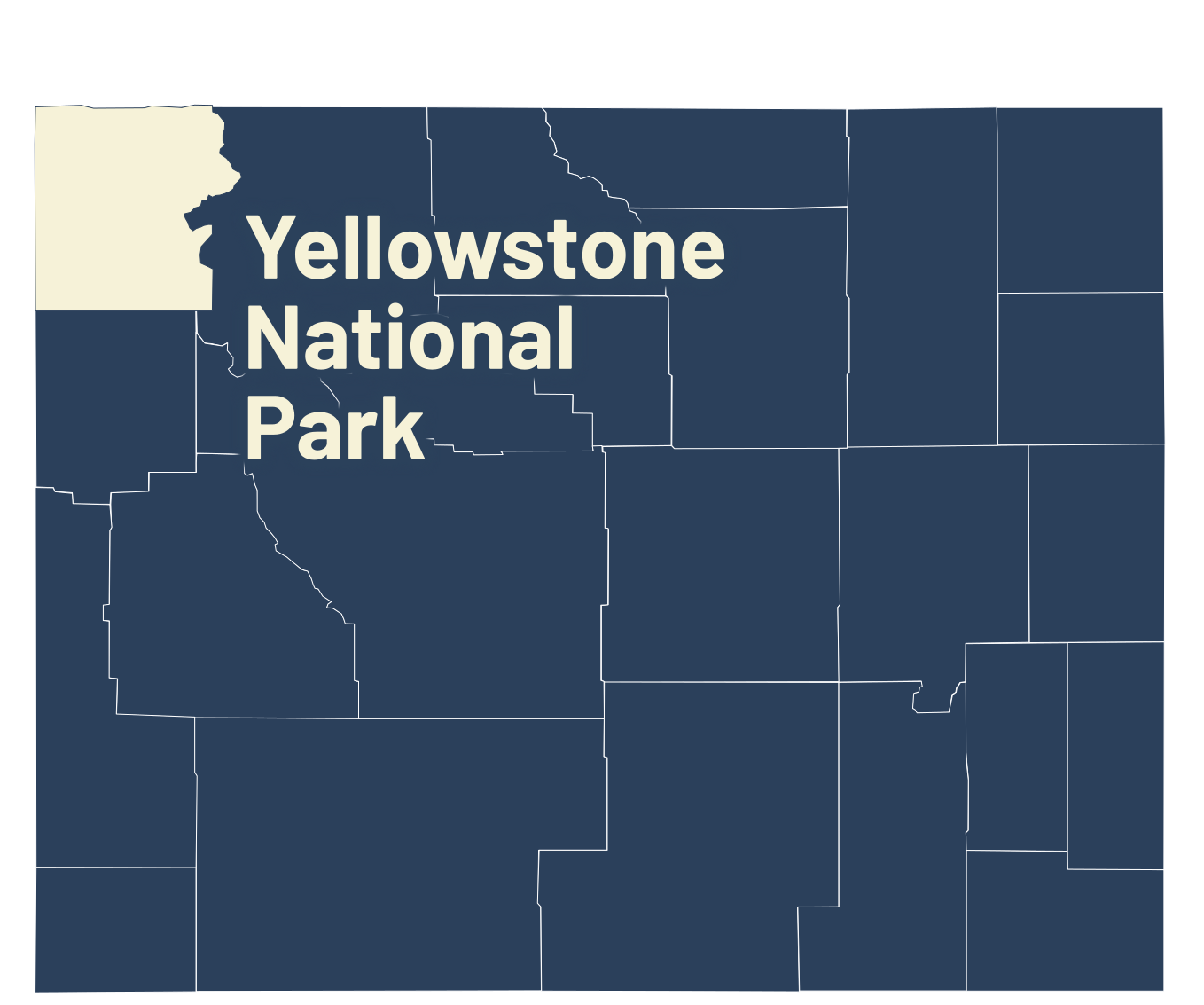
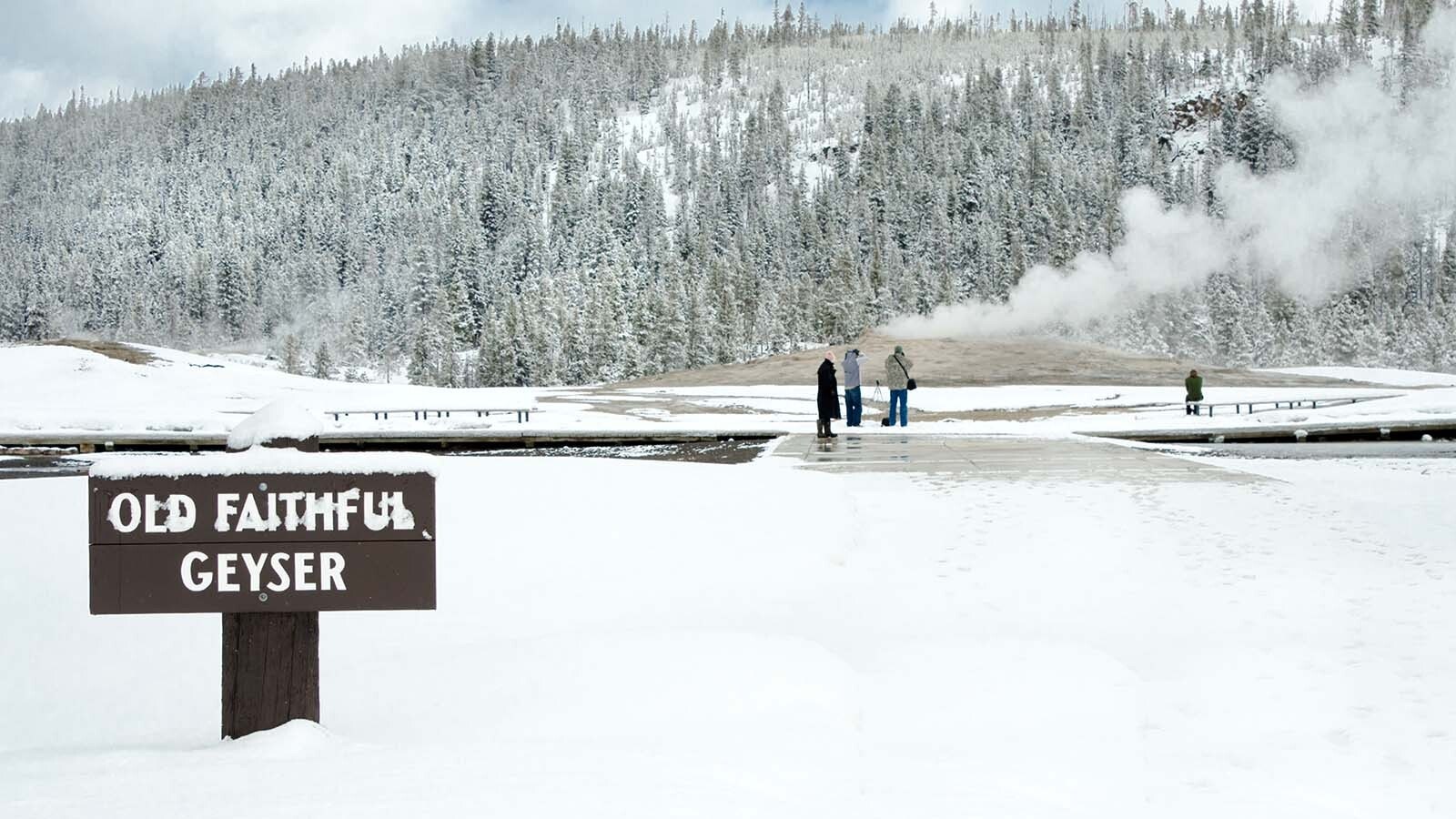
After Wyoming saw record-high temperatures throughout much of December, Old Faithful in Yellowstone National Park did a 180-degree turn and was the coldest place in the continental United States this weekend.
Temperatures in the famous geyser basin reached a low of minus 27 degrees Sunday, as the Cowboy State finally got glanced by a wave of crippling cold heading eastward from the Arctic.
However, that was just a blip on what’s destined to be one of the warmest, driest Decembers in Wyoming’s history as multiple high temperature records were broken across Wyoming just days before.
“We’ve been breaking or very near to all-time December highs in the last week,” said meteorologist Taylor Wittman with the National Weather Service (NWS) office in Riverton. “Lots of places were breaking daily high temperature records, day after day.”
The post-Christmas forecast saw a wave of Arctic air finally penetrate into the southern Rockies. That was a brief reprieve from an unseasonably warm winter, but it’s not the seasonal shift many have been looking for.
The same factors that made December so dry and dreary look like they’re going to return and persist into the beginning of 2026. There’s plenty of winter weather, and more to come, but Wyoming’s still being blocked from its share of the bounty.
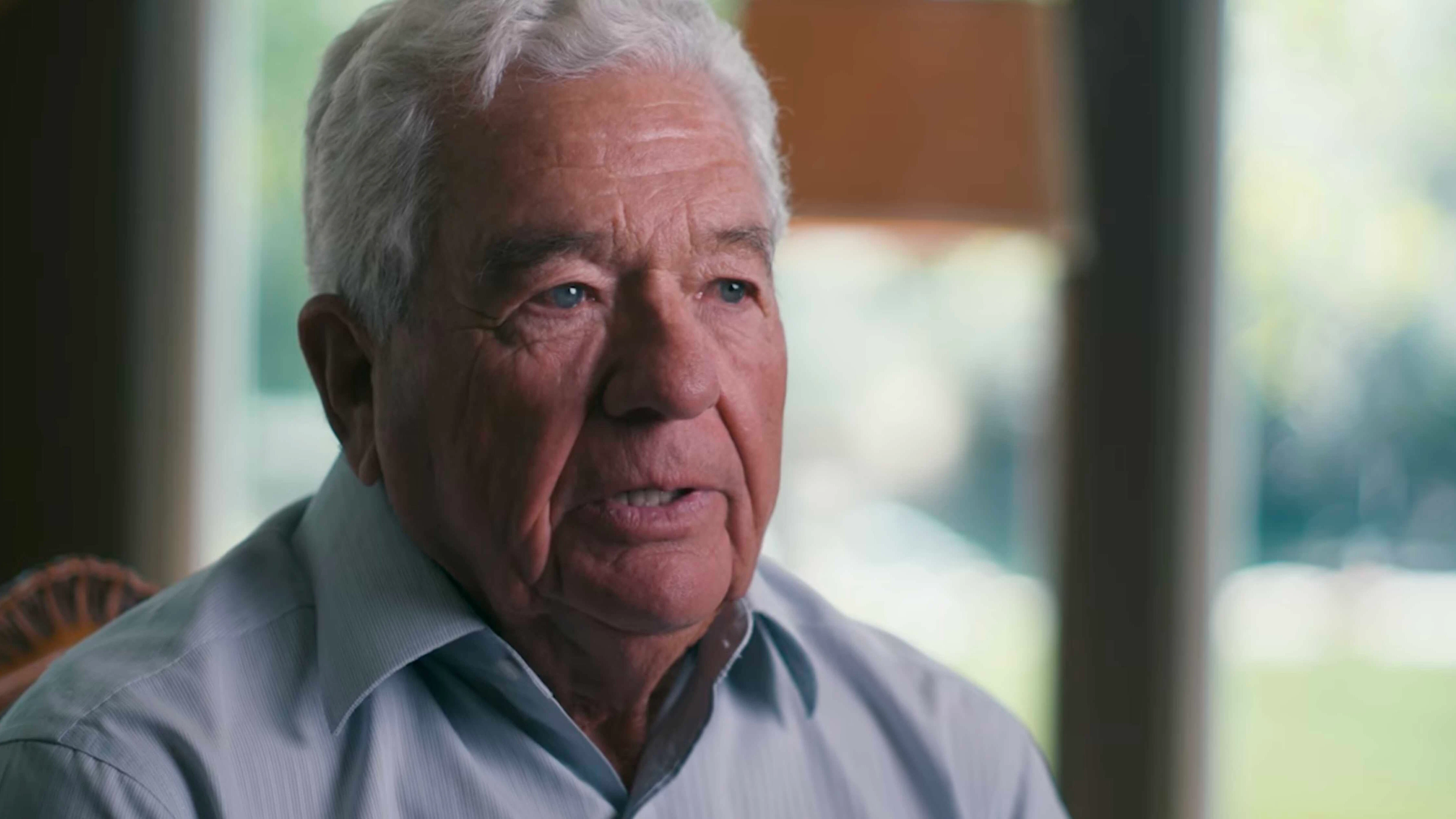
“Hopefully, January and February will even the score, but it won't be like a light switch,” said Cowboy State Daily meteorologist Don Day. “There’s literally nothing happening for the next few days, and we’re going to see temperatures well-above average for late December.”
Wrong Side Of The Block
It’s been an unorthodox December in Wyoming.
High-temperature records dating back 150 years in some communities were broken on the days leading up to and including Christmas. Even the trees aren't taking it well.
It wasn't all bad. The snowpack in western Wyoming is outrageously high thanks to an influx of wet, heavy snow that sent seasonal averages up to 145% for December.
The main factor keeping Wyoming warm and dry for the last month was a stubbornly persistent jet stream over the Bering Strait, which has been causing climate chaos across North America.
While Wyoming and the Rocky Mountains have broken high-temperature records, the eastern half of the nation has been experiencing the opposite.
“That’s what we call an upper-level ridge,” said meteorologist Matthew McLaughlin with the NWS office in Cheyenne. “It’s been pushing low-pressure systems with cold temperatures and moisture eastward.”
Wyoming’s spent several weeks on the wrong side of this ridge.
The high elevations, particularly in western Wyoming, have seen some winter weather, but most of the state has been stuck with warm weather from the Pacific Ocean, while the cold Arctic air is funneled elsewhere.
The good news, at least in the short term, is that the wall is weakening a bit. By Friday evening, it will have weakened enough for a cold front to finally descend across Wyoming.
“The ridge is going to slowly push east while a low-pressure system moves in from the Pacific Northwest,” McLaughlin said. “We're going to have some cooler air drop down into the Intermountain West, which will give us some precipitation and a comparatively significant drop in temperature.”
The bad news is that it isn’t going to last.
The ridge weakened over the weekend, which explains the subzero temperatures in Yellowstone, but McLaughlin said long-range models indicate another blocking wall is already forming.
“There’s another upper-level ridge setting up over the Intermountain West,” he said. “Our winter-esque temperatures don't look like they're going to stay too long.”
Day said another “massive” high-pressure ridge is forming over the Atlantic Ocean. Northern Wyoming got “sideswiped” by that ridge as it funneled snow and subzero temperatures eastward.
“This huge goes up to Greenland and across Europe,” he said. “Northern and Western Europe are going into a deep freeze with snow. It's a classic situation, and that block is affecting us this week, too. It's all about the blocks.”
Back To Before
The final days of December will feel like the rest of December, with the exception of Sunday. Once this cold front moves on, daytime highs will return to unseasonably warm territory.
“We could see temperatures return to the 40s, 50s, and possibly even the 60s coming into the early days of January,” McLaughlin said. “We will jump back up again after the drop.”
Wittman was more optimistic, but not much.
While it will get unseasonably warm again before the end of the month, it’ll finally be too cool to jump back into the 60s.
“I’m not seeing a rebound of the 60-degree weather,” he said. “Temperatures will still be seasonal, maybe a little warmer than seasonal, but cooler than what we had leading up to Christmas.”
Day said the Bering Strait block is showing signs of weakening, but we’re stuck with it for another week, at least. Beyond that, it’s more of a “what if” scenario.
“If the block breaks down next week, around Jan. 6 or 7, that will translate to the weather pattern getting consistently colder, and more storms and fronts moving through the Rockies, starting the week of Jan. 13,” he said. “If the block doesn't break, then we're just going to have to delay that for a week or so.”
Even if the block breaks, Wyoming won’t be immediately subjected to polar-vortex blizzards, like those in January 2024. There will be a transitional period, lasting several weeks, as the weather fills the void created by the high-pressure ridge.
“We can't make the mistake and say if the block changes next week, the weather will dramatically and immediately change,” Day said. “We’ll get that winter weather eventually, but it’s a process.”
No Cause For Alarm (Yet)
It’s still too early to say whether Wyoming will keep being blocked or finally get a window for winter weather in January.
However, Wittman and McLaughlin both agreed that it’s too early to worry about Wyoming’s winter.
“I want to say we should be concerned by these warm temperatures right now, but January and February could change for the better,” McLaughlin said. “It’s too early to say, but we’ve had scenarios where a late-season snow has helped out.”
When the numbers are crunched, Wittman believes this could be one of the warmest Decembers in Wyoming’s history, but that’s not a prognosis for the rest of the winter.
“We still have a lot of winter left,” he said. “We can still get colder temperatures coming in and snow later on, so don't give up hope yet. We’ve got plenty of winter to go.”
Day said a highly trusted European weather model supports a shift toward colder, wetter winter weather across the Rocky Mountain region in mid to late January. However, that model just demonstrated that it’s far from flawless.
“That's one of our best seasonal models we have, but it said the same thing for the first half of December, and it bombed, to be honest,” he said. “It did not forecast this block correctly, so we can’t take that model to the bank.”
High-pressure ridges can last (and block) for several weeks, but not months.
According to Day, the block will break, but meteorologists won’t be able to get a handle on Wyoming’s upcoming winter until everything’s unblocked.
“First, we've got to get the block to break down,” he said. “Then we've got to wait for weather patterns to react to that. I’m of the opinion that it's hurry up and wait, and until we see that blocking pattern break down. It’s all about the blocks.”
Andrew Rossi can be reached at arossi@cowboystatedaily.com.