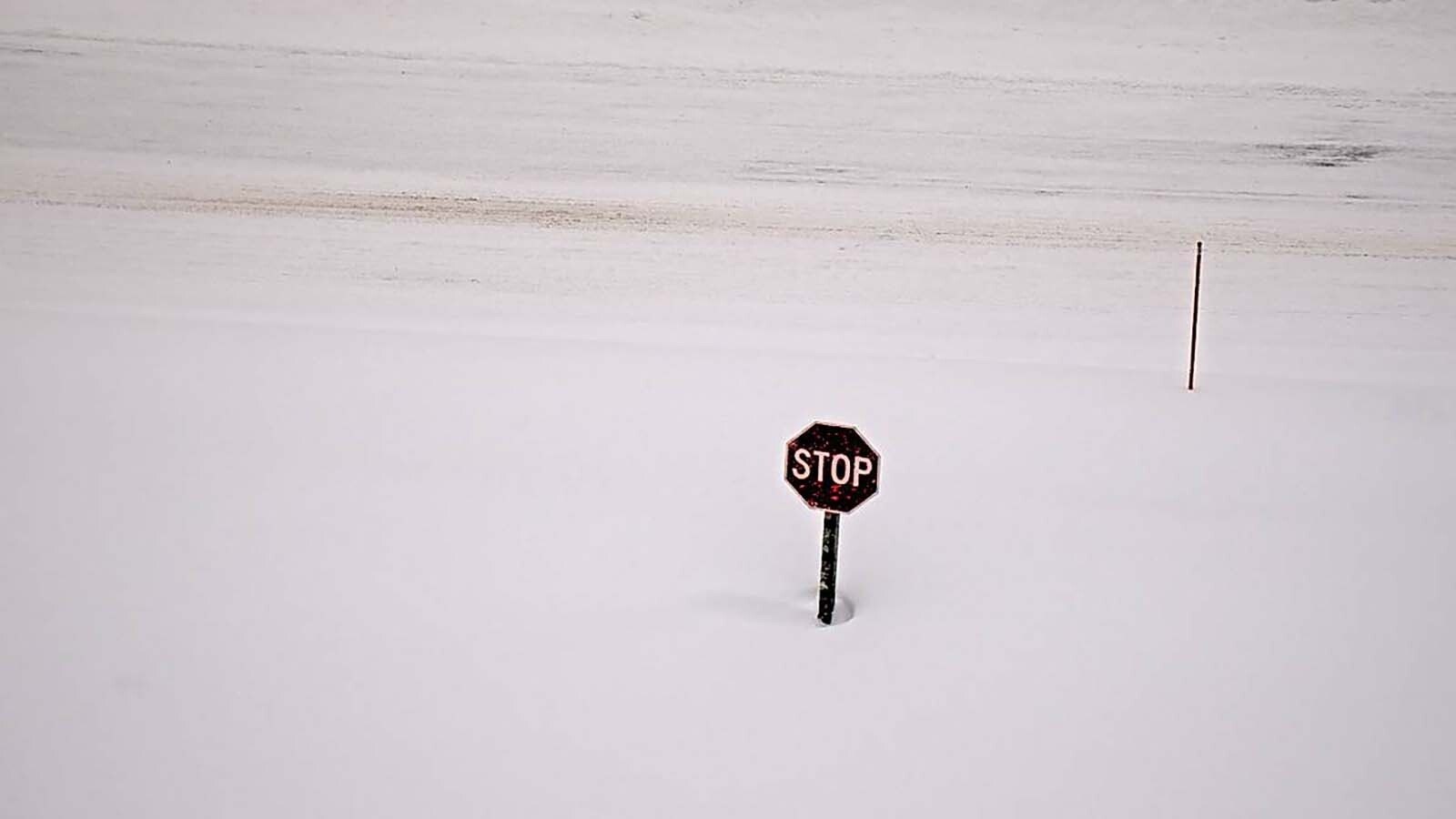
The Stop Sign Snow Challenge, sponsored by the Wind River Outdoor Co. in Dubois, encourages people to bet on when a stop sign on Togwotee Pass will be entirely buried by snow.
It’s only happened once since the challenge started in 2017, but keeping tabs on the snow level until March 31 is a fun distraction from the doldrums of winter.
With record-breaking temperatures throughout December across much of Wyoming, one would think the stop sign doesn’t stand a chance of being buried.
But as of Friday, the odds it’ll be completely buried by the end of March 2026 look pretty good, with snow already nearly halfway up the sign.
In fact, while most of Wyoming is experiencing spring-like warmth and summer-like dryness, many mountains in western Wyoming have between 90% and 143% of their average snowpack.
“It’s rare and completely counterintuitive, but we’re experiencing a really warm temperature anomaly while those drainages have above-average snowpack,” said Cowboy State Daily meteorologist Don Day. “That stop sign looks better than it did at this point last year.”
Stellar And Subpar Snowpack
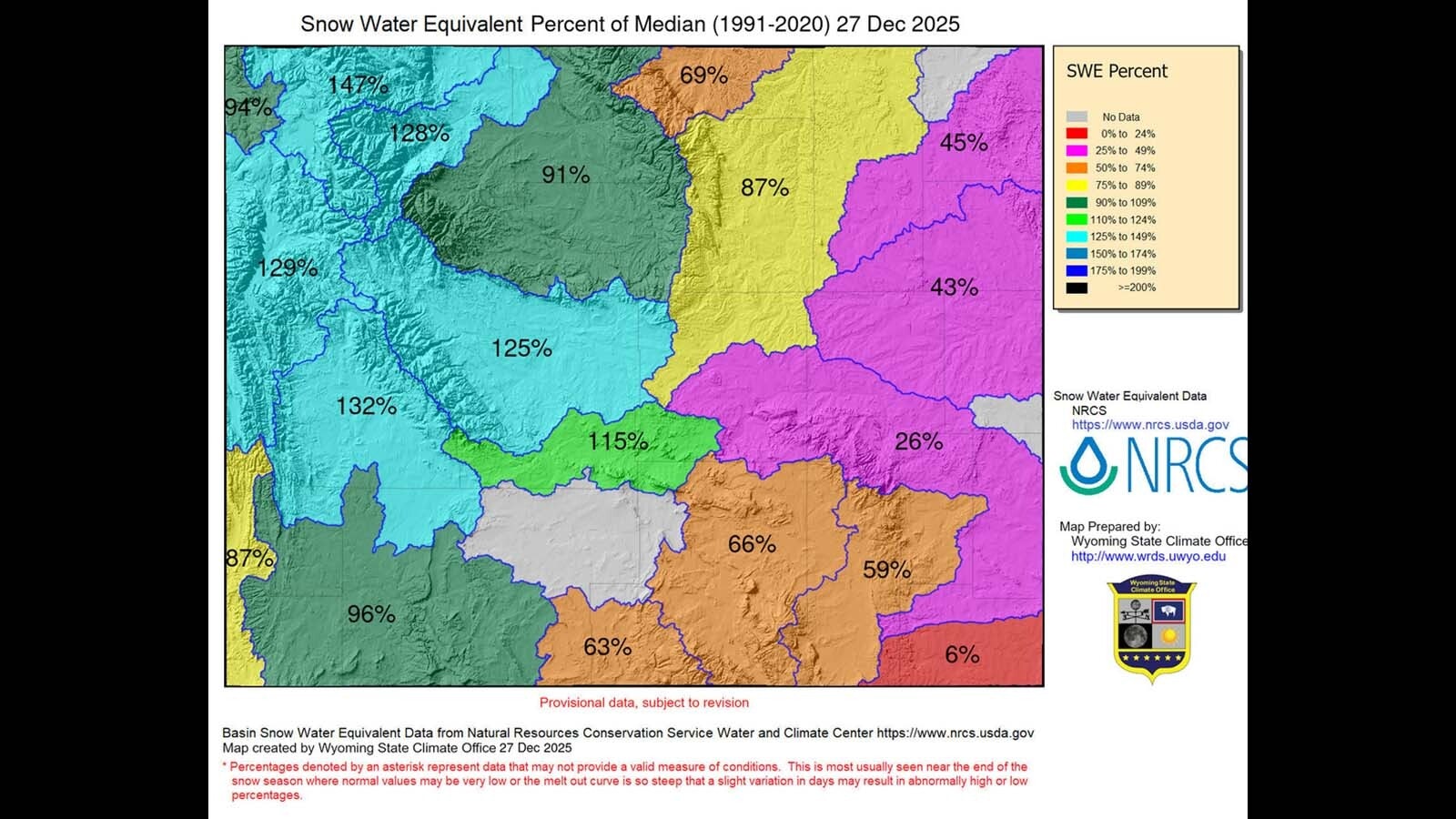
According to the Wyoming State Climate Office, there’s a disparity in the snowpacks across the Cowboy State.
The snow water equivalents range from 6% in the southeastern corner to a staggering 143% in Yellowstone National Park.
“It's pretty clear to see that there is a pretty big gradient in precipitation across the state,” said meteorologist Adam Dziewaltowski with the National Weather Service (NWS) office in Riverton. “A good portion of western Wyoming is sitting above 100%, while eastern Wyoming is very much below normal.”
Day said it’s consistent with a trend across the Western United States.
There are several “islands of snowpack” that reflect the climate chaos of the last month, he said.
“We've got this island of above-average snowpack in Montana, western Wyoming, and parts of Idaho, but well below normal snowpack in the central and southern Rockies,” Day said. "And as of this morning, the snowpack in the Sierra Nevada in California went up to 170% because of all the snow they've been getting."
Colorado’s statewide snowpack was 54% of its normal December levels, tied for the worst snowpack in the state’s recorded history. Meanwhile, Utah’s snowpack was at 55% of its December levels in the middle of the month and hasn’t received much of anything since.
Several factors contribute to these islands, but the dominant one is the Continental Divide, Day said. The overall trend is more snow and cold on the eastern side of the divide, while it's warm and dry on the western side.
“There hasn't been any Canadian air that's been able to come into the Rockies,” Day said. “The moisture producing big snow in the western mountains is coming from the warm Pacific air.”
That’s where what’s playing out has been “completely counterintuitive,” according to Day.
The western Wyoming mountains have been getting plenty of moisture, but their height makes them inherently selfish when it comes to sharing it.
“The drainages in northeastern Wyoming and the Bighorns aren't nearly as good because the western mountains are capturing most of that moisture,” Day said. “When the air goes downslope, it dries out.
"And this is already subtropical air being pushed up from California. It’s only clipping the Bighorns and not getting further.”
The basins on either side of the Bighorns are at 88% and 81% of their average snowpack, respectively.
What’s Good
The irony of this excellent snowpack in western Wyoming is that many Wyomingites aren’t aware of it.
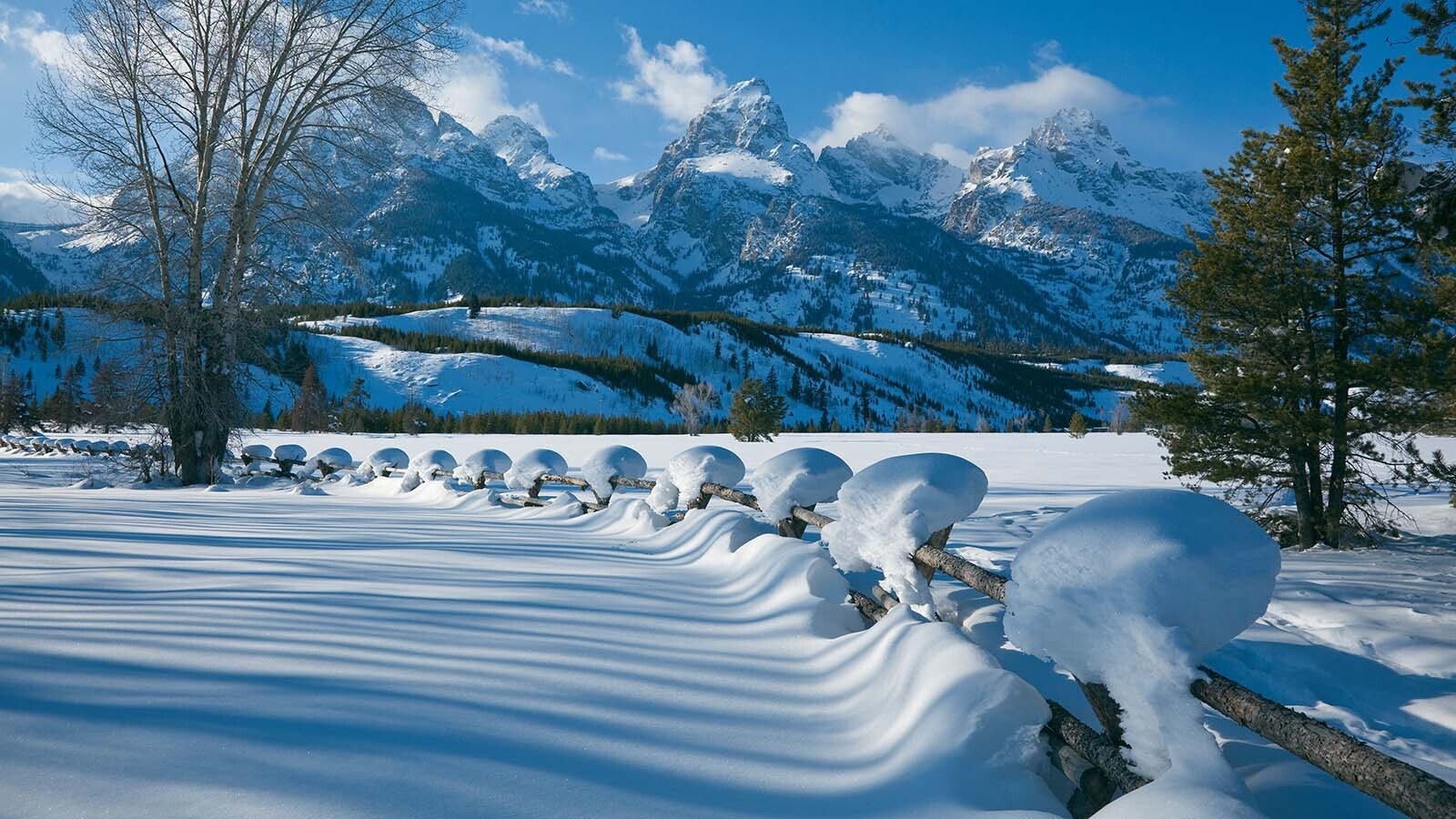
The Tetons are enjoying 123% of their average snowpack, but Jackson and the Teton Valley isn’t getting that bounty of snow.
“All this moisture is producing big snows in the mountains but isn’t reaching the valleys,” Day said. “It’s been mostly raining in Jackson, with a little snow at night, but there was an avalanche at the top of the Tetons last week.”
The snowpack might not measure up to much in terms of inches, but its water content is phenomenal, he said. It’s more like wet, heavy spring snow rather than dry winter snow.
That explains why the Wind River Range is doing nearly as well, with 116% snowpack, and why the stop sign in Togwotee Pass is already about halfway buried. That’s small comfort for eastern Wyoming, but Day believes that it’s better than nothing.
“Anytime you get more water or above-average snowfall in a particular season, that's good, no matter what,” Day said. “If you asked somebody in Pinedale if they’d like a spring with great runoff and good water for rafting and irrigation, but not have to shovel a lot in winter, they’d probably say that’s a great winter, and that’s kind of how it's going.”
The problem is that most of that moisture isn’t leaving the western mountains. For that to change, some walls will need to come down.
“That’s one reason why the record-high temperatures were broken on Christmas, because there's no cold air intrusions in December,” Day said.
Beyond The Backyard
Meteorologists will tell you that there’s plenty of winter left for Wyoming and the Rocky Mountain region, but that’s small comfort for the regions experiencing record-breaking warmth and dangerous dryness.
The blame for that lies “outside our backyard,” Day said.
“If it's not in my backyard, it's not happening,” he said. “That’s my experience when talking to people about what’s going on with the winter weather so far.”
A series of high-pressure ridges in the Northern Hemisphere has been making forecasting difficult for several weeks. These ridges have affected the jet stream, redirecting Wyoming’s winter precipitation to other areas.
“There's a pretty big, potent ridge of high pressure to the south that's been keeping everything well to the north of us,” said Dziewaltowski. “That has helped Arctic air slide to the east.”
The bizarre thing is that Wyoming’s western mountains have benefited from the blocks while the rest of the state struggles.
It’s rare to have a warm anomaly that also generates above-average snowpack, but it’s a natural consequence of what’s happening beyond the backyards of Wyoming.
Climate Countdown To 2026
Meteorologists are seeing a shift in the short-range forecast, and Day believes many Wyomingites will be surprised when they wake up to single-digit temperatures over the weekend.
“It’s a two-day cold shot,” he said. “It’s going to start to warm up again next week, but not to the levels that we're at now.”
Day would be the first to say that December’s overall warmth and dryness has been anomalous but not unprecedented. He’s found similar patterns in the not-too-distant past that might offer a glimmer of hope.
“December 2010 sticks out,” he said. “We had blocks in the Pacific and Greenland, and temperatures were about as warm as they are now. Things started to return to ‘average’ once the block broke in January, and February was severely cold. There was a lot of winter that year.”
The blocking patterns that kept December dry will break eventually and are already showing signs of weakening. The short shot this weekend is an indication of that.
“The push of cold air this weekend should bring things back closer to normal, to even slightly below normal, which is what you'd expect to see in a normal Wyoming,” Dziewaltowski said. “Highs in the 20s and overnight lows in the single digits over the weekend, going back to highs in the mid to upper 40s through the end of the year.”
Nobody can enter the 2026 Stop Sign Snow Challenge, as the submission window closed Oct. 31.
If the current snowpack in western Wyoming is maintained through the next few months, Wyomingites might see a fully buried stop sign while enjoying more moisture and colder temperatures across the state.
Day is falling back on historical precedent. Even if Wyoming ends December with record-breaking warmth, it’s not a guarantee for the months to come.
“These blocking patterns are extremely stubborn,” he said. “They can come, fade away, and come back. You won’t find any database with an above-average December, January, and February in the same year. It’s possible, but it’s really hard to do.
"There will be a switch, but it won’t be a light switch. It’s a process.”
Andrew Rossi can be reached at arossi@cowboystatedaily.com.