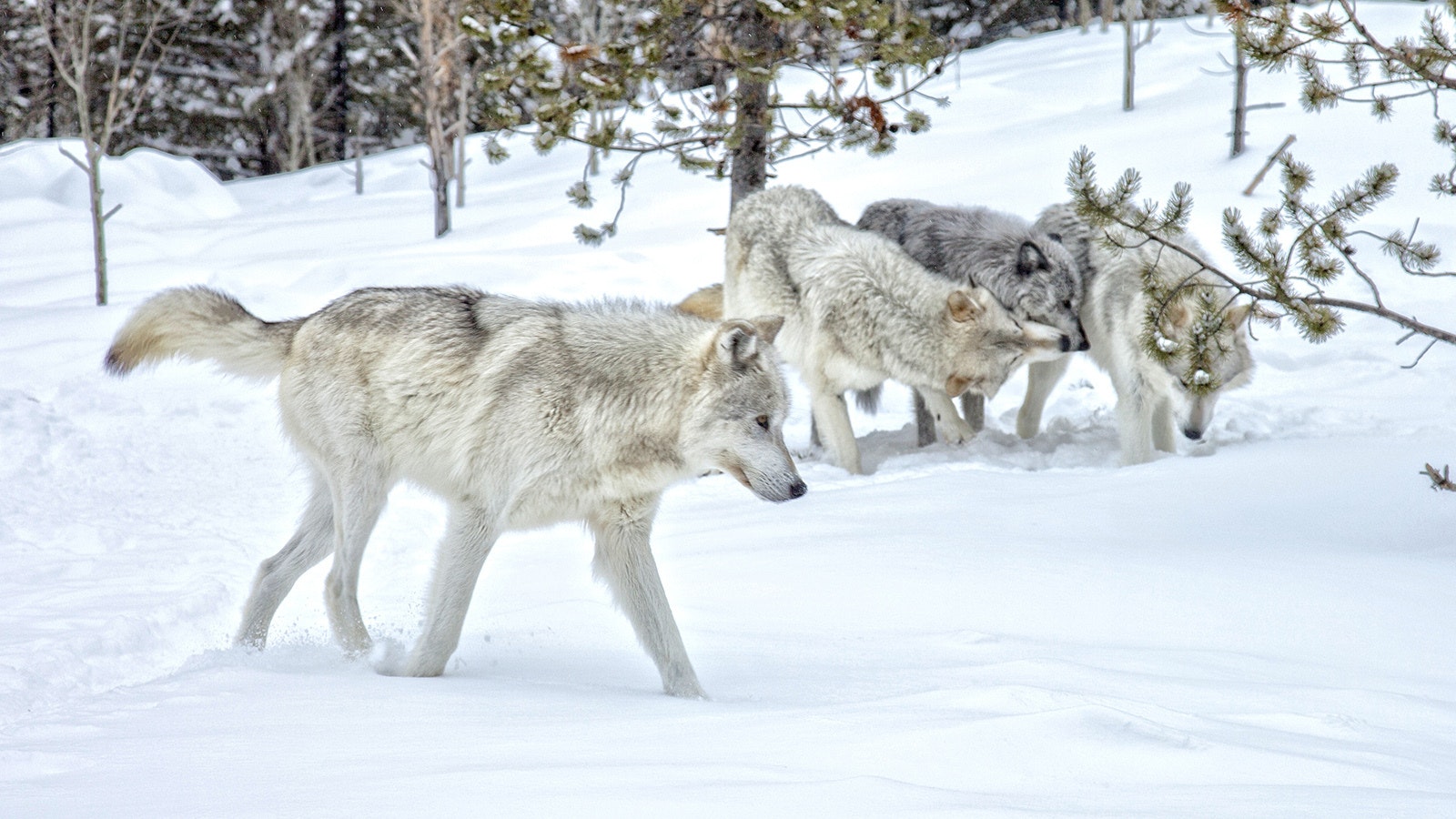
The U.S. House of Representatives has voted to delist gray wolves in the Lower 48 states from federal protections under the Endangered Species Act, passing legislation that Wyoming Rep. Harriet Hageman co-sponsored from the day it was introduced.
H.R. 845, the Pet and Livestock Protection Act, passed 211-204 largely along party lines.
The bill, written by Rep. Lauren Boebert, R-Colorado, and Rep. Tom Tiffany, R-Wisconsin, instructs the Department of Interior to reissue a 2020 Trump administration rule that delisted the gray wolf nationwide.
In a provision that has drawn widespread opposition from conservation groups, the bill also declares that "reissuance of the final rule under Section 2 shall not be subject to judicial review.”
In other words, district court judges can’t halt the delisting.
Hageman, Wyoming's lone representative in the House, was among 37 original co-sponsors of the legislation when it was introduced on Jan. 31.
Gray wolves in Wyoming's northern Rockies have already been delisted and the state has held hunting seasons in the trophy zone outside Yellowstone National Park.
In Wyoming's predator zone, wolves can be taken without licenses or limits, though all kills must be reported to the Wyoming Game and Fish Department within 10 days.
Bipartisan History
During floor debate, Rep. Pete Stauber, R-Minnesota, whose district contains most of the gray wolves in the Lower 48, argued the species has fully recovered.
"It's been proven time and time again that the gray wolf is not endangered and, in fact, has fully recovered," Stauber said.
"When the gray wolf was listed as threatened in Minnesota under the Endangered Species Act in 1978, a recovery goal of 1,250 to 1,400 wolves was set,” he added. "Today, according to data from the U.S. Fish and Wildlife Service and the Minnesota Department of Natural Resources, we have over 2,700 wolves in Minnesota."
Stauber noted that delisting efforts have spanned multiple administrations held by Democrats and Republicans.
"In 2009, the Bush administration delisted the gray wolves. Activist groups sued to relist," Stauber testified. "In 2013, the Obama administration delisted the gray wolves. Activist groups sued to relist. In 2020, the Trump administration delisted gray wolves. Activist groups sued to relist.
"And just last year, the Biden administration even agreed when they chose to defend the Trump administration's 2020 delisting rule."
Stauber called the gray wolf "one of the greatest success stories of the ESA, and one that should be celebrated."
Livestock Losses
Boebert, who represents a Colorado district where wolves have been reintroduced, emphasized the economic toll on agricultural producers during her floor remarks.
"Colorado's agricultural producers have lost $580,000 in just one year from wolves already introduced," Boebert said. "In March of this year, one of the Canadian wolves attacked and killed a working cattle dog in Jackson County, Colorado."
She added that wolves do not respect state boundaries.
"Last year, a gray wolf from the Great Lakes region was found over 1,000 miles away in Elbert County, east of the Continental Divide,” she said.
Stauber cited a recent incident in his district to underscore public safety concerns.
"Just last month in Ely, Minnesota, a wolf was seen in a school parking lot in the middle of the day, just feet from the schoolhouse door," Stauber said. "And because of the gray wolf's listing status, nothing could be done to protect the lives of the students there."
Conservation Opposition
Conservation groups condemned the vote, arguing the legislation ignores scientific evidence and blocks legitimate legal challenges.
"This is the most dangerous threat to wolves we have seen in years," said Kitty Block, president and CEO of Humane World for Animals. "It is a reckless and deeply unpopular move that ignores science, the courts and the values held by millions of Americans who overwhelmingly support protecting these iconic animals."
Bradley Williams, the Sierra Club’s deputy legislative director for wildlife and lands protection, said the bill undermines the foundation of the Endangered Species Act.
"The science is clear: Wolves still need federal protections to recover across their historic range, and stripping them now would put this iconic species at risk," Williams said. "Blocking judicial review only adds to the recklessness of this bill."
Williams pointed to the ecological benefits wolves provide: "We have seen firsthand how vital wolves are to ecosystems like Yellowstone National Park, which suffered greatly from the absence of wolves before their reintroduction in 1995.
"For more than 50 years, the American people have overwhelmingly supported the Endangered Species Act and want to see it upheld, not undermined."
What's Next
Five House Democrats voted for the bill and four Republicans voted against it. Eighteen representatives did not vote, including eight Democrats and 10 Republicans.
The most recent data from the U.S. Fish and Wildlife Service shows the legislation would remove Endangered Species Act protection from more than 4,500 wolves in the western Great Lakes region, as well as nearly 2,800 wolves in seven Western states.
If passed by the Senate and signed by the president, the law would take effect no later than 60 days after enactment. The bill specifically exempts the Mexican wolf subspecies from delisting.
David Madison can be reached at david@cowboystatedaily.com.