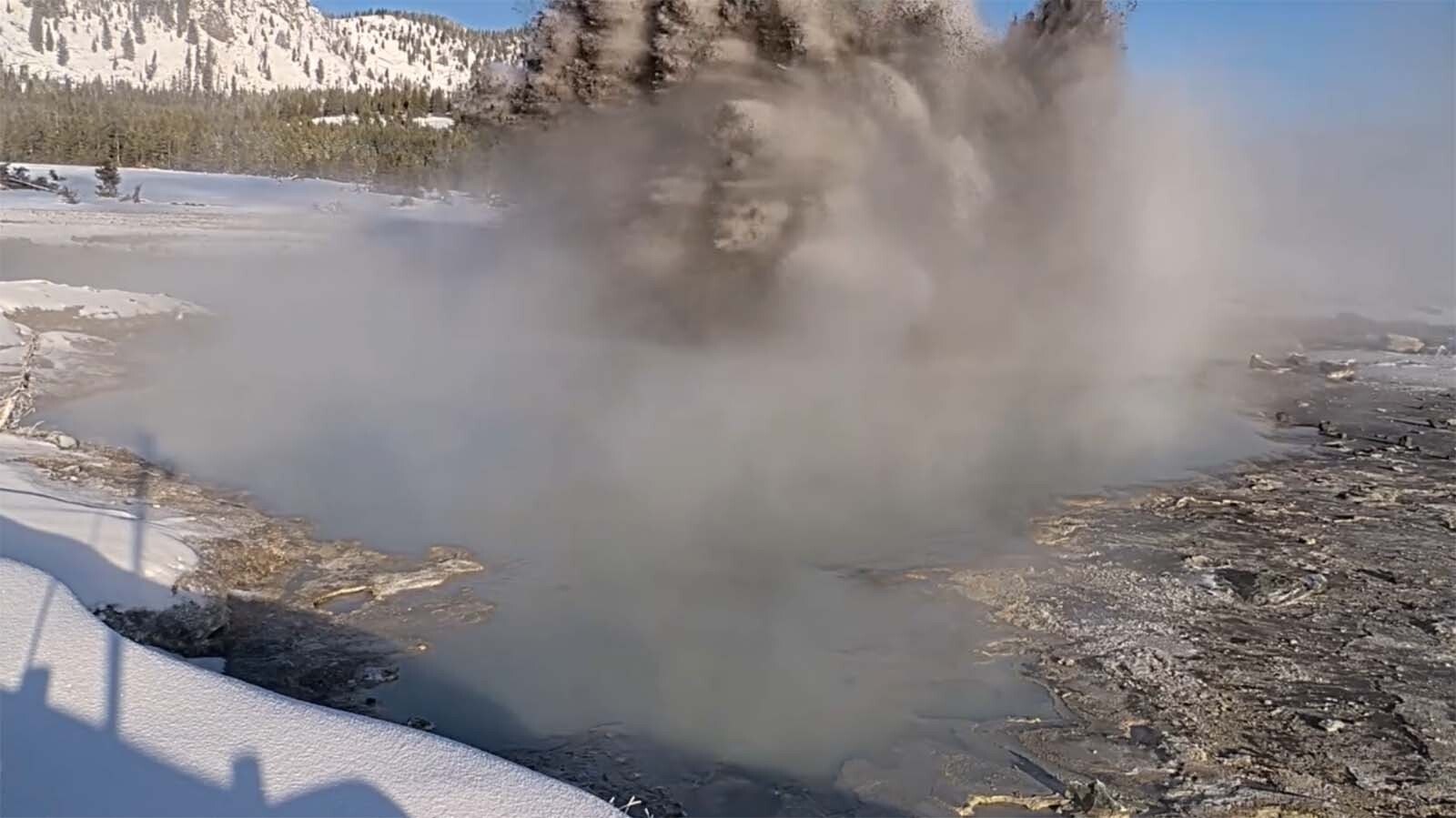
Black Diamond Pool in Yellowstone National Park has erupted again, sending a dirty deluge of water and mud 40 feet into the air.
Fortunately, this eruption was captured on a recently installed static webcam mounted on the boardwalk destroyed by a massive hydrothermal explosion at the pool in July 2024.
Once again, one of the most closely monitored geothermal features in Yellowstone has proved predictably unpredictable with Friday’s blowup.
“What we're seeing now is a continued adjustment of the plumbing system after the big disruption that occurred last year,” said Mike Poland, scientist-in-charge of the Yellowstone Volcano Observatory. “I wouldn't say it's predictable at all.
"In fact, I think what we're seeing from this is that it's decidedly unpredictable.”
The Biscuit Basin boardwalk has been closed to Yellowstone visitors since the hydrothermal explosion.
The National Park Service (NPS) will decide when it’s safe for the thermal basin to reopen, but Black Diamond Pool’s ongoing activity is delaying that decision.
“That’s not up to us, but we now understand more about how Black Diamond is behaving, and that's the information that will be critical to helping the park make its decision,” Poland said.
Decidedly Unpredictable
Since Black Diamond Pool blew itself apart in July 2024, there have been 14 documented eruptions. The time between those eruptions has varied from more than 46 days to less than two days.
“There was another one on Dec. 18 that happened during the night,” Poland said. “We think it was a similar size based on the monitoring data.”
According to Poland, the eruptions themselves can vary widely. The eruptions on Dec. 18 and 20 are the most dramatic, but Black Diamond Pool has a more diverse personality.
“Many of these eruptions throw material 30-40 feet in the air,” he said. “There have also been very small ones that have been like a bubble burst, and the splashing doesn’t get above 1-2 feet high.
"And we've even seen periods where something happened at the bottom of the pool and that caused a little bit of a wave on the surface, but nothing broke the surface.”
Varied behavior among Yellowstone’s thermal features isn’t unusual. Some, like Red Spouter, shift from fumarole to hot spring depending on moisture levels.
Black Diamond Pool was a hot spring before its recent hydrothermal explosion, and it’s still a hot spring today. This isn’t even the first time it’s had a period of increased activity.
“It's on par with what the pool did in the mid 2000s to mid-2010s, when it had a couple of dozen eruptions per year,” Poland said. “There's clearly a lot of things happening in the plumbing system, but that’s not particularly unexpected.”
Even if its behavior isn’t unexpected from Poland’s perspective, the unpredictability of Black Diamond Pool keeps NPS personnel on edge.
If it continues, the likelihood of anyone other than rangers and scientists visiting Biscuit Basin soon is very low.
What’s Known
Poland has observed a pattern in the scale of Black Diamond Pool’s eruptions.
The July 2024 event sent water hundreds of feet into the air and was powerful enough to hurl large rocks across the thermal basin.
That event was the result of a hydrothermal explosion, which is an unpredictable event that can occur anywhere at any time.
Poland said there hasn’t been another explosion at Black Diamond Pool since 2024, and there seems to be an upper threshold to its recent activity.
“We saw on Dec. 20, which is 30-40 feet, seems to be as big as it gets,” he said. “It's not predictable in the sense that we don't know when these events are going to happen, but the size of the activity doesn’t get much bigger.”
Another curiosity is that whatever happened to Black Diamond Pool seems to have been isolated to Black Diamond Pool. The other thermal features in Biscuit Basin haven’t changed at all.
“Jewel Geyser continues to erupt every few minutes, and Sapphire Pool continues to be a gorgeous, clear blue water pool,” he said. “None of the other features in the basin have changed, so this new activity was highly restricted to Black Diamond pool area.”
Listening In
Some of the newest tools in the Yellowstone Volcano Observatory’s are monitoring systems that detect acoustic signals.
Poland said the noise emanating from Black Diamond Pool is one of the most intriguing things they’ve observed since the explosion.
“Acoustic and seismic monitoring equipment about 100 meters away from the pool has picked up this low-frequency acoustic noise,” he said. “It's not something humans can hear, and when we look at the video, there's no eruption, but we have seen a very subtle variation in the water level.”
Poland doesn’t have an explanation for this acoustic noise.
He guessed that it could be related to the influx of gas or steam, which could also explain the small displacement of water seen in the videos.
What’s special is that this kind of acoustic signaling has rarely been seen or “noticed” in Yellowstone before, let alone 100 meters from its source.
In that sense, Black Diamond Pool is already giving scientists new insights into Yellowstone’s thermal basins.
When the NPS decides Black Diamond Pool is safe enough, they’ll have to revamp the area and rebuild boardwalks before it’s reopened to the public.
Until then, there’s plenty for Poland and other scientists to observe.
“We're learning new things all the time,” he said. “We have an opportunity to learn some things about the plumbing system of Black Diamond Pool, specifically, and a lot more about just how dynamic these features are.”
Andrew Rossi can be reached at arossi@cowboystatedaily.com.