A Utah company is leading a charge to make the United States a dumping ground for radioactive waste from around the world.
That's what watchdogs monitoring the EnergySolutions project near Clive, Utah, say is unfolding after the Northwest Interstate Compact — a congressionally mandated governing body for waste issues — voted Friday to approve the company's request to import more than 1.3 million cubic yards of radioactive waste from Ontario, Canada.
It's the first time in U.S. history that foreign nuclear power waste will be permanently disposed of on American soil, according to a coalition of environmental groups raising concerns.
For its part, EnergySolutions is framing the compact’s decision as part of a wave of good news, which it hyped recently in a "Mission Impossible" parody video.
It's titled "Mission Possible 2026" and it promotes the company's upcoming January conference in Salt Lake City. The video promises attendees will learn "top secret updates on the state of EnergySolutions," and features the tagline: "Should you choose to accept this mission."
The message then self-destructs at one point during the video, but not before declaring: "The nuclear industry is rapidly advancing, and this year's conference will tackle it all. … The rise of small modular reactors, key remediation challenges, a global surge in nuclear energy."
That doesn’t distract opponents of nuclear waste storage, who say taking others’ radioactive waste is a bad idea.
"I think they are wildly overhyping themselves as a nuclear energy company," said Lexi Tuddenham, executive director of HEAL Utah, a watchdog group that monitors EnergySolutions' Clive facility.
"Until very recently, they were simply more of a nuclear services — and specifically around waste disposal — company,” Tuddenham told Cowboy State Daily. “But I think they're trying to convince investors that they can do all of it. And that rather overproduced video is a way to channel investment."
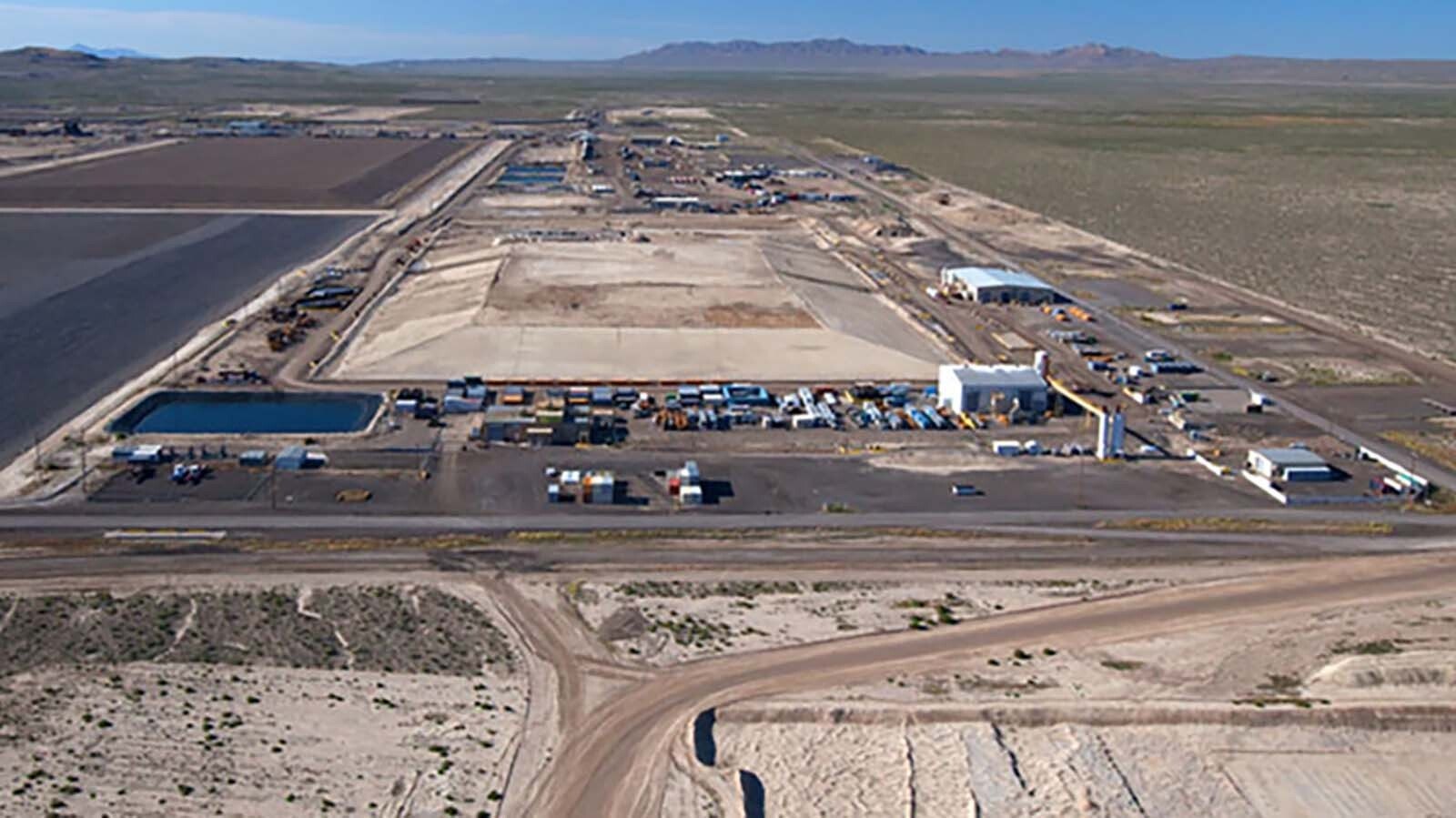
The EnergySolutions waste facility sits about 5 miles south of the Clive exit on Interstate 80 in Tooele County, roughly 80 miles west of Salt Lake City.
The 1-square-mile operation sits in a remote desert area about 20 miles from the nearest home, according to the Utah Department of Environmental Quality.
Wyoming Concerns
For Wyoming, the international waste deal raises immediate questions about what's coming through the Cowboy State.
"It is possible that some of those routes will go through parts of Wyoming," Tuddenham said. "We don't know yet, because none of those specifics have been addressed. We don't know specifically what radioisotopes are going to be in the waste. We are simply told that it will meet the definition — the U.S. definition of Class A or low-level radioactive waste."
That “low-level" label can be deceiving, she said.
“Low-level radioactive waste does not mean that it is not harmful," Tuddenham said. "And there are still potentially long-lived radioisotopes within that, everything from plutonium to a lot of other isotopes, which can cause profound health effects, and that also could make their way into the air, land and water and into the food chain."
Asked whether it's fair to say plutonium from Canada could travel through Wyoming communities, Tuddenham said, “It’s absolutely possible."
"There's a transport risk," Tuddenham said. "And I think it's something that everyone needs to be concerned about, because what this decision does is that it potentially blows open that door for radioactive waste coming from all over the world to be disposed of here in Utah."
D'Arrigo emphasized that the current classification system allows dangerous materials to qualify as Class A waste.
"Any radionuclide that is not included in these two charts is automatically Class A," she said, referencing federal regulations. "And that's why we're making the point that plutonium is coming in from Canada.
"It may not be massive amounts, but plutonium is one of the most deadly radionuclides, one of the deadliest substances on Earth, and we're importing it. And putting it into ditches in Utah."
Wyoming is also tied to this story through its growing nuclear partnership with Utah.
According to the EnergySolutions presentation, the “state of Utah is committed to nuclear advancement not just in Utah, but regionally" and has "signed the 2025 tri-state agreement with Idaho and Wyoming (to) boost energy policy, infrastructure, and nuclear innovation collaboratively across states."
Waste Volume
The 1.3 million cubic yards of Canada waste heading to Utah represents just the opening chapter of EnergySolutions' expansion plans.
According to a company presentation to the Northwest Interstate Compact, EnergySolutions "has an agreement with the State of Utah to expand disposal capacity to U.S. Nuclear Industry."
Utah "supports EnergySolutions desire to dispose of Ontario's Class A Low-Level Radioactive Waste at the Clive, Utah facility,” it says.
Under the approved arrangement, Ontario waste will be capped at 15% of the expanded disposal capacity at Clive, with 85% reserved for U.S. generators.
The company frames the Canada import as serving an "additional purpose" beyond profit: to "provide a much-needed disposal outlet. … Ontario generators currently lack and critical capital to expand Clive, Utah, disposal capacity for U.S. generators."
According to the presentation, 2025 Utah legislation "mandates a fee of up to $30 million if EnergySolutions files an expansion application before Dec. 31, 2025."
The company says it is "accelerating regulatory approvals to file and pay this fee on time."
That $30 million goes toward funding "Utah's nuclear strategic plan," according to EnergySolutions.
"For me, I tend to look at that and say, ‘Wow, you know, I can only imagine how much they're going to make off of this if they're voluntarily willing to pay $30 million tax to fast track that,’" Tuddenham said.
This isn't EnergySolutions' first attempt to bring foreign waste to Utah. The company tried in 2007 to import waste from Italy. That effort failed when Utah's governor at the time said no.
"EnergySolutions learned its lesson back then when they tried to import all of Italy's waste," said Diane D'Arrigo, radioactive waste project director at the Nuclear Information and Resource Service.
D'Arrigo told Cowboy State Daily that, "This time, before they made it public, they went to the governor and the Legislature and the agency, and they got all of them to support it."
Why Canada?
Why is Canada shipping its radioactive waste to the United States?
As Cowboy State Daily reported in September, Canada announced in November 2024 that it had selected Wabigoon Lake Ojibway Nation and the Township of Ignace in northwestern Ontario as host communities for a deep geological repository for used nuclear fuel.
The site selection process started in 2010 with 22 communities expressing interest. The repository will be built 650-800 meters underground.
Despite identifying a permanent storage solution on its own soil, Ontario generators are shipping waste south.
"I don't know why they can't take care of their own waste," Tuddenham said. "And I will say we have talked to advocates on the other side of the border who agree with us and say, ‘You know, we should not be shipping this stuff out. We should be taking care of this problem domestically if we're going to produce it. And we're going to benefit from it, then we should dispose of it here.’"
A spokesperson for Canada’s Nuclear Waste Management Organization told Cowboy State Daily this isn’t something his agency would handle.
“This site in Utah looks like it’s for low-level nuclear waste only. The NWMO is mandated to isolate and contain intermediate-level and high-level nuclear waste,” said NWMO spokesman Craig MacBride, suggesting someone at Ontario Power Generation might know why Canada's waste appears headed for Utah.
EnergySolutions and Ontario Power Generation did not respond to messages left by Cowboy State Daily.
Tuddenham, whose group has led efforts against toxic and radioactive waste since 1999, offered her guess about the motive behind bringing in waste from Canada: "I imagine that someone's going to make a buck in this.”
However, the deal isn't final yet.
Approval for EnergySolutions to move forward is contingent on Canada export authorization and U.S. Nuclear Regulatory Commission approval for importation of the waste, according to HEAL Utah.
D'Arrigo isn't expecting any roadblocks.
"NRC has never denied imports for nuclear processing," she said. “So, it can be expected to rubber-stamp this."
David Madison can be reached at david@cowboystatedaily.com.