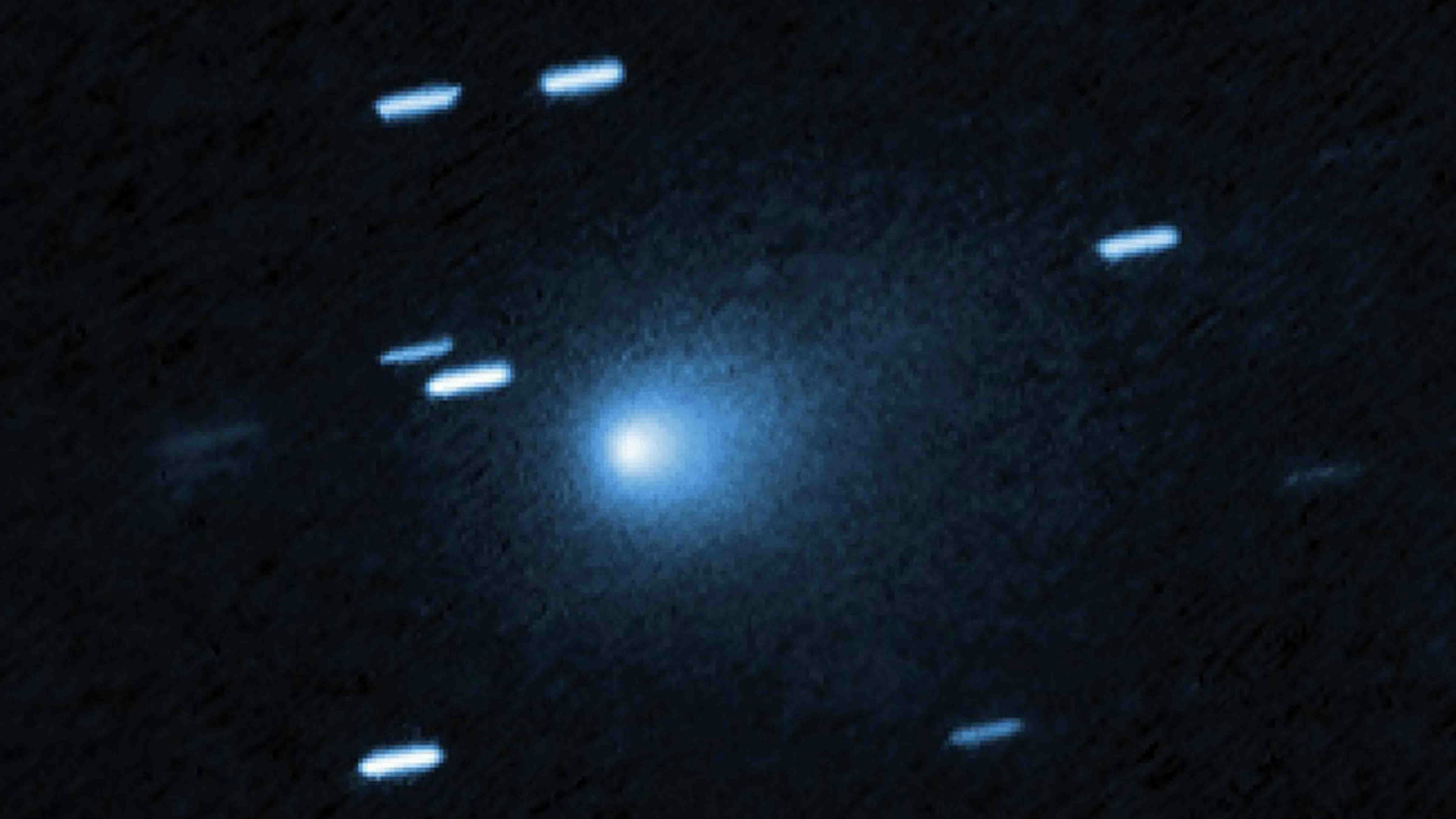
Astronomers still have their telescopes turned toward 3I/ATLAS, the 33-billion-ton interstellar object discovered earlier this year. It will make its closest approach to Earth on Friday.
"It'll be 167 million miles away from us," said Max Gilbraith, planetarium coordinator at the University of Wyoming. "That's a little further than the distance between the sun and Mars."
Even though it poses no threat to Earth, NASA is keeping a close eye on the object, which is presumed to be a comet. It's not every day that we get to see and study an object that's older than the sun and everything in our solar system.
The thing that's currently captivating celestial sightseers is 3I/ATLAS's unusual "anti-tail." It's a phenomenon that indicates there's a lot more to this object than meets the eye, and once it's gone, it's gone forever.
Tails And Anti-Tails
Comet tails are formed by the outgassing of the icy elements that make up comets, which Gilbraith called "dirty snowballs," trailing the objects as they pass by the sun. What makes 3I/ATLAS unique is a "protrusion" that's positioned and shaped in such a way that it has given the comet an "anti-tail."
"An anti-tail is a comet tail pointing towards the sun, which is in the opposite direction of a normal tail," he said. "It's rare, but there are a couple of ways that can happen."
According to Gilbraith, possible causes of an anti-tail include a hole in the comet's shell, possibly caused by an impact with another celestial object. That shell is made up of dust and other debris collected by the comet as it hurtles through space.
When the sun's energy hits the volatiles in the hole, they become so energized that they shoot straight out of the hole. Gilbraith compared it to the intense heat created when sunlight is directed through a magnifying glass.
"In this case, we've got a particularly volatile region of the comet that's getting direct sunlight," he said. "That volatile material is shooting out in the path of least resistance, which is straight toward the sun rather than falling behind the comet."
There could be other explanations for the anti-tail, which astronomers are debating among themselves. Further study and additional images could reveal the critical clues needed to determine its source.
While many astronomers are captivated by the rarity of this comet's anti-tail, Gilbraith isn't convinced that it's as rare as it seems. We might just be able to see them when we couldn't before.
"As we get better images of more comets, I would suspect that we see this happen more often," he said.
Before The Beginning
The main thing about Comet 3I/ATLAS that has captured astronomers' interest is that it's a "rare" interstellar object. Unlike nearly every other known comet, like Halley's Comet, this one didn't originate in our solar system.
"Since this is an interstellar comet, the chances it has ever gone around a star are probably zero," Gilbraith said. "This is probably the first time this comet has ever had a tail or an anti-tail."
Being an interstellar object, Comet 3I/ATLAS is more than 4.6 billion years. That's the approximate age of our sun, and its creation created the material for the formation of the solar system.
Gilbraith noted that this is the third interstellar object discovered within our solar system within the last decade. Where some see a fortunate confluence of rare celestial sightings, Gilbraith sees a marked improvement in the tools and technology we use to study space.
"We wouldn't have noticed these objects before because we didn't have the technology to see them," he said. "Now, we've got great tools to spot them. If there's a sudden drought of interstellar comets, maybe we'll start reevaluating whether this is a rare occurrence. But just like with regular comets in the solar system, they might be happening all the time, and we've just got the tech to see them."
Gilbraith said that NASA is collecting hundreds of images of Comet 3I/ATLAS from several systems, including the Hubble and James Webb Space Telescopes. Some images have even come from MAVEN and the Mars Reconnaissance Orbiter, which are currently orbiting Mars.
"The data that they got from MAVEN is particularly interesting, because it's set up to observe the kinds of spectral data that a comet would produce," he said. "It's cool to have all these missions that we can turn into impromptu observatories when we're shielded from the comet."
Another telling sign that Comet 3I/ATLAS is an interstellar object is that its motion isn't being influenced by the sun's gravity. While Halley's Comet has a predictable orbit that always brings it back around, Gilbraith said this comet is on a "fully hyperbolic orbit."
"This comet is a one-and-done," Gilbraith said. "This will be the last chance we have to see it in our solar system, and until we invent some constant momentum propulsion system to catch up with it, it'll be someone else's problem."
No Aliens, No Sightings
Another idea brought forth to explain Comet 3I/ATLAS's anti-tail is that the object isn't a comet at all. Some have postulated that it's actually an indication that the object is an alien spacecraft.
Gilbraith heard that idea. Based on the wealth of evidence already collected, he's dubious, at best.
"The main reason MAVEN's data was interesting was that it was on the far side of the sun at that time," he said. "If the comet were doing any secret alien things, it would have been picked up while it was going close to Mars."
If there are answers to many questions astronomers have about Comet 3I/ATLAS, they probably won't come from the observations of Wyoming's amateur astronomers. It might look bright through the Hubble and James Webb Space Telescopes, but even the best stargazers won't be able to spot it on their own.
"When it makes its closest approach on Dec. 19, it's going to be in the 13th magnitude," he said. "That's really, really dim for even the most advanced telescopes on Earth to pick up."
Gilbraith always encourages Wyomingites to get outside and stargaze, especially during rare visits from comets. Comet 3I/ATLAS is an amazing celestial object for astronomers, but it's not worth the effort for the rest of us.
"I wouldn't have high hopes of trying to get it from our backyards here," he said.
Andrew Rossi can be reached at arossi@cowboystatedaily.com.