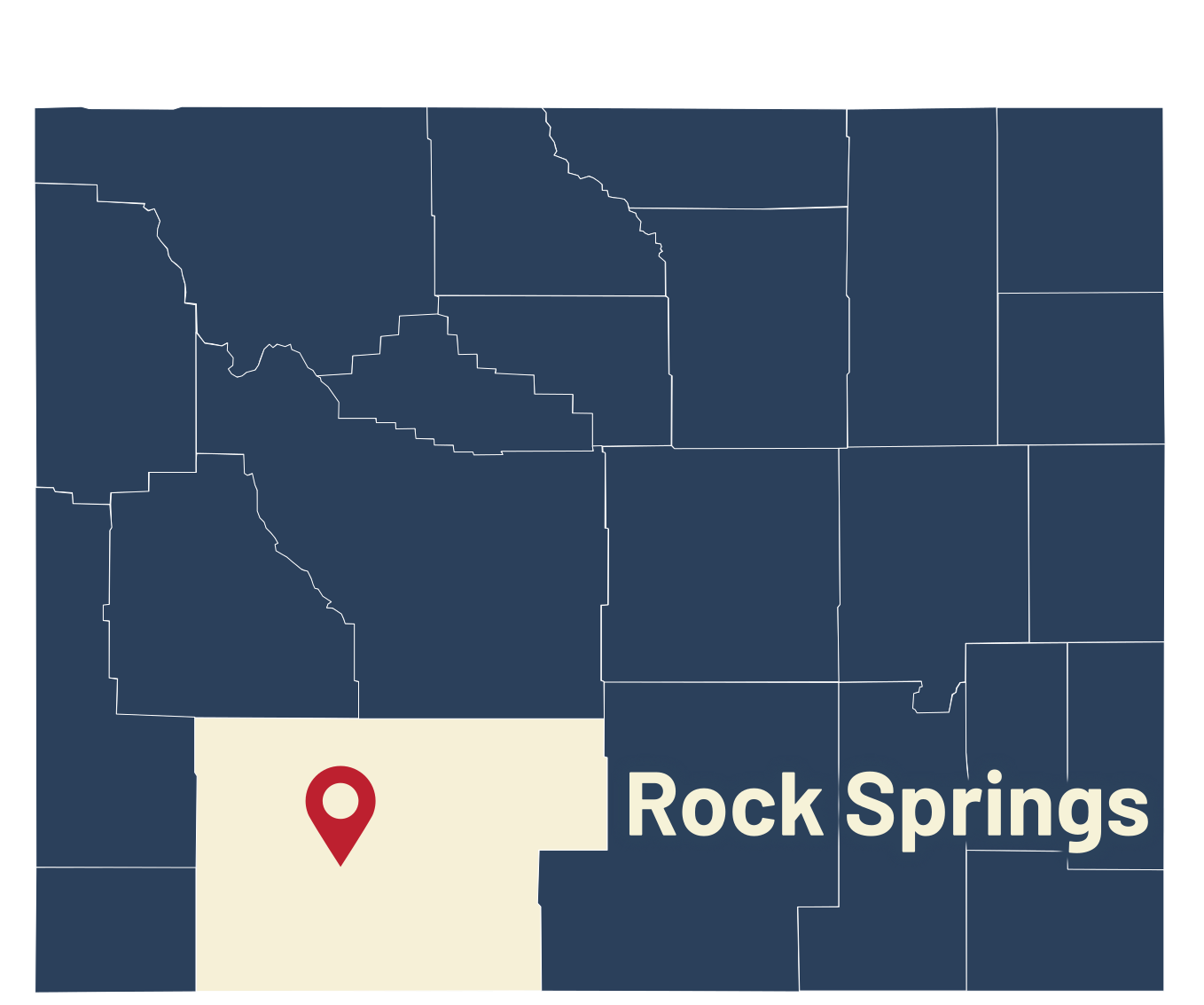
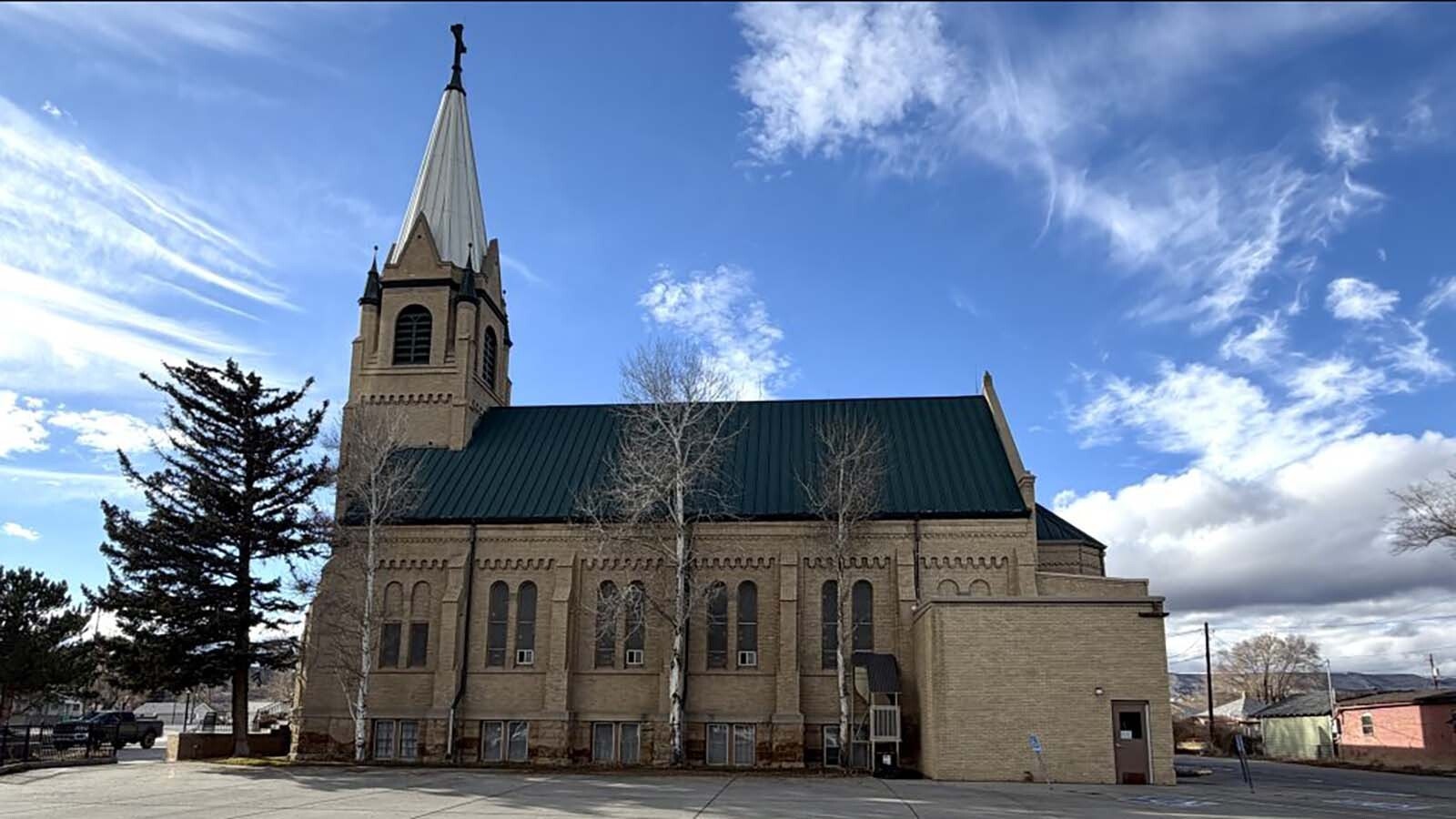
The founders of Saints Cyril and Methodius Catholic Church in Rock Springs started their church a century ago to give immigrant parishioners a place of worship where they felt comfortable and could speak their own languages.
Generations later, members of the congregation struggle to preserve that proud legacy, now asked by church hierarchy to attend a sister church the founders had split from — because their church has been shut down.
The drama of this church’s early days is briefly laid out in a National Register of Historic Places application for the church, which talks about the tensions between the two church communities, as well as how Slavic immigrants pushed to have their own church, with customs familiar to them, as well as priests who spoke their language.
Those tensions, common during that timeframe of America, are part of the basis for the Rock Springs church’s presence on the National Register of Historic of Places.
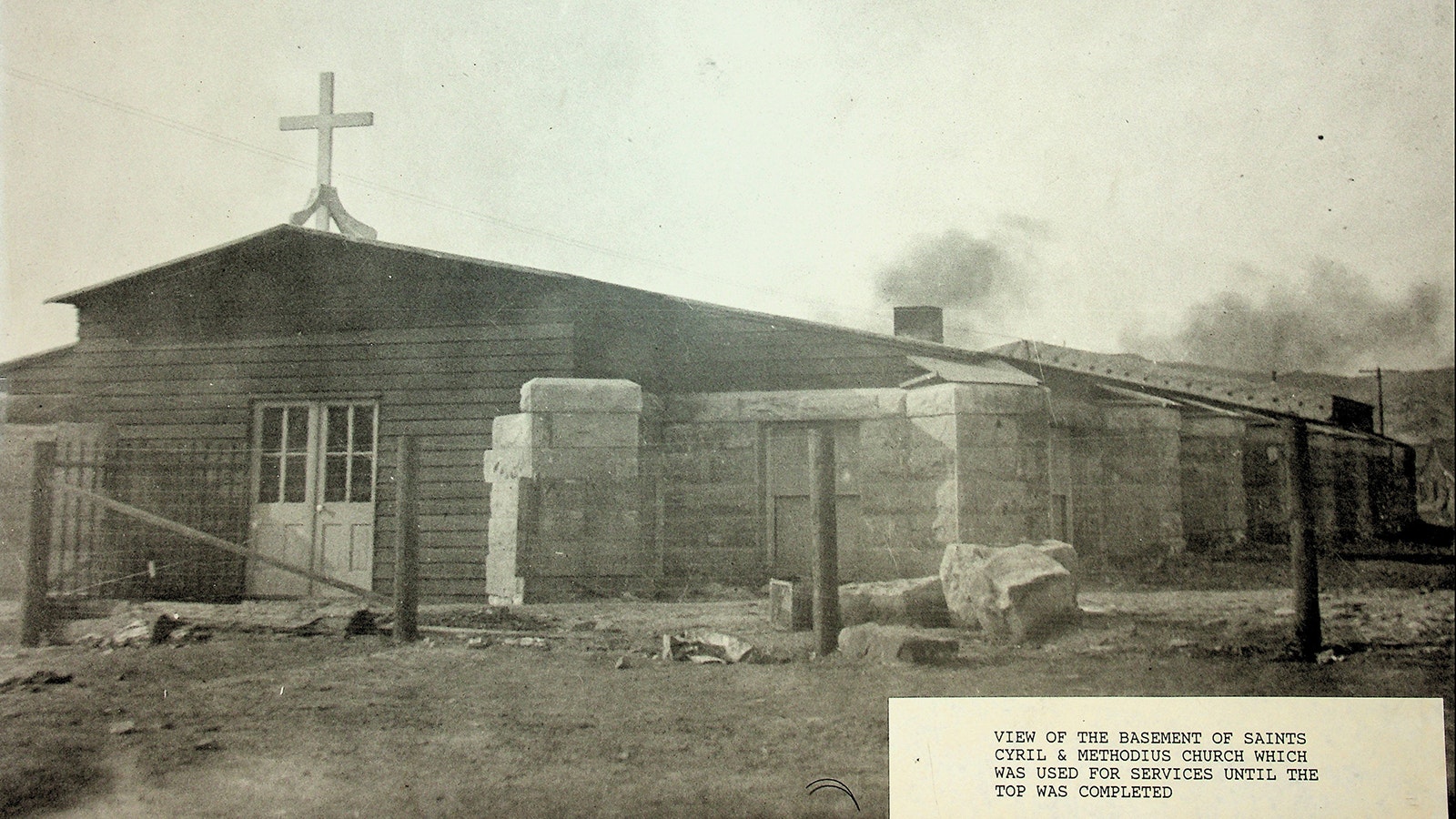
Saints Cyril and Methodius had humble beginnings. It started as a dug-out, covered basement space on the Slavic side of the tracks. Ultimately, the determined immigrants raised $15,000 for their very own church and never looked back.
It is a history tied to a wave of immigration that once helped to build a railroad and a nation.
Flash forward to today, however, and the parishioners of Cyril and Methodius are being asked to attend church at our Lady of Sorrows from here on out.
They held their last Mass in their beloved Cyril and Methodius Church on Nov. 22.
It’s a bittersweet date that fell on the finished church’s 100th anniversary.
New Church Planned
Parishioners of Cyril and Methodius have been told their church is to be put up for sale, in part to help fund construction of a brand-new church. In the meantime, they’re to attend Our Lady of Sorrows, about 2 miles away.
The suddenness and finality of the long-discussed closure came as a surprise to some parishioners, who hadn’t realized their church was in immediate peril.
Among them is Mary Hamilton, who is leading an effort to try and save the historic church where she has been a member for decades.
“They’ve worked on this for probably 13 years, so I just really didn’t think it would ever come to pass,” she said. “But now I guess they’re at the juncture of, in my opinion, fundraising has kind of stalled. So, the next thing is to get rid of assets we have that don’t fit the needs of what they want to do.”
That’s led to a closure order that’s taken her and other longtime members aback. They hadn’t expected their church would close, based on the lack of fundraising, any time soon.
“I really consider myself a newbie in regard to the church, because there are people who have six and seven generations that have gone to this church,” she said. “I’m certainly not the one who has probably more invested in it than other people, but I’ve raised all eight of my kids there in this church. We’ve buried a baby with this church. We were married there. I have a lot of ties to it.”
Rare For Churches To Make Historic Register
Cyril and Methodius Catholic Church is a product of the historical trends that helped build America, earning it, and its sister church, Our Lady of Sorrows, a place on the National Register of Historic Places.
That’s rare for churches, according to the Alliance for Historic Wyoming’s Megan Stanfill.
“Churches are pretty difficult to have listed on the National Register,” she said. “Because every single church in most communities is historic,” she said. “So, it would really fill up the National Register of Historic Places with churches. So, they had to make the case that they play into a social movement beyond religion.”
The fact it was built by immigrants and still serves as a local soup kitchen in Rock Springs shows that it has had a long and established impact on the community beyond being a religious, sacred space.
“It’s really incredible to have two churches of the same denomination in a community that are still in use with their original purpose, making an impact in their community,” Stanfill said. “It’s absolutely amazing.”
Because of that, and because there is a grassroots effort to save the church, Stanfill has added the church to its Watchlist of Endangered Properties.
“The church does have the intention to build a large campus in the future,” Stanfill said. “So that kind of puts both churches at risk of relegation. And the Alliance isn’t against adaptive reuse, but we do think that when a property loses its original use, that is detrimental to preservation of the site.”
Two Catholic Churches So Near Each Other?
Cyril and Methodius are the patron saints of all Slavic people, many of whom were pouring into Rock Springs at the turn of the century to work in Union Pacific coal mines.
How Rock Springs ended up with two Catholic Churches — the only Wyoming community where that happened — is a tale of drama that’s briefly told in the church’s National Register application.
At first, as these Slavic immigrants arrived in Rock Springs, they attended Our Lady of Sorrows. But that particular church was being manned at the time by Irish priests, who catered more to Western European countries like Italy, France and Ireland. The newly arrived Slavic people didn’t feel entirely comfortable there. They wanted a church that would recognize their unique culture and customs. As well as priests who could speak their language and hear their confessions.
As their numbers grew, they began to push for their own church and, even though it would put two churches in the same community, the bishop at the time ultimately gave permission. The Slavic members contributed an overwhelming $7,000 toward its construction.
There were machinations along the way, which sought to put build a brand-new church and put the two congregations together, creating a relationship that would ever after be stormy and tempestuous, according to the history outlined in the National Register of Historic Places application.
But the fledgling church survived such challenges, beginning every so humbly, in a covered basement space that was all their own, until such time as additional funds could be raised for a more proper place of worship.
Building A Church For The Ages
It took the parishioners until 1924 to accomplish that, according to the history outlined in the National Register of Historic Places. But finally, there was $15,000 in their coffer, which would be enough for them to build a full church.
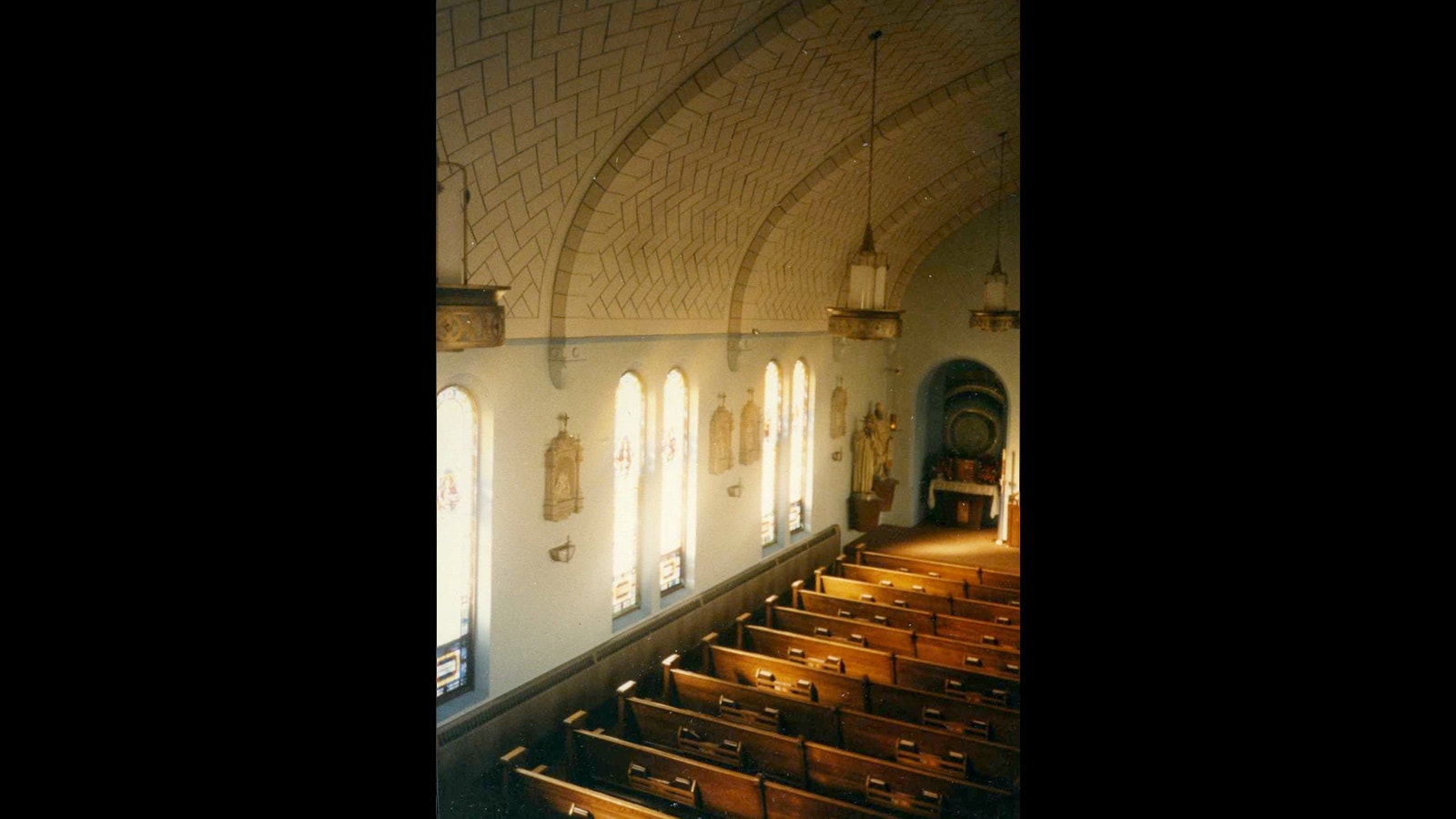
It wouldn’t be grandiose in size. They built it over the old basement space, to save some money. In addition, 58 volunteers from the congregation helped with excavation for the new foundation, further saving money. They also performed other tasks to save the church money, like unloading bricks and painting roof shingles.
Individual church members of means helped with some of the more expensive items. Stained glass windows, side altars and huge bells weighing hundreds of pounds.
Statues of Cyril and Methodius were commissioned for the marble alter, described in a newspaper of the time as having a reproduction of DaVinci’s Last Supper.
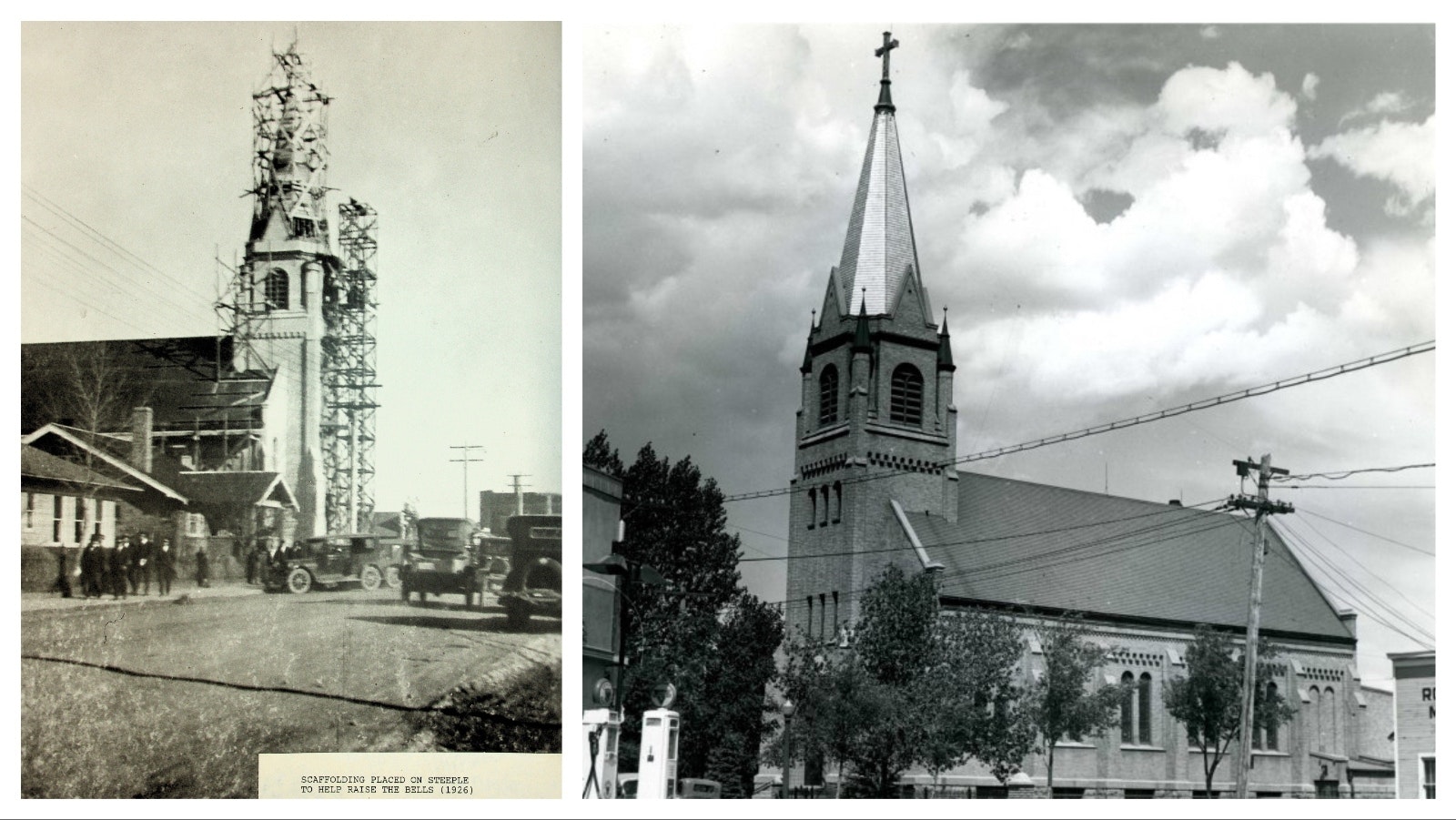
There was also a 125-foot bell tower, which Hamilton said she’s been told makes the church the tallest building in Rock Springs. Three bells for the tower were commissioned in the key of F, G, and C, while a fourth, and smaller bell, had unspecified tones.
The names of their donors were inscribed on these bells, which were rung in traditional Slavic patterns, passed down by parishioners whose fathers and fathers before them had rung such bells.
That continued until the 1940s, when a tape replaced the special bell-ringing teams that had once known such patterns.
The cross above the belfry was gold-leafed in 1934. All seemed complete to the church elders who remembered the early days, gathering in a covered basement to worship the Lord.
They had built this church for the ages. It would be a sacred place of worship not only for themselves, but for the generations of great-great-grandchildren to come, in what was now their adopted homeland.
The March Of Deferred Maintenance
But time has done its work since then. History has been forgotten by the grandchildren of tomorrow.
Cyril and Methodius has closed, and its parishioners have been ordered to attend Our Lady of Sorrows.
To some, like Hamilton, it is unthinkable that their beloved church might close.
“This church is 100 years old,” Hamilton said. “The stained-glass windows are that old as well. It’s got a cross that we’ve tried to, we’ve had parishioners who’ve tried to get the lights on this cross at the top of the church repaired. And the priest wouldn’t let us do that.”
Other parishioners have told her of times they, too, offered to do something toward the upkeep and maintenance of the church and were turned down.
“There were these older people who said, ‘I offered to pave, to renovate or to do maintenance on the organ or to fix the elevators and they told me no,’” Hamilton said. “So, there’s been no money to do the maintenance.”
An electrician has told Hamilton he offered to help by fixing some things, who was also turned down.
“My opinion is that’s because they’re trying to get it off the books,” she said. “Deferring maintenance makes it look like it’s in worse shape than it is.”
A Grassroots Effort At Salvation
Hamilton is seeing a healthy number of people who want to help the church survive and remain a sacred Catholic space.
“We did a very quick petition, and I got 200 that I believe are Catholic names,” she said. “And another 50 from the community.”
A Facebook group she started to help save the church already has 200 members, and she has an email list of 300 people who have asked to be kept up to date.
“I have a committee of about 25 people,” she said. “And I have five people as directors of our nonprofit.”
The nonprofit has been working with a group called Save Rome of the West, which specializes in helping the congregations of churches that are closing to save their churches.
“Our nonprofit would purchase the church, so it would still be a Catholic church in the diocese,” she said. “It would still be a sacred space. And then any kind of, it’s really deferred maintenance, we would, as a nonprofit, raise funds to maintain it.”
That would give the facility at least two masses a year, Hamilton said. Though, with permission, if they could raise enough money, a Dominican Order priest could be brought in to have a weekly mass at the church.
“We want to keep it Catholic,” she said. “We don’t want to just relegate it and sell it. It’d be the Baptist or the Mormons or something. It’s not about those religions, though. It’s just that everybody knew it as their Catholic Church. The heritage and the history of the families that built it. Both are so deep in Rock Springs.”
There will be difficulties ahead for the group in saving this sacred space, Hamilton acknowledged. But something in her heart, something in her spirit, can’t accept any other answer.
It’s a piece of history she believes must be saved. It’s part of the history of what made Rock Springs, and it's part of the history of a people who came to America to help make it great.
Renée Jean can be reached at renee@cowboystatedaily.com.