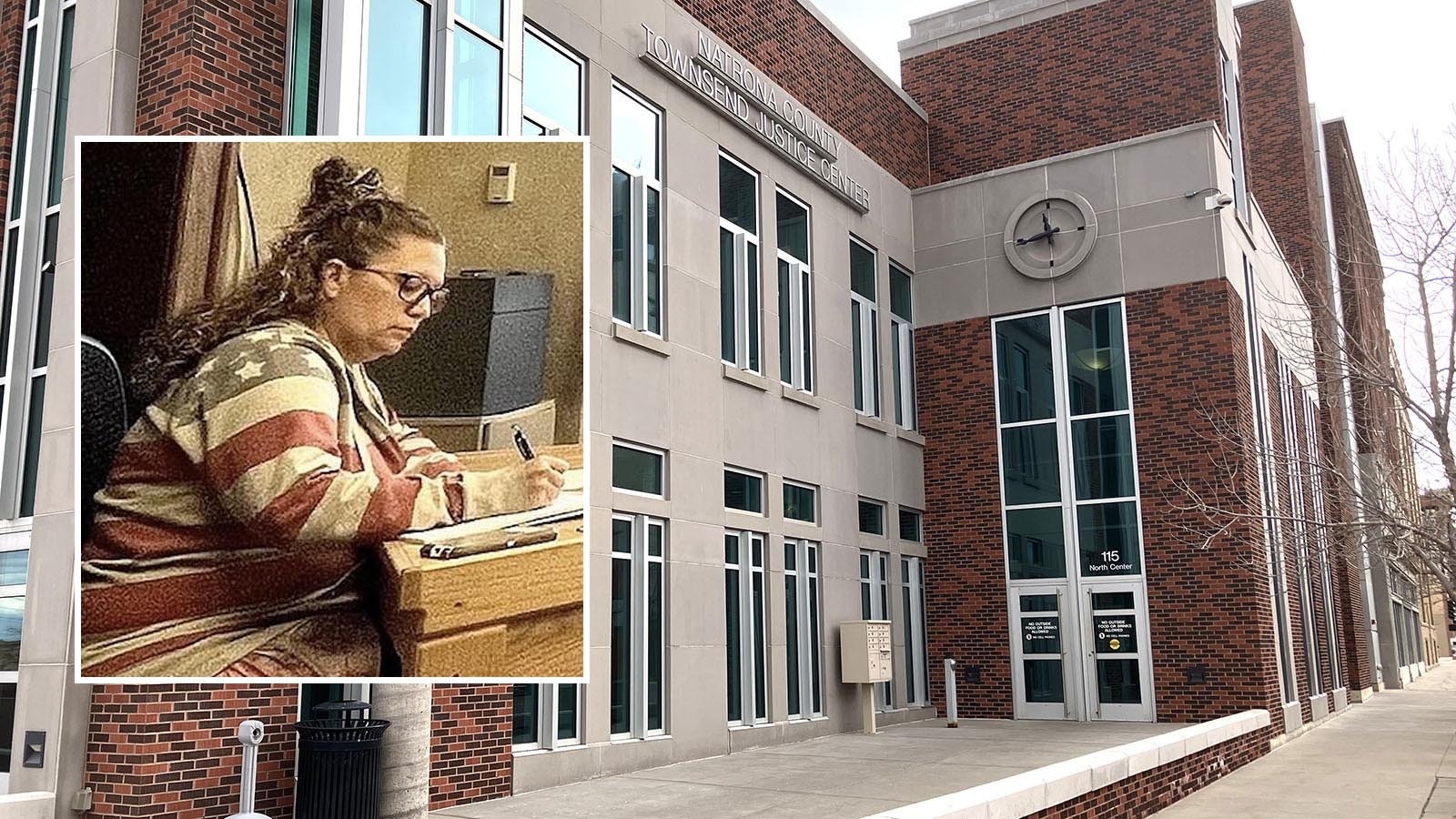
The attorney for Weston County’s clerk filed a strongly-worded motion Monday in Casper Circuit Court, accusing state lawmakers of exceeding their authority and violating the county clerk’s constitutional rights when they subpoenaed her to testify this autumn.
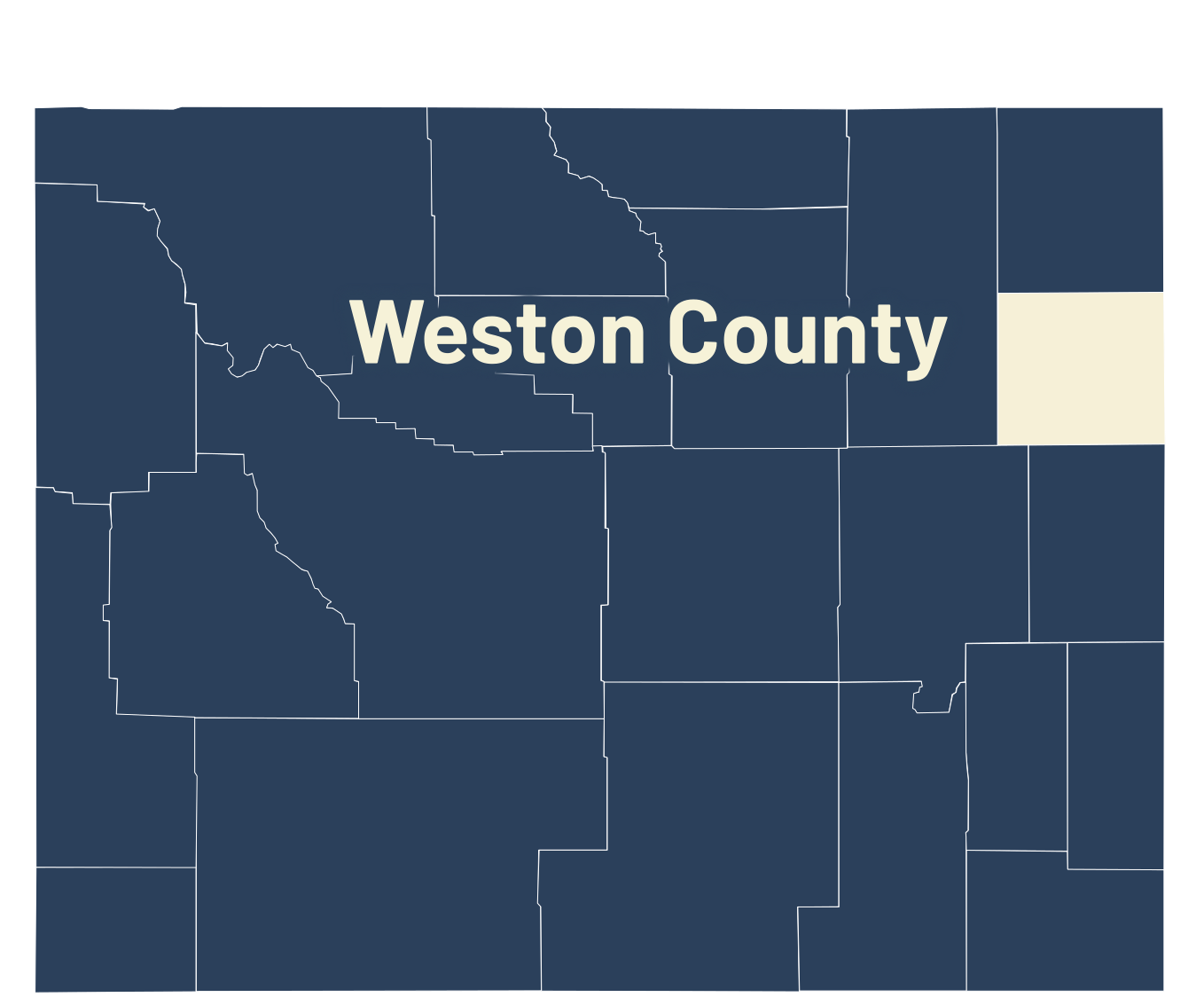
Errors in uncontested legislative and County Commission races surfaced in Weston County, in last November’s general election.
After a legislative committee subpoenaed Weston County Clerk Becky Hadlock to discuss those errors and she did not appear for its September meeting, the Natrona County District Attorney’s Office charged her, on Oct. 24, with failure to appear for a legislative subpoena.
If convicted, she faces up to six months in jail and a $100 fine.
She pleaded not guilty Nov. 14.
Hadlock’s attorney Ryan Semerad argued in a Monday filing that the state legislators who issued that subpoena exceeded their lawful authority, conducted their investigation against the confines of state law and violated Hadlock’s rights.
“That subpoena was void from the start so this prosecution must fail as a matter of law,” wrote Semerad. He’s asking the court to dismiss the case “with prejudice,” meaning permanently.
His motion quotes a concurring opinion in a U.S. Supreme Court case of 1952, Youngstown Sheet & Tube Co v. Sawyer:
“The accretion of dangerous power does not come in a day. It does come, however slowly, from the generative force of unchecked disregard of the restrictions that fence in even the most disinterested assertion of authority.”
Semerad’s motion hinges upon the assertion that legislators used their fact-finding subpoena authority to investigate Hadlock for criminal conduct – a role of the executive branch.
State law gives the Management Audit Committee the power to issue subpoenas, and to report subpoena violations to relevant prosecutors.
Semerad, an attorney of noteworthy accomplishment in Wyoming, confirmed Monday to Cowboy State Daily that he is not being paid via public funds to represent Hadlock.
This case is ongoing.
Here Comes Trump
Semerad’s motion says that the Management Audit Committee exceeded the authority state law gives it by subpoenaing Hadlock to uncover a crime.
The attorney cited multiple public documents and statements to support this theory.
The Wyoming Constitution distinguishes three branches of state government: executive, legislative, and judicial.
A 1990 Wyoming Supreme Court case affirms that the executive branch has “the exclusive power” to prosecute alleged crimes, the motion notes.
“Here, the Subcommittee wanted to question Clerk Hadlock about allegations that she broke the law. That is, they wanted to ask her – at least in its members’ eyes – potentially incriminating questions,” wrote Semerad.
But the clerk has a constitutional right against self-incrimination.
That’s a “safeguard against heedless, unfounded, or tyrannical prosecution,” the motion says, quoting a federal case from 1908. It “covers legislative hearings just the same as criminal investigations and prosecutions.”
If a legislature could dodge a person’s privilege against self-incrimination, it could also circumvent “virtually all the constitutional protections” of privacy, including those under the Fourth Amendment to the U.S. Constitution, Semerad wrote.
Here, the attorney invoked the president as a figurehead.
“(Without these protections), a future Democrat-dominated Wyoming Legislature could subpoena President Trump and compel his testimony on allegations of misconduct and criminal wrongdoing related to the events of January 6, 2021, on pain of criminal prosecution,” Semerad wrote. “And, at least under Wyoming law, President Trump would have no recourse.”
Other Law Stuff
Semerad’s other challenges to Hadlock’s charge say:
- The Management Audit Committee must have its legal staff its investigations in a confidential manner, protecting people’s identities in their ultimate reports and referring potential criminal findings to executive branch authorities (referencing state statute 28-8-107 through 28-8-108);
- Staffers who disclose information collected during the committee-directed audit are subject to “immediate termination of employment;”
- The committee gave just six days’ notice to Hadlock, when courts generally recognize 14 or more days’ notice for subpoenas appropriate – a gesture Semerad calls a violation of her due process rights.
“Even if the MAC possessed any authority to act as it did,” wrote Semerad, “the MAC violated Clerk Hadlock’s due process rights by serving her with a subpoena compelling her to travel 165 miles to provide in-person testimony on six days’ notice.”
He pointed to laws requiring fair and reasonable notice of subpoenas, and a reasonable opportunity to obtain counsel and respond to the command.
The subpoena reached Hadlock around 2:25 p.m. on a Tuesday, for a hearing the following Monday, the motion says.
Semerad wrote that she would have had to achieve “three extraordinary things” before 5 p.m. that Friday to block the subpoena: find a lawyer, file a request to a court and have the court issue the block.
“Because Clerk Hadlock, like most county employees, does not keep a constitutional litigator on retainer,” wrote Semerad, “the six-day window was unreasonably short notice here.”
The Saga …
The Management Audit Committee in July formed a subcommittee to investigate Hadlock’s errors in the 2024 general election – when numerous faulty ballots surfaced in Weston County and botched two uncontested races.
Secretary of State Chuck Gray noticed the errors and arranged their correction within days of the election.
Weston County Clerk Becky Hadlock at first protested that the ballots were correct, and filed a false or fraudulent post-election audit, Gray has asserted numerous times at state legislative committee meetings.
Gray urged Gov. Mark Gordon to investigate Hadlock for removal from office, including on the post-election audit claim.
Gordon, however, based his investigation of this spring only on the complaints of Weston County voting residents – not Gray’s complaint – in accordance with the law underpinning governor’s investigations, his office said in September.
The governor had declined in May to remove Hadlock from office, citing a lack of “malicious” conduct, and a hesitance to undermine the local electorate’s will.
Investigating That
On election night Gray caught the anomalies in Weston County and arranged contact with Hadlock.
When her first post-election audit showed “issues,” says the motion, Gray “continued his dialogue with Clerk Hadlock about resolving these issues,” wrote Semerad. By 9:42 a.m. on Nov. 8, 2024 – three days after Election Day – Hadlock’s general election results were accurate.
By Nov. 12, 2024, Hadlock had submitted a second post-election audit that identified 21 ballots with two issues, says the motion.
In Semerad’s view, the laws already on Wyoming’s books worked.
“Despite the current laws working, Secretary Gray complained that, despite his requests, Executive Department officials had not adequately responded to, investigated, prosecuted or punished Clerk Hadlock’s conduct,” wrote Semerad, citing both a Gray press release and public legislative testimony.
Let’s Make A Panel
The Management Audit Committee met in July in Cheyenne and formed a subcommittee to investigate Hadlock.
Rep. Rachel Rodriguez-Williams, R-Cody, later became the chair of the subcommittee on the Weston County Clerk.
She said the subcommittee should “receive or compel testimony and investigate and produce a comprehensive report” regarding the post-election audit, Semerad noted.
The Legislative Service Office (LSO) first contacted Hadlock on Sept. 8, about appearing for the subcommittee’s meeting, the motion says.
That was 21 days before the scheduled Sept. 29 meeting.
Hadlock wasn’t available, she said. Court documents say she’d scheduled her and her mother’s medical appointments for that day.
The LSO and Hadlock collaborated to send witnesses from the Weston County Hand Count Committee.
“Over many emails,” wrote Semerad, “the LSO never informed Clerk Hadlock that her appearance and testimony was essential to the Subcommittee’s work and would be compelled by subpoena if she did not agree to come voluntarily.”
The attorney attached a chart listing those communications, their dates and content.
Subpoena Formed
Management Audit Chair Christopher Knapp, R-Gillette, “executed a document” with the title “Subpoena” on Sept. 17, which commanded Hadlock to appear for the Sept. 29 meeting, the motion says.
According to Semerad, six days passed:
“The MAC (Management Audit Committee) did not have Clerk Hadlock served with this subpoena document until the afternoon of Tuesday, September 23.”
Hadlock reiterated that she had a scheduling conflict. She’d confirmed that with LSO “several times” while helping LSO secure other witnesses, the attorney wrote.
She would not be attending, Hadlock added.
As Scheduled …
The Sept. 29 hearing unfolded in Casper as scheduled.
A pregnant pause followed when Rodriguez-Williams called for Hadlock to come forward.
The other two witnesses Hadlock had helped arrange both testified, one via video link and one in person.
Rodriguez-Williams said Knapp and the LSO had made “good faith efforts” to “invite” Hadlock to attend the meeting. She later said the authorities would be notified about the violation of the subpoena.
The committee published an audit report Oct. 6, repeating Gray’s “findings and conclusions” and casting the governor’s investigation law as overly restrictive.
Also around that time, the Management Audit Committee or the LSO contacted the Natrona County District Attorney’s Office and the Natrona County Sheriff’s Office, about Hadlock’s no-show.
Sgt. Ken Jividen called Knapp.
Knapp said the Sept. 29 meeting’s purpose was to study the election and examine “any acts of wrongdoing, how those circumstances came to pass, and how to prevent a repeat of future mistakes of the same nature,” reportedly.
Knapp said he authorized the subpoena because the committee understood her communications with LSO to mean she wouldn’t testify “willingly,” court documents say.
Knapp claimed the subpoena authorized Hadlock to appear through a Zoom call, the documents also say.
Semerad denounced the claim as, “of course, not true.”
Secretary Finds This ‘Deeply Troubling’
Gray in a Monday text message to Cowboy State Daily reiterated his earlier complaints about the post-election audit.
“Becky Hadlock is again showing a complete lack of accountability,” wrote Gray, saying she had the opportunity comply with the subpoena and “explain herself, and her actions surrounding the submittal of a false post-election audit.”
Instead she didn’t comply with the subpoena, wrote Gray, “making a mockery of the process.”
“There has still been no explanation provided for why the first false post election audit was submitted after I made Hadlock aware of the concerns with the results,” he added.
The first submission was “clearly false and not something that can be brushed off as a simple error.” He referenced two county clerks’ testimonies at the Sept. 29 meeting.
Gray called Hadlock’s questioning of the legislature’s oversight role “deeply troubling and in line with her lack of accountability.”
Lastly, Gray wrote: “I also question who is paying for this 50-page brief.”
Rodriguez-Williams, Chairman Say Nope
Rodriguez-Williams in her own comment said the committee is “statutorily vested with oversight authority and used that authority to examine what happened during the 2024 general election in which Hadlock misprinted ballots and submitted a false post-election audit.”
Hadlock’s brief, continued Rodriguez-Williams, “even admits that our subcommittee's work was intended to look into what happened and provide potential legislative fixes- in other words, to do the work of a legislative committee.”
“She may not have liked being compelled to provide testimony,” concluded Rodriguez-Williams, “but that doesn't make it illegal."
Knapp echoed that in a text message saying the committee "followed our statutory authority" in crafting a subcommittee to ask questions of administrative processes, seek legislative intent in the election laws and information to improve those laws.
LSO worked "to invite" Hadlock or her deputy clerk to appear in person or remotely, Knapp wrote. "Those efforts were both professional and accommodating."
He said the subpoena was issued appropriately by statute and process, and the alleged violation "was taken up by the proper authority in Natrona County."
"Our hearing and questions dealt with fact finding," Knapp continued, reiterating that the committee sought to find flaws in state law, the possible need to change the law or add laws.
Knapp said he and Rodriguez-Williams cooperated fully with the Narona Conty Sheriff's Office before it referred this case for prosecution.
Clair McFarland can be reached at clair@cowboystatedaily.com.