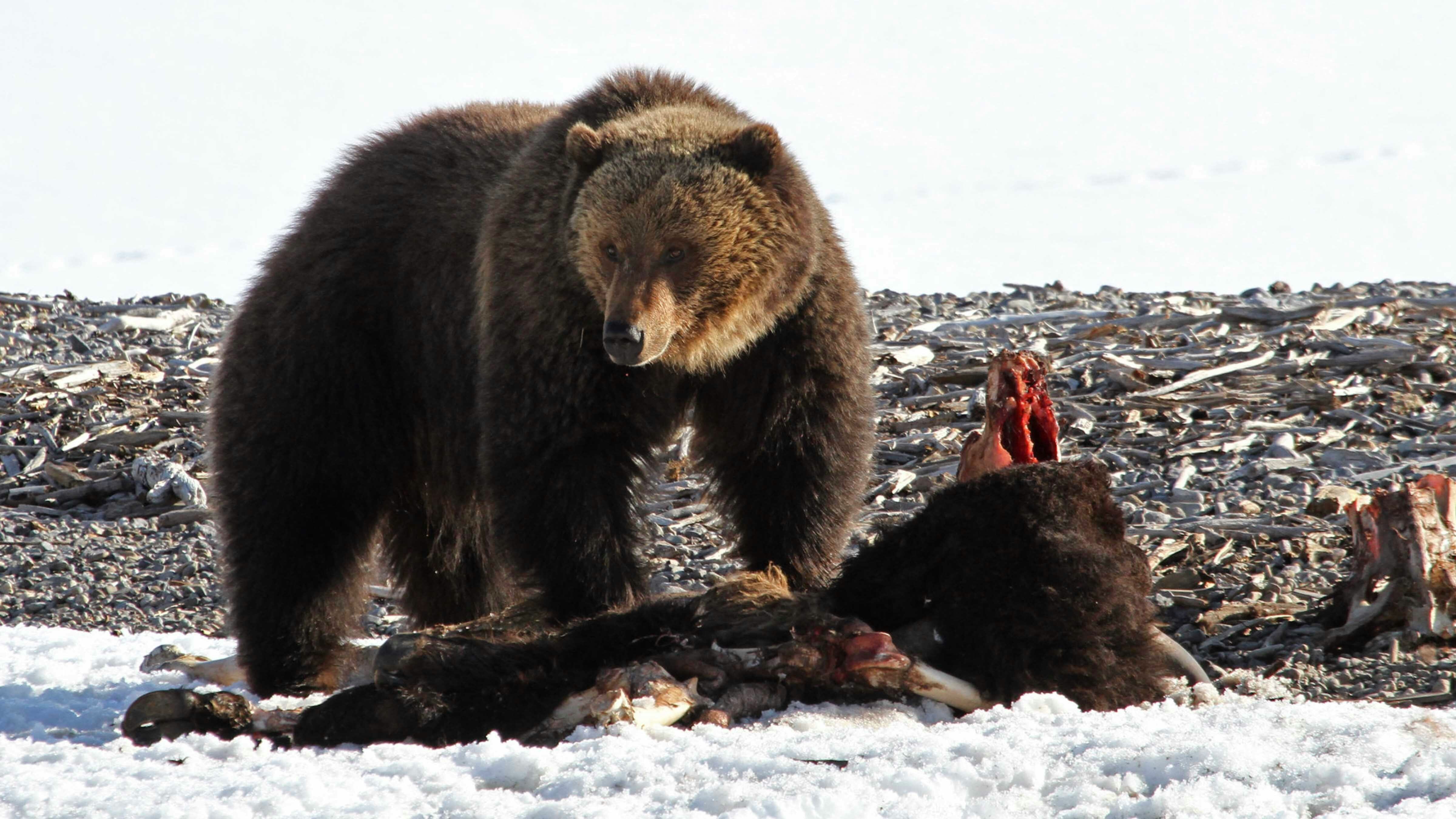
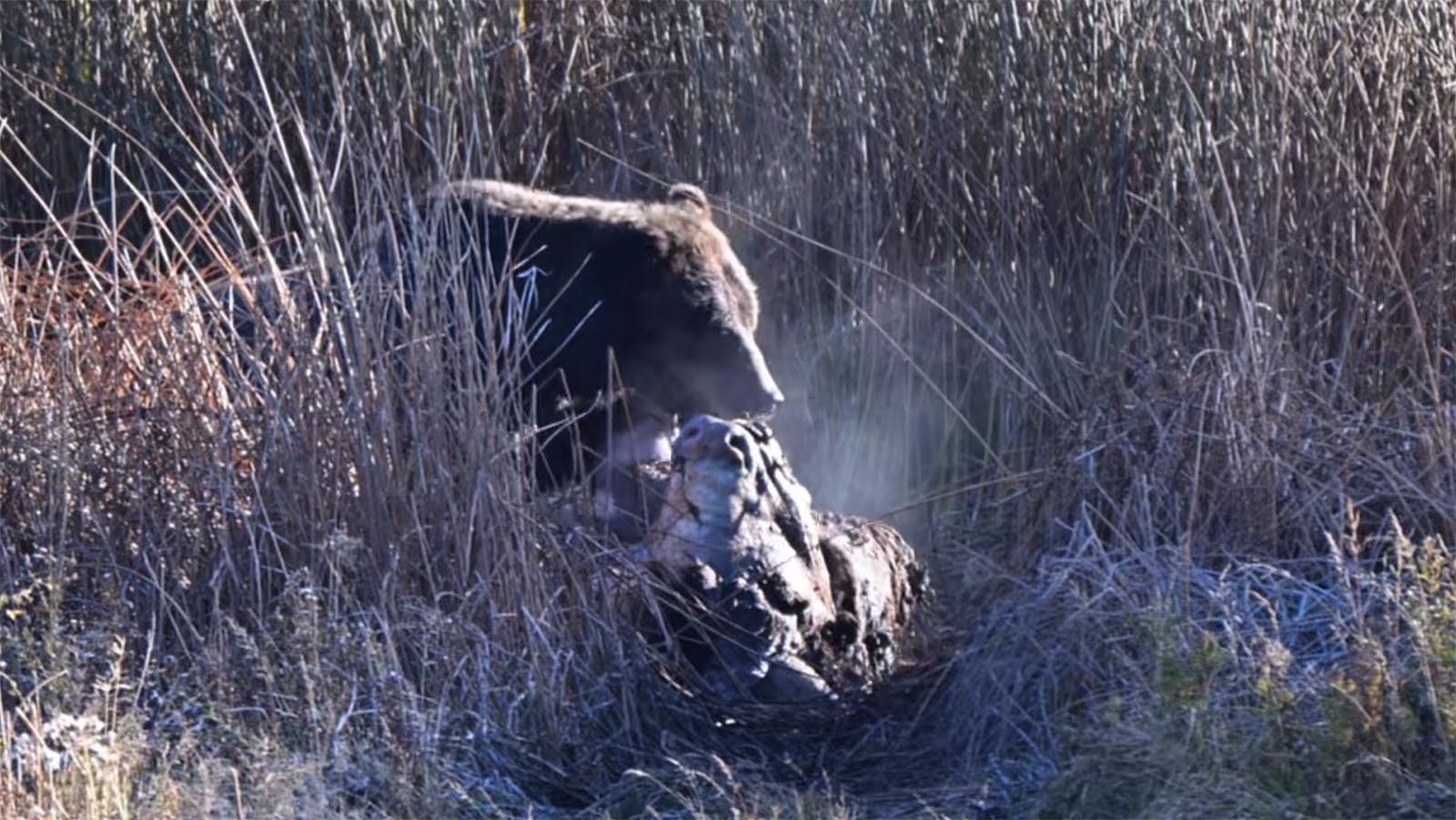
Grizzlies feasting on big game carcasses is nothing new, but it was a rare occurrence when a big male bear called Ojo decided to treat himself to bison brains, scooped right from the skull.
He was one of four males gathered around the carcass in late October. That’s when grizzlies were in their pig-out phase called hyperphagia. That’s when they gobble down as much as they can, piling on fat for hibernation.
And Ojo apparently thought the brains were a special treat, because he still had plenty of other options when it was his turn to feast, wildlife watcher and photographer April Holm of Idaho told Cowboy State Daily.
“They (the other grizzlies) had been into the stomach area, but there was still lots of meat on the carcass when Ojo started to eat into the skull,” she said.
Ojo has only one eye. It’s not known how he lost the other one, Holm said.
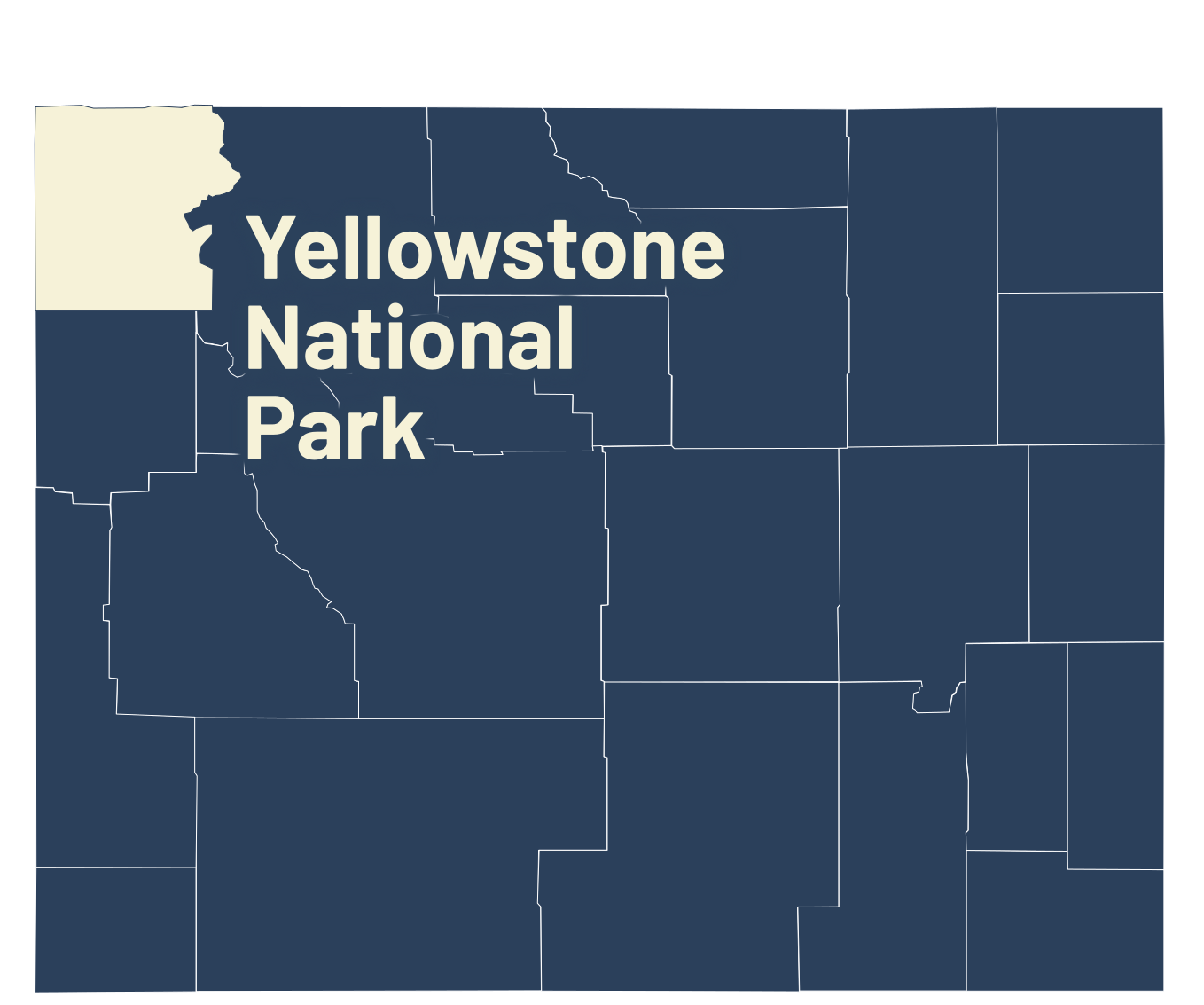
She and her husband, Patrick, frequently visit Yellowstone and Grand Teton national parks, getting material for their Holm On The Range wildlife photography and video business.
Why The Brains?
A grizzly going after brains on a carcass seems to be quite rare, retired federal ecologist Chuck Neal of Cody told Cowboy State Daily.
He has spent countless hours afield in grizzly country and has seen plenty of carcasses picked over by bears.
“Seldom is the head bothered at all,” he said.
All bears species are intelligent, and grizzlies are next-level smart, Neal and other experts previously told Cowboy State Daily.
Grizzlies are also “highly individualistic,” with their own survival tricks and particular tastes, Neal said.
So cracking skulls to get at brains might be something Ojo figured out at some point, he said.
“It’s quite possible, and even likely, that a particular bear has discovered foods that are important to him, and that other bears don’t know about,” Neal said.
Even with the immense strength of a grizzly, it would be difficult to get through a thick bison skull, Neal said.
However, brains could hold considerable nutritional reward, being especially high in fats.
Like many other species, “bears need fats and carbohydrates” to properly digest and absorb the protein from red meat.
In humans, eating just red meat alone leads to a potentially fatal condition called “rabbit starvation.”
So named, because people have reportedly starved to death eating just the meat from rabbits, but not getting the fats and other nutrients required to properly process the protein in the meat.
That’s why one expert previously told Cowboy State Daily that if somebody in a wilderness survival situation caught a porcupine for meat, they should consider also eating the brain, along with other fatty internal organs.
Bears, The Ultimate Dietary Opportunists
When it comes to food, grizzlies are opportunists, and they aren’t picky, Wyoming Game and Fish Large Carnivore Specialist Dan Thompson told Cowboy State Daily.
"Bears have high dietary plasticity and are not picky. If enough people watch enough bears through a long enough time they'll probably watch them do all kinds of interesting things and tell stories about it to their friends,” he said.
"Bears or the epitome of adaptability and opportunism when it comes to what they eat and nothing surprises me when it comes to bears finding food,” Thompson added.
Gang Of Four Grizzlies Gets Along, Mostly
Holm said that Ojo wasn’t the only famous Yellowstone grizzly gorging on the carcass that day, although he was apparently the only one with a taste for brains.
Strangely enough, there weren’t any knock-down, drag-out fights between the four males, she said. Just a few bluff charges and some growling and snapping.
“They more or less took turns on the carcass,” she said.
An elder grizzly, aptly called Old Man, was also there. He looked thin and worn from age and might not make it through another winter, Holm said.
“The other grizzlies seemed to recognize, ‘You’re our elder, so we’ll let you take your turn,’” she said.
There was also a young bear, Grizzly 288, who seemed to be at the bottom of the pecking order.
And then there was Big Red, thought to be one of the largest grizzlies in Yellowstone, she said.
At one point “Big Red came charging down a hill” toward the carcass in an apparent display of dominance, but none of the other bears fled the scene, she said.
Mark Heinz can be reached at mark@cowboystatedaily.com.