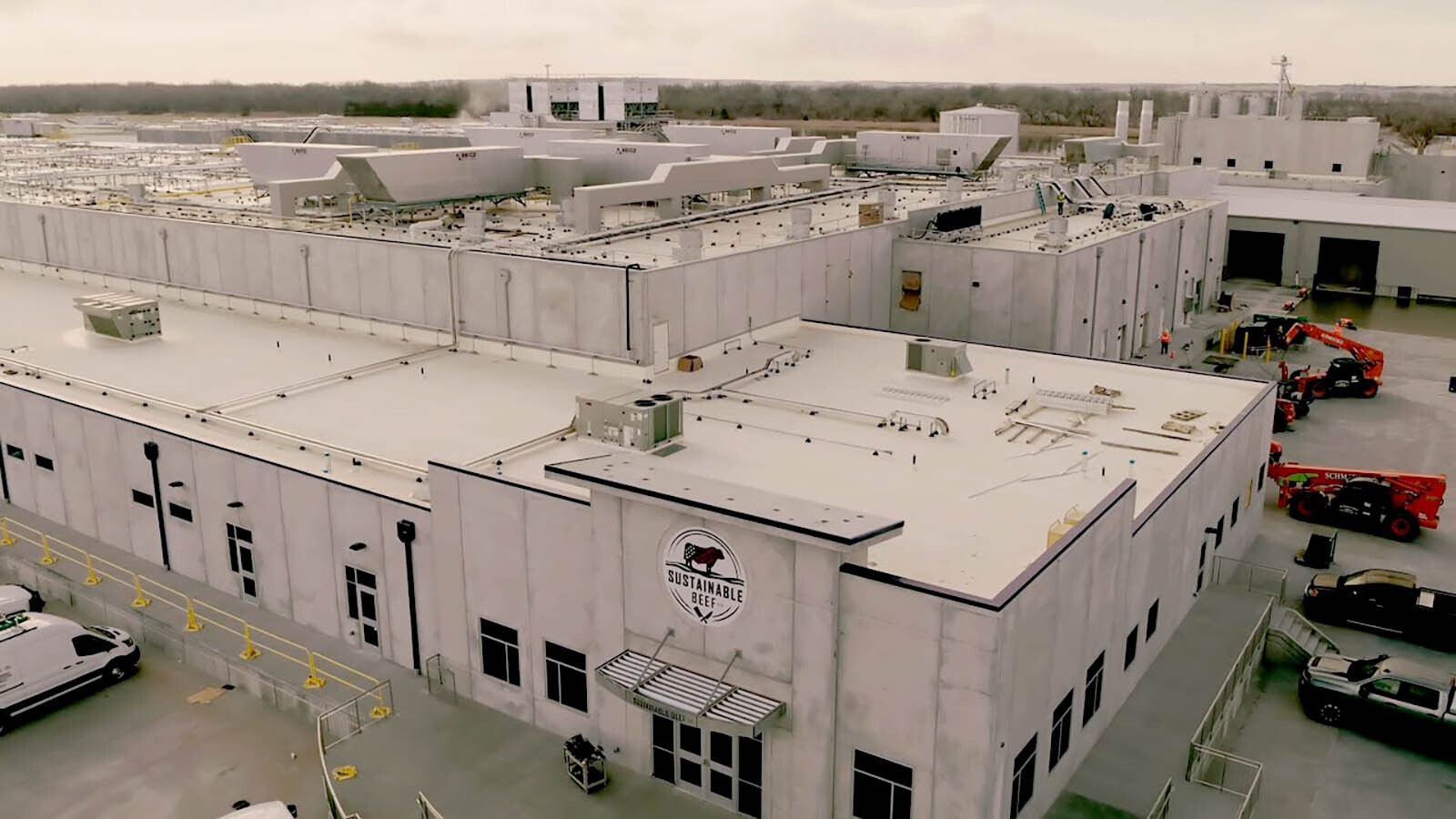
Nebraska’s new producer-owned packing plant opened in May and is among the first to be built in America in a generation. It’s also an experiment that’s already rewriting the future for a small western town that was once the fastest shrinking community in Nebraska.
The model is something that Wyoming cattle ranchers say does have promise in the Cowboy State — if all the right pieces can ever come together.
“I’m very familiar with that, and I’m friends with the main guy who is there,” State Sen. Ogden Driskill, R-Devils Tower, told Cowboy State Daily. “He’s a Wyoming fellow. He’s part of the Wasserburgers out of Lusk. And he is a major production, seed stock producer in Nebraska now.”
Driskill worked with Wasserburger five or so years ago to try and open a producer-owned packing plant in Wyoming.
“I spent many years working with some of the very same folks from there, trying to bring a packing plant to Cheyenne of all places,” Driskill said. “We just couldn’t get some of the pieces put together. But it was with some of the same people who are down there.”
Nebraska has some inherent advantages when it comes to opening a vertically integrated packing plant like Sustainable Beef, which is owned by producers, feedlot owners and other investors, including a minority stake held by Walmart.
Among those advantages is the number of feedlots that can feed into such an operation, as well as a lot more infrastructure that’s already built and ready to go for a new packing plant.
“When you start getting into these 1,000-plus head a day plants, it’s really complicated,” Driskill said. “I kind of looked around Torrington, and they didn’t have the labor market.
"Cheyenne has one of the best locations for a packing plant, and it falls right into an opportunity zone, which helps for investment.”
From Fastest-Shrinking To Growing Town
Ultimately, Driskill said he couldn’t bring enough of the right elements together for the total package in Cheyenne, either. So it went to North Platte, Nebraska instead, where it’s rewriting that town’s future.
In 2021, North Platte was Nebraska's fastest shrinking town. It was losing the most people of any city in the state. But that’s been turning around ever since Sustainable Beef announced its plan to operate a producer-owned plant that would process 1,500 head of cattle per day.
In the grand scheme of things, that’s a small amount of cattle. It’s just 1.5% of the overall national market.
It may not compete with what the big four can do in volume, but that’s still big enough to make a world of difference for the town of North Platte. Even though the plant only just opened in May, early economic indicators have put a smile on lots of people’s faces.
Among them is North Platte Area Chamber & Development Corporation President and CEO Gary Person, who weighs in about the change in a video documentary about the project put out by First National Bank of Omaha (FNBO), which is the company's banker.
“We have broken records in retail sales,” Person said in the documentary. “(We) grew valuation substantially. We will have crossed a threshold of $1 billion worth of retail sales and expenditure. That is exactly double what it was five years ago.”
FNBO’s city ambassador for North Platte, Laura Troshynski in a blog post about the project said the city’s mall has revitalized since the project’s announcement and that new restaurants and small businesses have opened as well.
The hospital underwent a major expansion, and the rec center upgraded as well.
“With new jobs and renewed energy, North Platte is growing again,” she said. “That’s something that hasn’t happened in a decade.”
My Piece And Yours Too
Revisiting the idea of a producer-owned plant in Wyoming is something Driskill said he’d love to do at some point. He sees it as a way to loosen what he characterized as a stranglehold that the big four meat packing plants have on the American beef industry.
“These people have messed with the beef markets for years, they really have,” Driskill said. “The big four have been really predatory, and what they’ve done has hurt our industry a whole bunch.”
Driskill, whose family has been farming and ranching in Wyoming for going on eight generations now, said producers used to get a fair piece from the overall value chain. But that’s changed dramatically in recent times.
“The beef I sell, I take all the risk from birth to about 250 days on them,” he said. “All that risk is mine. All the death loss, all the storms, the weather, everything that happens to them. Then they go to a feedlot, and they spend another 240 days where they mimic what we do, but they start with a live product and a little less risk.”
After feedlots, the cattle head to the packing plants for processing.
“And they make as much money as we do in 48 hours,” Driskill said. “They literally load a fat steer off of a truck, kill him, pull his hide off, process him and then they send it to a grocery store, who, once again, generally has them less than 72 hours.”
Yet these entities make as much and often more net profit per head than the guy at the bottom of the chain, who's taking on the most risk.
Ranchers, though, don’t get many choices when it comes time to sell their beef. They cannot hold a beef for a year, in hopes of better prices. They have to take what the market is offering when the beef is mature, whether the market price for the commodity covers their costs or not.
When inflation rises and commodity prices fall, it’s particularly hard on producers. They’re getting less money to cover the rising cost of inputs. That’s been driving many producers to retire or leave the industry, while simultaneously failing to attract very many youthful replacements.
Wyoming has been losing farms and ranches at the rate of 5.5 farms and ranches every week for the last five years, according to the latest USDA Census of Agriculture, which says the Cowboy State has lost around 1.2 million food-producing acres for the most recently tracked five-year period.
“Years ago, we used to get our piece out of it,” Driskill said. “Today they take our piece for us. And our part of the margins has gone down on an honest basis, and I think that’s wrong for producers.”
Sheep Industry Tried A Similar Idea, And It Didn’t Go Well
That doesn’t mean, however, that Driskill thinks Packers shouldn’t make a profit. Everyone on the value chain needs to get a fair share of the available profit, he believes.
That’s something Cheyenne rancher and former National Cattlemen’s Association President Mark Eisele agrees with as well.
“Everyone says we’re in cahoots with the packers,” he said. “But the reality is we’re trying to make sure that they play by the rules.”
Eisele, too, thinks the idea of producer-owned packing plants has something to add to the overall market.
“They’ll never have the capacity to replace the big packers,” he said. “That’s just the reality of it. Trying to find the workers, the right kind of workers, is really difficult.”
But having an extra hand to raise whenever beef is being auctioned can’t help but be good for ranchers.
“It creates competition for those additional cattle,” Eisele said. “It’s probably a good thing, and a good thing in that area. They’ll have cattle because that’s right in the heart of cattle and feeding country.”
The packing plant was also built by a Colorado company, Eisele added, who goes all over the world.
“That’s kind of neat, because it’s a local employer, local business, and all that money came back to Colorado for that,” he said. “It wasn’t done by a giant contracting company. So, I think that was kind of neat.”
One note of caution Eisele offered, though, is that a similar approach was tried by the sheep industry at one time.
“That ended up stumbling and faltering after a few years,” he said. “That left most of those producers who invested in it, I don’t know if they’re high and dry, but they sure didn’t come out of it the way they wanted to. I would caution everybody to think about that, because history has a tendency of repeating itself if you don’t remember those lessons."
What About Walmart
Walmart is one of the investors involved in the Sustainable Beef project. It owns a minority stake and has agreed to sell the beef processed by the company in their stores.
“The Walmart angle is interesting,” Eisele said. “They’re running their high-end program called Prime Pursuits, and that’s been really successful.”
The vertical integration with Walmart is something that gives Driskill some pause.
“I’ve got very mixed emotions about that,” Driskill said. “That’s what’s happened in the pork and chicken industries and the vertical integration hasn’t had huge benefits for the on-the-ground producers. So that’s somewhat scary.”
On the other hand, Driskill said he’d rather deal with what vertical integration brings than to have products being sold into a monopoly.
“I know the Walmart people, by the way, and they’re friends,” Driskill said. “They’re just businesspeople, and they know how to do business. They know how to do it in a great way. But I’m not positive it’s totally healthy for my end of the industry.”
It’s something that can be dealt with over time, though, Driskill added, if and when there are problems.
Smaller Could Be Better In Wyoming
If Driskill were to try again with a producer-owned packing plant, he’s not sure he’d go for an operation that does 1,000-plus head of cattle.
“I think any producer owned plant is a huge plus,” he said. “They don’t have to be huge ones. The truth is, Wyoming would probably be just as far ahead, rather than to have a plant like the one they have (in Nebraska) to have three or four plants that did 500 head a day. Then you could scatter them around the state.”
The diesel fuel alone from shipping the processed beef to markets would represent a huge economic boost for any small rural town, Driskill suggested.
“A fat truck is 40 head of cattle,” he said. “If you look at 1,500 head a day, that’s 40 semi-loads a day of trucks coming in. Just think about the diesel on 40 trucks a day coming in and tires. It’s unbelievable the impact on economy. It’s not the direct money. It’s the indirect money that’s absolutely incredible.”
Renée Jean can be reached at renee@cowboystatedaily.com.