The University of Wyoming asked state lawmakers this week for an extra $54 million for the upcoming two-year budget cycle on top of its standard $440 million state-funded budget.
That’s for an artificial intelligence program, a paid student internship program, shops and equipment to train professors of technical trades, a grant for its athletics department, and laboratories to work with the state’s minerals industry — among other efforts.
Some members of the legislative Joint Appropriations Committee, meeting Wednesday at the state Capitol, asked questions about the need for and costs of these projects, and about whether UW’s climate is “woke.”
UW leaders countered that the projects are important, and the university fosters open discourse.
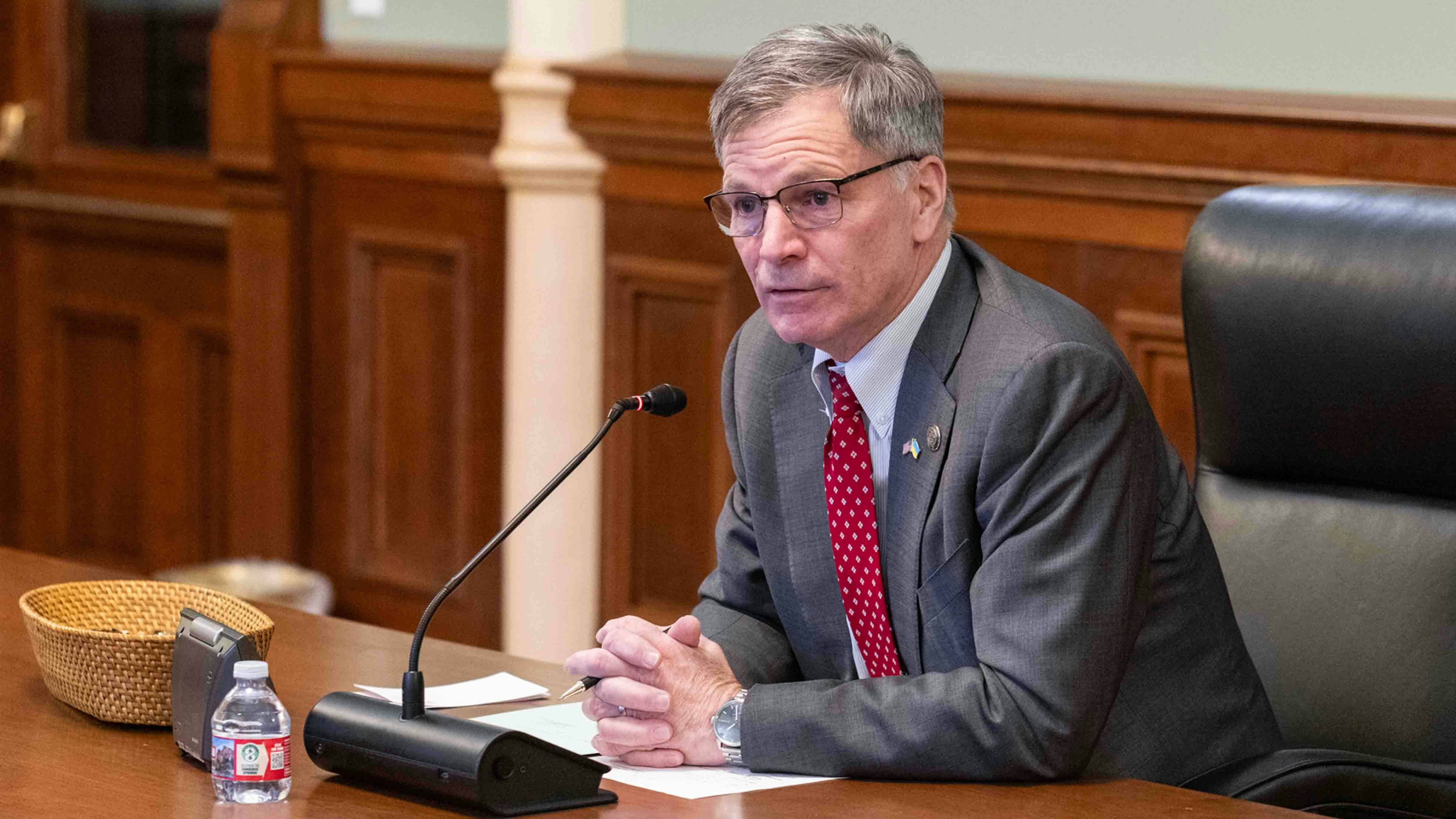
Rep. Ken Pendergraft, R-Sheridan, called forward the leader of the student body, Associated Students of the University of Wyoming (ASUW) President Paula Medina.
“I’ve heard a lot of stories over the last several years about a prevailing woke attitude at the university,” said Pendergraft, adding that on the other hand, he’s also heard of “a much more open dialogue” at the university recently.
“Have you noticed a change in temperature?” he asked.
Medina said she could only evaluate this school year since that’s been her only year monitoring the whole-school “temperature” as student president.
Both UW and ASUW leadership have launched efforts to foster freedom of expression and freedom of speech, she said.
“This specific year we’ve had a lot of, like, heavily charged political moments that I think are highlighting some discontent on either side of the political spectrum,” she said. “But I think… students are still very capable of having constructive discussions and dialogue at the university.”
UW President Ed Seidel echoed that.
The Ask: AI
UW is asking for $2.5 million from the state’s general fund, or main checking account, to cultivate “artificial intelligence expertise” at the school, its budget narrative says.
The school’s budget narrative says it would use this money to secure a mirroring match from other donors.
Seidel cast AI’s dominance as inevitable.
“I think we all know in this room that AI is (an) incredibly disruptive force for everything that we’re doing these days,” Seidel said. “It will change every aspect of the workforce of the future and it’s just critical that UW is involved in these opportunities, and our students prepared with the skills they’ll need to be able to be working in the coming decades.”
The “academic side” harbors some concerns about it still, Seidel noted, adding that UW has a working group addressing those concerns.
Gov. Mark Gordon in his own budget vision released last month, recommended against giving UW the $2.5 million.
Pendergraft asked what the requested money is meant to buy.
“It’s not primarily aimed at staffing,” answered Seidel. “It’s aimed at developing projects.”
The money for those projects “is coming primarily from companies that want to work with us to make sure they understand how AI is going to impact their business or their entire market and so on,” Seidel added.
If the legislature grants this money, it won’t be the first time.
It granted $2.5 million to UW for the AI initiative in its 2024 budget, and the university used that to leverage $5 million in non-public funding from large corporations, small businesses, philanthropic foundations and individuals, its budget narrative says.
Student Internships
UW wants $2.3 million to fund paid internships for its students.
That’s to help pump around 300 more interns into the workforce and overcome some companies’ limitations toward paying them or toward hiring on more than one intern, Seidel said.
About 75% of UW students leave Wyoming after they graduate, Seidel noted. He argued that this program is “aimed at” keeping students in the Cowboy State instead.
Senate Appropriations Chair Tim Salazar, R-Riverton, was skeptical.
“I know when I was a college student, going out there and doing it yourself – there was a reward, first of all, in finding that job. Number two, you found it yourself,” said Salazar. “I completely understand we’re looking for mechanisms to keep our young people here. I’m just wondering if we’re robbing them of that reward of doing it themselves?”
Seidel said he too was “very entrepreneurial” about finding summer jobs in college, but they tended to be along the pizza-place line rather than within a field toward which he was striving.
“I’d like to be able to say, ‘If you come to the university; if you wish to have one, we’ll guarantee you a paid internship for, say, a summer or semester,” countered Seidel.
Rep. Trey Sherwood, D-Laramie, said this program is her favorite of UW’s requests, and she’s seen how youth reinvigorate the marketplace in her town.
Gordon recommends the legislature fund this program fully.
Are You Still Doing... That?
UW asked for $285,783 for the next two-year budget cycle, and on a recurring basis, to pay for an additional clinical assistant professor for a medical apprenticeship, the Casper Family Medicine Program.
Gordon recommends the legislature fulfill that request.
Pendergraft asked a cryptic question about the program.
Pendergraft said, “About two years ago we were having dinner in Sheridan –“
“I recall,” said Seidel.
“And I mentioned to you some allegations – I had no evidence of those allegations, they were merely hearsay – about some procedures that were taking place supposedly at this facility,” said Pendergraft. “Are you able to assure me that, if that ever did happen that it no longer happens?”
Seidel called forward UW College of Health Sciences Dean Patrick Hardigan, who answered, “We did look into it and currently there are no such – educational (lessons) or procedures going on with any of the residents. So I want to be clear on that.”
Pendergraft in a Thursday text exchange with Cowboy State Daily declined to confirm whether his question, posed during the public meeting, was about transgender-related treatments.
He wrote: “I did not cite specific allegations as I have no solid evidence of the same. Those of whom I asked the question of (sic) are aware of the details. Their response was sufficient for me.”
During the legislature’s 2024 debate on this budget segment, however, Cowboy State Daily confirmed that UW’s Casper-based family medicine residency program had been teaching students gender transition treatments.
The program’s website at the time said it taught the treatments ranging from simple affirmation to working without outside surgical teams. Residents also oversaw treatments for minors, if the minors had parental permission and oversight, UW told Cowboy State Daily in February 2024.
Residents were able to opt out of those treatment lessons, UW said.
The topic ignited controversy in the state House of Representatives that year.
UW spokesman Chad Baldwin confirmed Friday to Cowboy State Daily that Hardigan understood Pendergraft’s Wednesday question as a reference to “gender-affirming care.”
Trade School Teacher Incubator
Rep. Jeremy Haroldson, R-Wheatland, has said it repeatedly during the Appropriations Committee’s budget-planning marathon, and two bills the legislature passed in 2025 indicate the same: most state lawmakers favor career and technical, or “trades,” education.
UW wants to help with that, by educating people to teach those trades, said Seidel.
It seeks $5 million to renovate existing campus spaces into trades shops, and $1 million to install woodworking, dust mitigation, drone, rover, welding, power tools, laser, robotics plumbing, wiring and other equipment.
“We understand how important the trades are,” said Seidel. “At the university we don’t train the tradesmen and women directly – but we do realize the importance of training their teachers.”
The need for trades teachers was a refrain Wednesday: the Wyoming Community College Commission voiced concerns to the committee about needing extra money to pay trades professors well enough to compete with lucrative business sectors also vying to hire them.
Two Labs, And More AI Research
UW seeks $4.5 million in one-time funds for the next biennium to build two labs plus $300,000 in recurring funds (that’s $150,000 annually) to secure a lab director.
The first facility, a minerals assay lab, is a nod to state law saying UW should provide assay, or minerals evaluation, services to Wyoming residents and industries for gold, silver, copper and lead in rock samples, says the budget narrative.
But a lab that can analyze those elements “is also capable of analyzing ALL critical minerals in rock samples,” and could serve mining companies in Wyoming, the narrative adds.
Seidel said Wyoming-based mining companies send millions of dollars out-of-state annually to analyze minerals.
Sherwood asked UW Vice President for Budget Alexander Kean if the lab could pay for itself over time.
It could and would soon turn a profit, answered Kean.
If the project aligns with current estimates, “it could become profitable within a year or two,” he said. “I think that gives you kind of a sense of how many dollars would be rolling through that lab – that you could begin to recover that cost pretty quickly.”
The second lab, an AI-enabled materials discovery lab, is slated to investigate potential uses for Wyoming’s minerals, said Seidel. One question it will answer: “Can we turn trona into sodium ion batteries?”
Gordon recommended funding the full request to build both labs and pay a lab director.
Other Stuff
The university’s other exception requests were:
- To increase an $8 million appropriation the legislature approved in 2022 – for a coal pyrolysis project – by $2.09 million, in light of “historic inflation” impacting the UW School of Energy Resources. Gordon approves that request.
- To secure $10 million in one-time, match-contingent funds to bolster the School of Energy Resources – and to research consumption of Wyoming coal, oil and natural gas.
- To put $20 million into a matching endowment fund. Gordon approves $12.5 million of that request, if the legislature earmarks $2.5 million of it “specifically” for matching grants to the College of Agriculture for the governor’s Agriculture Initiative.
But We Wrote About Athletics Yesterday
The Athletics Department seeks an additional $6 million for the upcoming biennium ($3 million per year) in addition to the roughly $19.2 million annually or $38.4 million per biennium it receives in state funding.
That’s in the wake of rising inflation, and a landmark settlement expanding opportunities for college athletes to be paid directly and enjoy other revenue shares.
Cowboy State Daily expounded on that discussion in more detail Thursday.
Clair McFarland can be reached at clair@cowboystatedaily.com.