It’s not a job for everyone.
For starters, it’s helpful to be an adrenaline junkie who looks forward to snow days, legs bouncing in anticipation and mind racing in multi-tasking mode.
There’s also the weight of precision and getting all the details right. A single overlooked cue might mean life or death for a motorist in peril stranded along a desolate stretch of Wyoming highway.
This is the life of a Wyoming Highway Patrol dispatcher, a post Crystal “Chris” McGuire held for the past 35 years.
McGuire stepped down in October at age 65 and is still getting used to life outside of a career she loved up until her last day of service.
It’s rare that anyone stays the course in a job characterized by high stress with an annual turnover rate of close to 30%, according to some estimates, on top of a 25% nationwide vacancy rate.
But as McGuire noted, it’s a young person’s game, and along with being of retirement age, her body was also telling her it was time.
“There’s a point in your heart when you know it’s time to slow down,” she told Cowboy State Daily by phone on Thursday. “You can’t keep up with the pace. Those young dispatchers are running circles around me.”
She’s still finding her bearings, McGuire said, and has been hitting casinos to get that next rush, but only in moderation.
“I have to be careful with that because my retirement will be gone,” she joked.
Inside The Life Of A Dispatcher
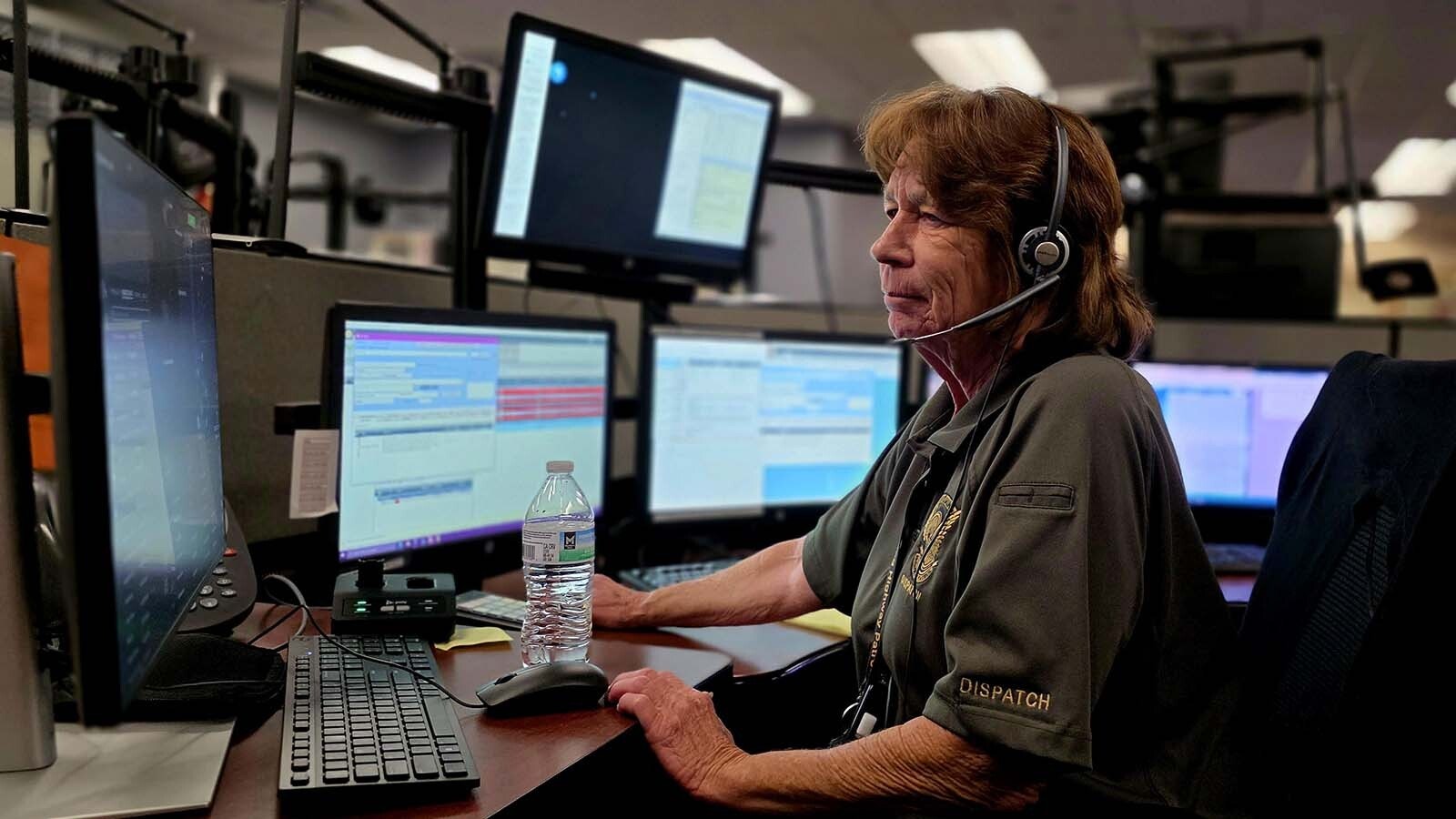
For those not familiar with dispatch work, McGuire was one of nine dispatchers on a shift who simultaneously work the radios, monitor multiple computer screens and answer phone calls from Wyoming Highway Patrol officers and anyone on the roadways requiring help of some kind.
This not only requires them to know the state’s highway and roadway system like the back of their hand but also requires them to dispatch troopers, get eyes on drunk drivers, run criminal background checks and respond to any number of emergencies while placating angry calls from motorists who have just been cut off or want to report a speeder.
Traffic complaints have become the most common call in recent years, McGuire said, requiring dispatchers to take down license plate numbers and file a report.
They handle domestic fights along the roadside, take reports on thefts at rest stops and bail out stranded motorists who run out of gas, which is also a common occurrence for travelers unfamiliar with the vast size of Wyoming and the long distances between gas stations in the rural pockets of the state.
Cows on the road are a serious — and frequent — concern that dispatchers handle.
They also keep an eye on troopers, and if they don’t answer or aren’t checking in, the dispatchers can look into their cameras to see if they need help.
Sometimes a dispatcher juggles two radios at once in between answering phone calls.

Steady Head
You have to have a steady head and be able to multi-task without losing your cool, McGuire said. You also have to be prepared to work 60-plus hour weeks due to a historically understaffed department.
McGuire can recall only one year out of her entire career when her office was fully staffed.
Per department policy, McGuire is not allowed to share the specifics of some of the crazier calls, only to say that there were several days where a dispatcher hung up, saying “What the hell was that?”
Then there’s the people who call cussing you out for no reason, McGuire added, and those they call the “frequent fliers” who regularly call in with their various complaints.
For McGuire, the most exciting days on the job were the snowstorms where it’s all hands-on deck with her knees bouncing.
During the last massive statewide snowstorm three years ago, McGuire and the other dispatchers were so busy calling in ambulances and tow trucks to clear multi-car pile ups that there wasn’t even time to breathe in between calls.
“I was there for 37 hours straight,” McGuire said. “The first one to go home had been there 32 hours.”
She’s also incredibly proud of her team’s work on the nationwide AMBER Alert of which she was the coordinator in Wyoming. WHP took over the alert from the Wyoming Division of Criminal Investigation in 2016 due to budget cuts.
McGuire put together a “code red” team who was charged with monitoring alerts 24/7 and making sure the criteria was met to issue one.
“I don't want to brag, but we built that alert to something to be very special and very dear to everybody in that center,” McGuire said. “And for all the alerts that we've issued, knock on wood, we've only had one go bad.”
It was an alert issued in Idaho in which the child was found deceased.
McGuire’s team was also in charge of the Ashanti Alert, which is much like the AMBER alert but for endangered adults, which Wyoming passed into law in 2023.
In fact, McGuire is continuing that work now through a part-time, contract position with the National Ashanti Network.
Dispatch Is A Calling
How does one end up in the high-stress life of a dispatcher? For McGuire, it wasn’t a deliberate decision. Rather, she hated her job and her husband got tired of hearing her complaining about it.
At the time, she was 29 years old and working at a hospital cleaning rooms and studying accounting in college.
She applied for the dispatch job and got it, though admittedly she almost quit early in the game after a hard call following her training.
“I had some pretty good supervisors who talked me through it,” she said.
Today, dispatchers spend roughly five to six months just in training, including having a communications training officer by their side for the first several weeks.
When McGuire started on the job, however, she had about 12 weeks of training and two with the trainer sitting by her side.
She also didn’t have all the bells and whistles available today thanks to technological improvements. In McGuire’s early days, dispatchers had seven radios with several different channels — some of which were talking at the same time.
This was before computers, so dispatchers jotted down reports on cards which were then sent down at a conveyer belt running through the center of the room that stopped at the desk of the dispatcher manning the radio in that particular section of the state.
Once the message got to the right person, the conveyer belt was turned off.
The system worked well for the most part, McGuire said, though they were pretty mortified years later when they upgraded their computer systems and found a number of cards stuck under the belt.
Kids in the Road
But in her early days first on the job, McGuire felt shaky at best.
Her worst moment, and one that sticks with her to this day, was a call from a hysterical woman, who called to report “kids everywhere, all over the road.”
As if the nature of the call was not disturbing enough, McGuire couldn’t get the pertinent information from the hysterical woman to dispatch troopers as fast as possible.
It took her supervisor stepping in to calm the woman down enough to jot down the particulars. It was an automobile accident with several young passengers.
“That was probably the hardest call I ever took,” she said. “It stuck with me pretty hard, and some people helped me calm her down and get the information.”
Her inability to do this on her own stung, McGuire said, and she felt like a failure.
Her supervisor talked her out of quitting, and as she learned that day, there would be plenty more such moments where she made mistakes and fell down on the job.
“There’s so many things that can happen in any situation,” she said. “You scrape your knees, and sometimes cry and think, ‘I’m done.”
But a good supervisor helps you through it, she said, a role she took on herself in later years.
Lost On The Road
Though technology has come a long way, McGuire said some things haven’t changed, and there are still times when a dispatcher can’t locate a person lost in rural Wyoming with no clue of where they might be.
Wyoming is a state with large pockets of no cell service, so a dispatcher has no way of locating that person by GPS or pinging their phone.
This requires them to know the state well enough to discern a location based on description alone.
Sometimes it takes careful extrapolation to pinpoint an out-of-state motorist who describes the area as having “mountains everywhere.”
McGuire was stunned to realize how many people have no inkling of mile marker signs.
“People traveling here are always surprised at how enormous this state is and how remote,” she said.
And though McGuire did eventually earn that accounting degree while working full-time as a dispatcher, she decided that accounting by comparison was far too boring.
“I guess you could say I’m an adrenaline junkie,” she said.
Humbled by Support
Though McGuire and other dispatchers work quietly behind the scenes outside of the purview of the public, many people took to the Wyoming Highway Patrol’s Facebook post announcing her retirement to voice their gratitude for her commitment and years of service.
She said she was “amazed” by the number of people — more than 270 — who took the time to comment.
“She’s one of the most amazing ladies I’ve ever known,” wrote Florencia Petrolite Gullick.
“Well deserved! Thank you for keeping every trooper safe and for all those in need,” added Alice Kay Cary.
“A wonderful human and wonderful dispatcher,” Jennie Strannigan said.
Others congratulated her on her storied career and wished her well in retirement.
On The Sidelines
Already, she’s enjoying her new life and finding it much easier to step away as she makes up for all the years lost working hard to support her family. This meant missed ball games, dinners and many other milestones that passed her by.
Her family is very grateful for her decision to step down, McGuire said.
At her retirement party, her daughter heard one of the lieutenant colonels musing that McGuire might be willing to come back to work part-time while McGuire was out of earshot of the conversation.
Her daughter shut that idea down, telling him, “No she won’t. It’s our turn.”
McGuire agreed. The 60-plus hour weeks she chose to work cut into her family time over the past three decades. Rarely, if ever, could she attend their sports games — let alone cook a Thanksgiving dinner. The bulk of the work rested on her daughter, while McGuire would get home from work just in time to eat.
This year was the first year in at least 20 years that McGuire cooked the entire Thanksgiving meal herself.
Now, she wants to make up for lost time by being the cheering grandma in the stands at her grandchildren’s sports game, starting with an overnight trip to Denver later this month for her grandson’s hockey team.
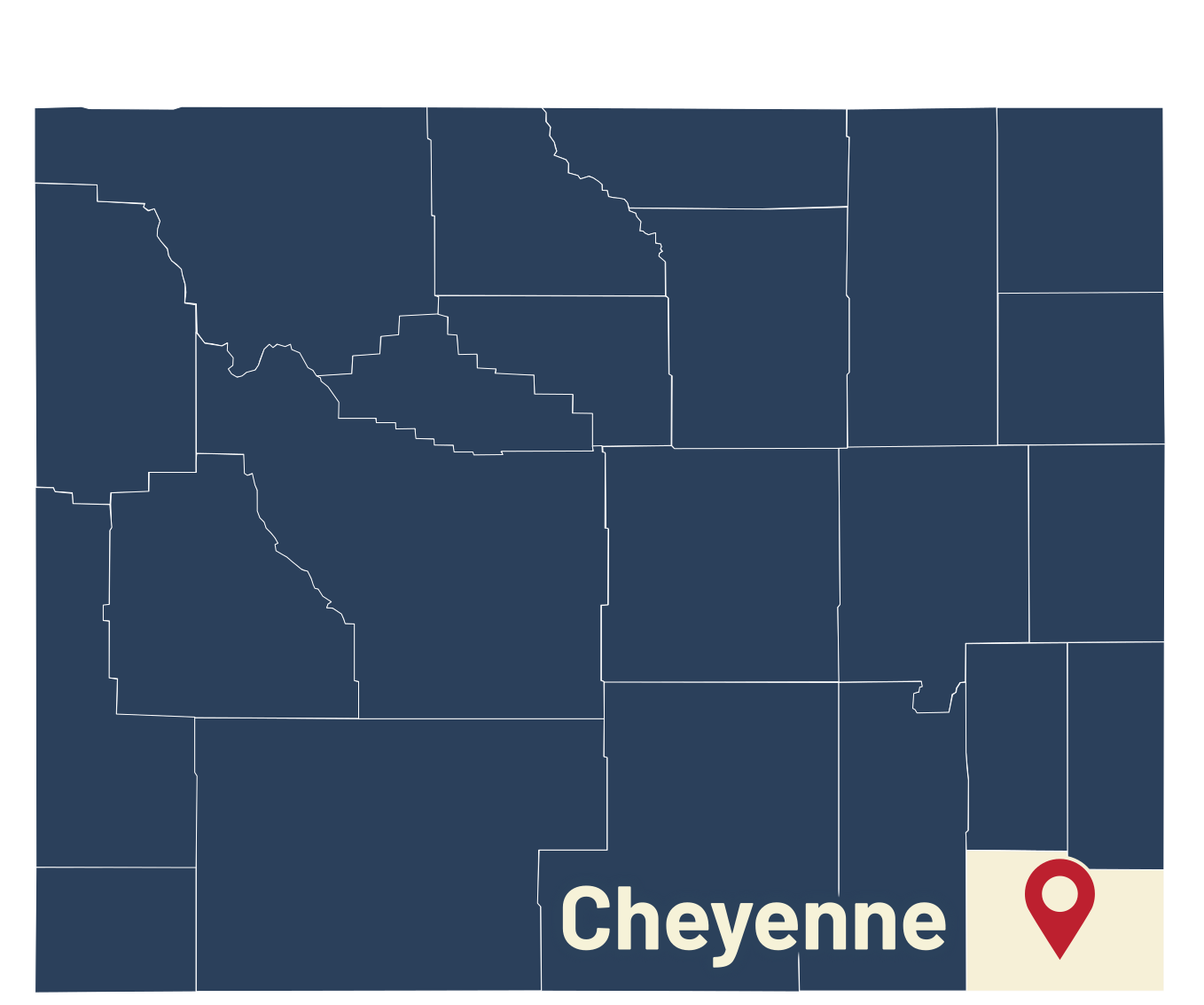
In the past, there’s no way McGuire could have pulled that off but now she’s all about spending time with her three children, two of whom live in Cheyenne with the other just an hour away in Fort Collins, and her numerous grandchildren.
“I’m just enjoying my family,” McGuire said, including going to leisurely dinners and lunches and not constantly staring at the clock.
She also plans to travel. In her former life, she didn’t do much of that. Typically, she would fly somewhere for work and occasionally spend a week visiting her sister in Arizona.
This fall she took a trip to Nashville and plans to go back again next year.
And though she may have officially stepped down, McGuire is not going anywhere and said she’ll do whatever she can to help those still on the job.
“They know I’m here for them,” she said.
Jen Kocher can be reached at jen@cowboystatedaily.com.