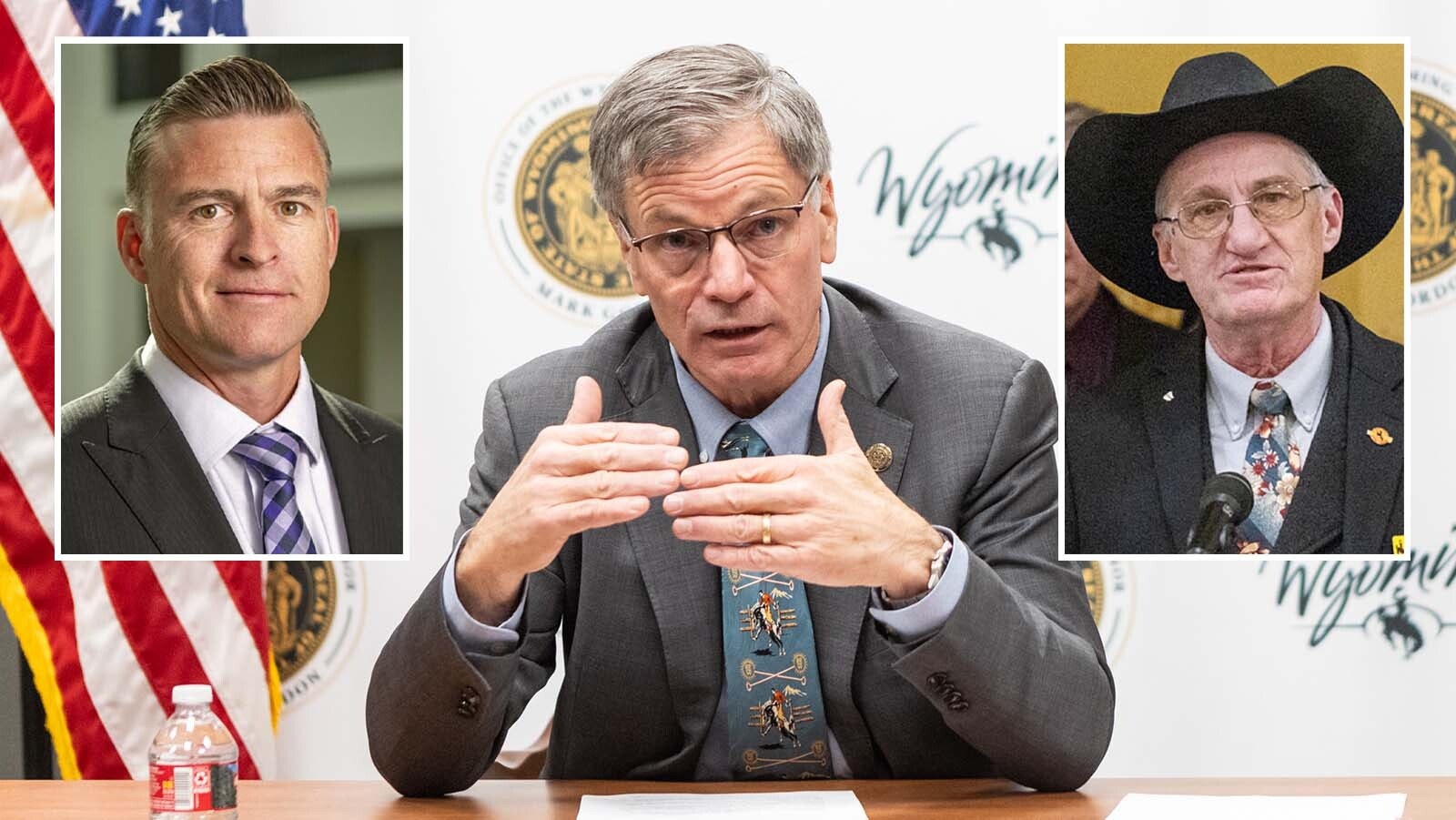
Wyoming’s top purse-holders Thursday grilled the leader of a state agency that exists to back business efforts in Wyoming over his $111.77 million budget request for the upcoming two-year funding cycle.
Multiple members of the legislative Joint Appropriations Committee cast the Wyoming Business Council as an agency that “picks winners and losers,” grows government, or skews the free market.
Wyoming Business Council (WBC) CEO Josh Dorrell countered, saying other states are investing in infrastructure and benefits to attract businesses, and Wyoming has no choice but to fund its own state-backed business incentives to defend its economy.
Dorrell’s presentation Thursday at the state Capitol was partly an explanation of his budget.
Lawmakers also lobbed numerous questions over whether backing businesses, or infrastructure projects to entice them, is the proper role of government.
“Back when Henry Ford began building cars, the government didn’t go out and build gas stations,” Rep. Ken Pendergraft, R-Sheridan, mused during the meeting.
Gordon’s Recommendation
Uniquely, the WBC is the only state agency for which Gov. Mark Gordon recommended budgeting at only roughly half of what it requested at a little less than $55 million.
Under questioning by House Appropriations Chair John Bear, R-Gillette, Dorrell said he couldn’t say why the governor proposed such a noticeable gouge, because he doesn’t find it wise to speak for the governor.
Gordon’s office in a Friday statement said he reiterates his support “for Wyoming’s continued economic growth and the tools needed to be competitive.”
The statement noted that entities besides WBC, such as the Wyoming Energy Authority, University of Wyoming School of Energy Resources, and Wyoming Community Development Association also partner with private entities to foster growth.
Still, Gordon’s office added, he’s had to make “hard decisions” with each round of budget recommendations. And he must keep his recommendations within a balanced budget.
The Legislature, however, can add to the budget, the statement says.
The Time Hawk
Senate Appropriations Chair Sen. Tim Salazar, R-Riverton, attempted to be a time-hawk, goading the conversation with reminders to focus on the budget.
But Salazar also struggled with the question of the role of government.
He referenced WBC’s slides presentation reporting job stagnation, shrinking wages, and the worst outmigration in the nation.
“Help me understand what the Wyoming Business Council has done over the years?” asked Salazar. “(Your presentation) doesn’t paint a rosy picture given the investment the state has given you over the years — and I’ve been one of them — what has gone wrong then?”
Dorrell said the agency “took a hard look” at its program effectiveness in 2020 and decided to improve those.
But to fix the economic problems the state faces today, “It’s going to require more investment. It’s going to require policy changes we’ve not been able to make,” he said.
Dorrell urged the legislators to collaborate toward greater solutions, and greater investment.
“So you’re suggesting to me today, that the solution to this is more money?” asked Salazar.
“Yes,” Dorrell answered, "and policy changes.”
Wyoming’s small communities often can’t raise their own money to improve things like streets and sidewalks and water lines, Dorrell said.
Infrastructure needs are growing, he added, citing a WBC analysis finding that between $500 million and $1.7 billion “is sort of the infrastructure shortfall that our communities are feeling.”
Salazar parried, “Thank you for giving us the courtesy of the truth.”
He asked whether Dorrell believes WBC’s budget would have to top $1 billion to achieve success.
“Yes,” Dorrell answered, though his budget pitch for this biennium was around one-10th that figure, and the governor’s recommendation less by half.
It’s Been ‘Monkeyed With’
In a back-and-forth with Pendergraft, Dorrell said Wyoming bears a burden, not always “palatable,” to compete with other states’ publicly-funded efforts to attract businesses.
“The market we have today has been monkeyed with, whether that’s a great thing or not,” said Dorrell. “There will need to be government interventions if we wish Wyoming to compete in the U.S. economy.”
Dorrell said it’s a “prevalent myth” that Wyomingites don’t want the state to grow.
He referenced a WBC-funded, statewide survey by poll firm The Tarrance Group in which around two-thirds of 500 participants said they favor their local communities growing their populations to support economic development.
Seventy-nine percent of those polled said they support their local communities “taking strong action” to grow their economy and jobs market.
Sixty-three percent of participants, conversely, said they would not support slightly higher taxes to bring economic development to their communities.
Pendergraft said he felt there were problems with the WBC’s poll’s phrasing.
“I reject those results, personally, out of hand,” said Pendergraft.
The representative said he disliked WBC giving money to a business in his community, but not to its four or five competitors.
Dorrell said he’d be happy to hear the names of those other companies to see if WBC could help them through the grant application process.
Pendergraft told Cowboy State Daily prior that he’d like to eliminate the WBC.
Dorrell told the committee that he also envisions a future Wyoming that won’t need the state’s help to grow — but he disagrees with Pendergraft on when that should be.
The Numbers
Of the WBC’s $111.77 million request for the 2027-28 biennium, Gordon is recommending the Legislature fund just more than $54.6 million.
He recommends denial of a $345,447 request for pay increases for WBC personnel. That’s a workforce comprising 37 full-time employees and two interns, Dorrell testified Thursday.
WBC was budgeted $11.79 million for personnel (including benefits and retirement) in the most recent biennium. It asked for $11.6 million this biennium.
Gordon recommends $11.27 million for the biennium.
Across 37 employees, that would equate to about $152,349 per year average, including salary, benefits and retiree insurance.
Dorrell did not immediately return a request for clarification on whether the two interns are paid.
Business Ready
The Business Ready Communities section of WBC gives money to towns, counties and joint powers boards for publicly-owned infrastructure to support economic growth in Wyoming, according to WBC’s budget request narrative.
It was born in 2002 and has led to the creation or projection of more than 6,493 jobs, the narrative says.
The narrative says that for every dollar of BRC funds invested, the program has leveraged nearly three times that in private capital investment, totaling $1.48 billion. Communities have met that with $315 million toward their own projects.
About a quarter of the revenue generated from these projects returns to the state program, while three-quarters stay with local communities, the narrative says.
Gordon recommended diverting $4 million from that program's request, fed by the Federal Mineral Royalty Funds account, and putting it directly under state elected official oversight instead.
Gordon's spokeswoman Amy Edmonds told Cowboy State Daily in a Friday text message the $4 million diversion is to "ensure a more consistent approach to community grants."
The $4 million would go to the Office of State Lands and Investments, a board comprising the state’s five elected executive-branch officials, to boost projects under three categories:
• Alleviating emergencies that threaten health, safety or welfare.
• Complying with a state or federal mandate.
• Providing an essential public service.
He didn’t push to cut the Business Ready Community project altogether, however, writing that he recommends a standard budget for $16.3 million.
Fibers …
Bear asked Dorrell about the agency’s $50 million pitch for a broadband “redundancy” plan to bolster fiber networks in the state. That’s to support large-scale data centers and recognize capture a portion of the artificial intelligence market, the agency’s narrative says.
The federal government has offered around $400 million toward expanding broadband in Wyoming, State Budget Department Director Kevin Hibbard told the committee.
Much of that, “we’re still trying to get our arms around” in terms of complying with federal rules to use it, Hibbard said.
But those federally-funded projects are more for consumers, whereas the $50 million state-backed project would be for businesses, Dorrell added.
Gordon recommended against funding the $50 million request.
Bear asked Dorrell why the state should invest in terrestrial fibers when satellite internet is gaining.
Dorrell said terrestrial fibers continue to improve as well.
Clair McFarland can be reached at clair@cowboystatedaily.com.