A successful experiment completed just across Wyoming’s western border by the Idaho National Laboratory is paving the way for cleaner, safer and more efficient nuclear power generation to meet a growing demand for electricity.
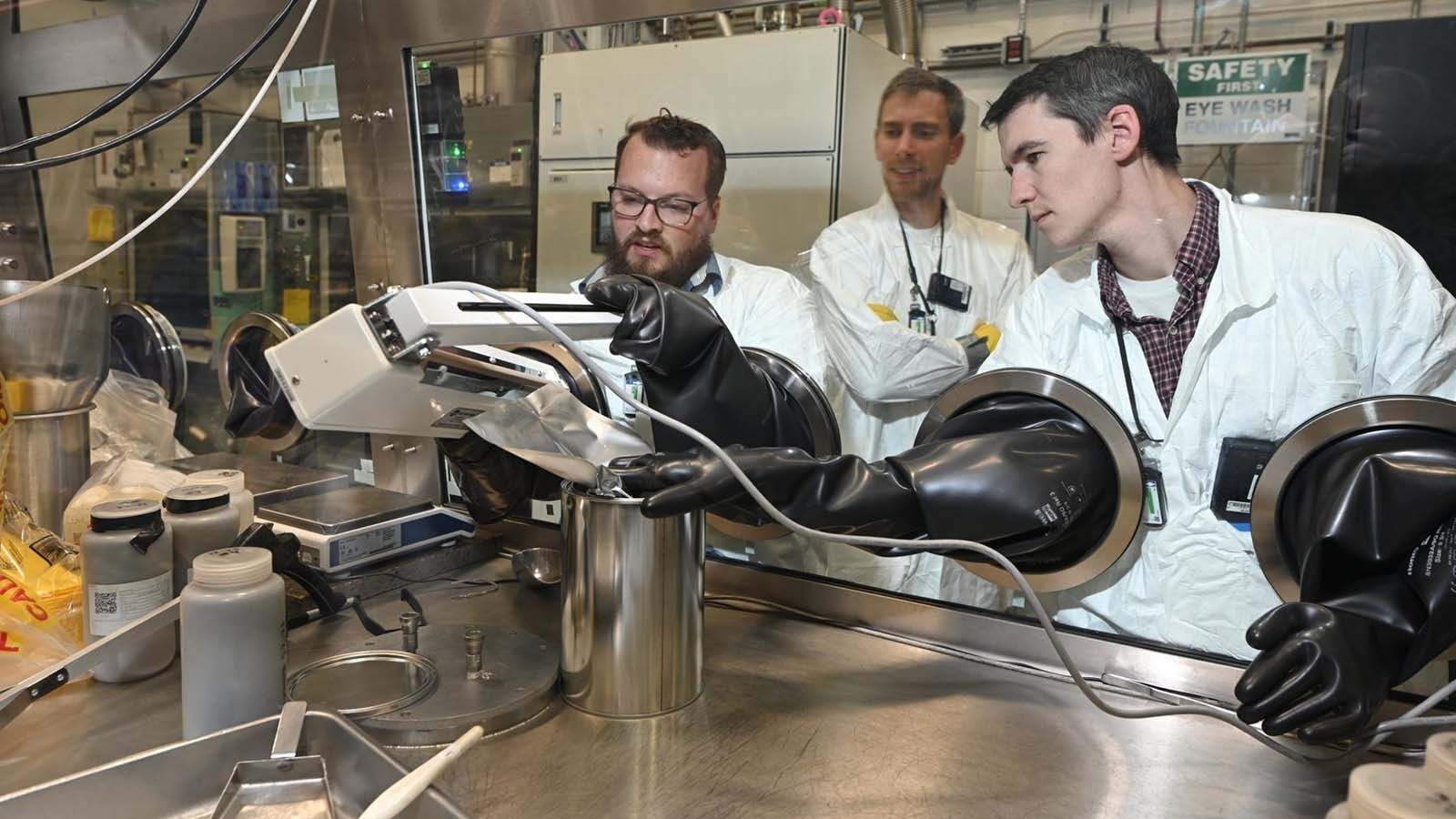
The U.S. Department of Energy Office of Nuclear Energy announced this week that researchers at INL have successfully created the first batch of fuel salt.
Fuel salt is a molten salt mixture used as both a carrier for nuclear fuel and coolant in a molten salt reactor, a type of advanced nuclear reactor.
The fuel salt is critical for conducting the world’s first fast-spectrum, salt-fueled reactor test, known as the Molten Chloride Reactor Experiment (MCRE).
The test will help inform the future commercial deployment of a new class of advanced nuclear reactors, something a number of Wyoming-connected companies are proposing to build.
“There is a lot of push for this,” said James King, project lead for the Molten Chloride Experiment at INL. “We need to have a lot of different options so we can move away from less safe power generations methods.
“This is one of those technologies that can move us to better safety.”
The liquid form of the salt fuel means the fuel can’t melt. The technology would also offer another low-carbon alternative to generating power.

Different From TerraPower’s Project
TerraPower, the nuclear innovation company founded by Bill Gates in 2006 that last year broke ground on a pilot Natrium nuclear power plant near Kemmerer, has been researching and developing its molten chloride fast reactor (MCFR) technology for the past nine years.
Its MCFR is a separate approach to nuclear power generation and not connected to Kemmerer’s Natrium plant, said Scott Burnell, Nuclear Regulatory Commissions’ Public Affairs Officer for TerraPower’s Natrium plant.
“This is part of an ongoing research effort at Idaho National Laboratory that would involve work continuing into the next decade,” Burnell said. “It does not have any immediate applicability to the industry as a whole.”
TerraPower confirmed in a statement Thursday that INL’s announcement “is not connected to the Natrium project, the sodium testing facility in Kemmerer, or any work happening in Wyoming.
“While TerraPower is building a sodium testing facility to support the Natrium reactor’s development, the fuel salt used in MCRE is not related to that work,” the statement reads.
Still, the breakthrough is good news for Wyoming.
Down the road, perhaps in the 2030s, new power plants employing advanced nuclear technologies such as MCFR could be established in places where power is already being made.
“You could envision a similar sort of deployment strategy as other reactors, where you replace coal generation with a molten reactor,” King told Cowboy State Daily. “Fast-spectrum molten chloride reactors will bring a lot of safety and long-term power generation.”
Fast Track
Travis Deti, executive director for the Wyoming Mining Association, praised INL’s and the DOE’s advancement.
“INL is doing a lot of good work to further America’s nuclear capabilities with these types of advances,” he told Cowboy State Daily in a text message. “This bodes well for Wyoming’s uranium recovery industry as we prepare to fill the fuel needs of the next generation of nuclear reactors to meet the massive projected demand for electricity.”
According to the U.S. Department of Energy, TerraPower’s MCFR technology could be used in the 2030s for land and maritime applications.
As research continues on advanced nuclear energy, water usage is a key consideration.
In dry places like Wyoming, finding ways to limit power generation’s dependence on water is critical. Both TerraPower’s Natrium reactor and its MCFR technology are designed to use significantly less water than traditional light water reactors.
The Natrium plant will use liquid sodium rather than water to cool the reactor.
By using liquid salt as both fuel and coolant, the Molten Chloride Reactor will operate at higher temperatures than conventional reactors to efficiently produce heat or electricity.
With the first batch of fuel salt successfully created at INL, researchers will now conduct testing to better understand the physics of the process, with a goal of moving the process to a commercial scale over the next decade.
“What I think we can all agree on is there is a need for energy,” King said. “Energy equals wealth. Energy equals prosperity.
“Of course, every developer thinks they have the magic bullet to solve all the energy problems. This [fuel salt breakthrough] does have a lot of potential benefit.”
Kate Meadows can be reached at kate@cowboystatedaily.com.