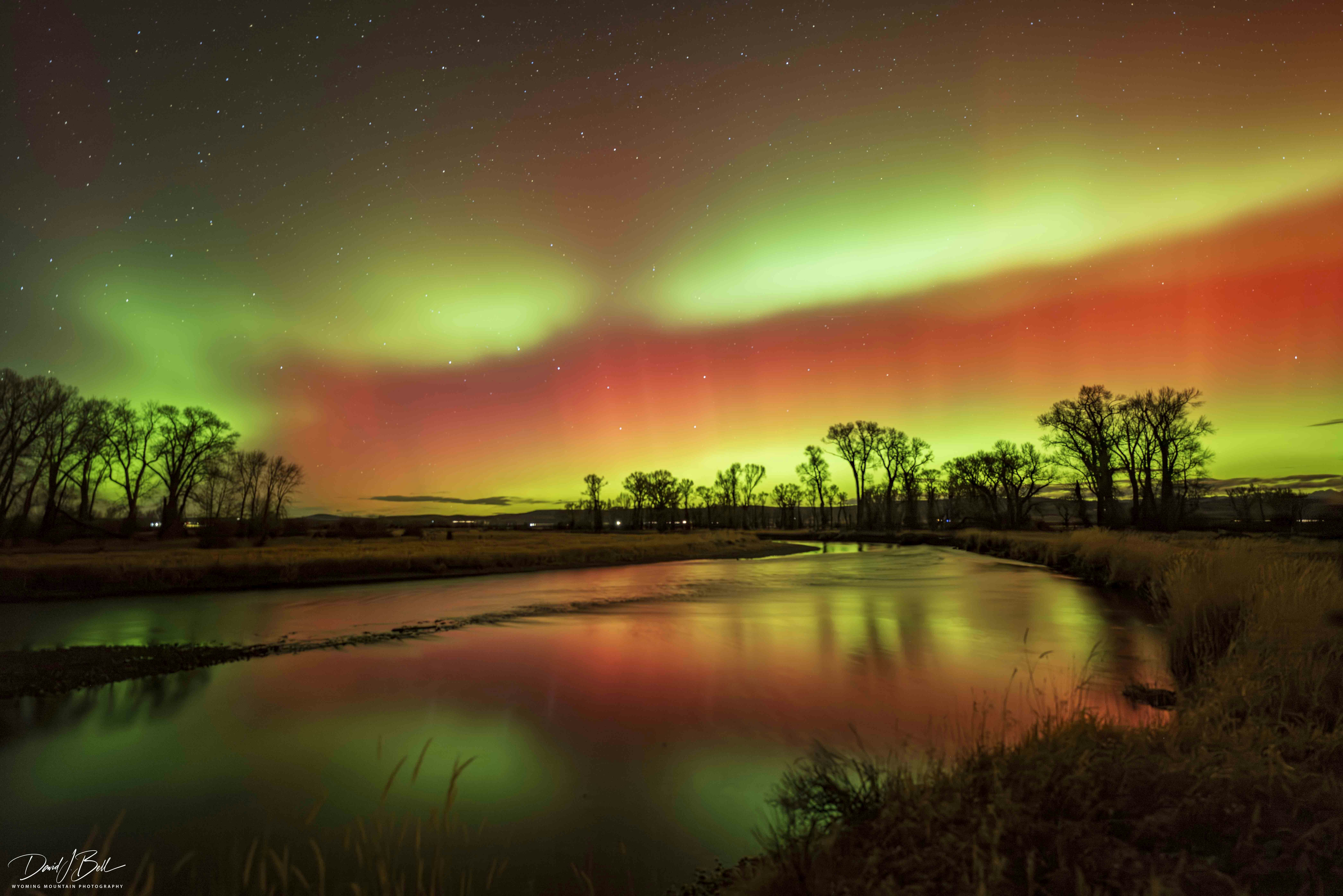
Wyomingites are still in awe of the spectacular auroras that streaked across Wyoming's skies last week. The most intense geomagnetic storm of 2025 stretched from the North Pole as far south as Mexico.
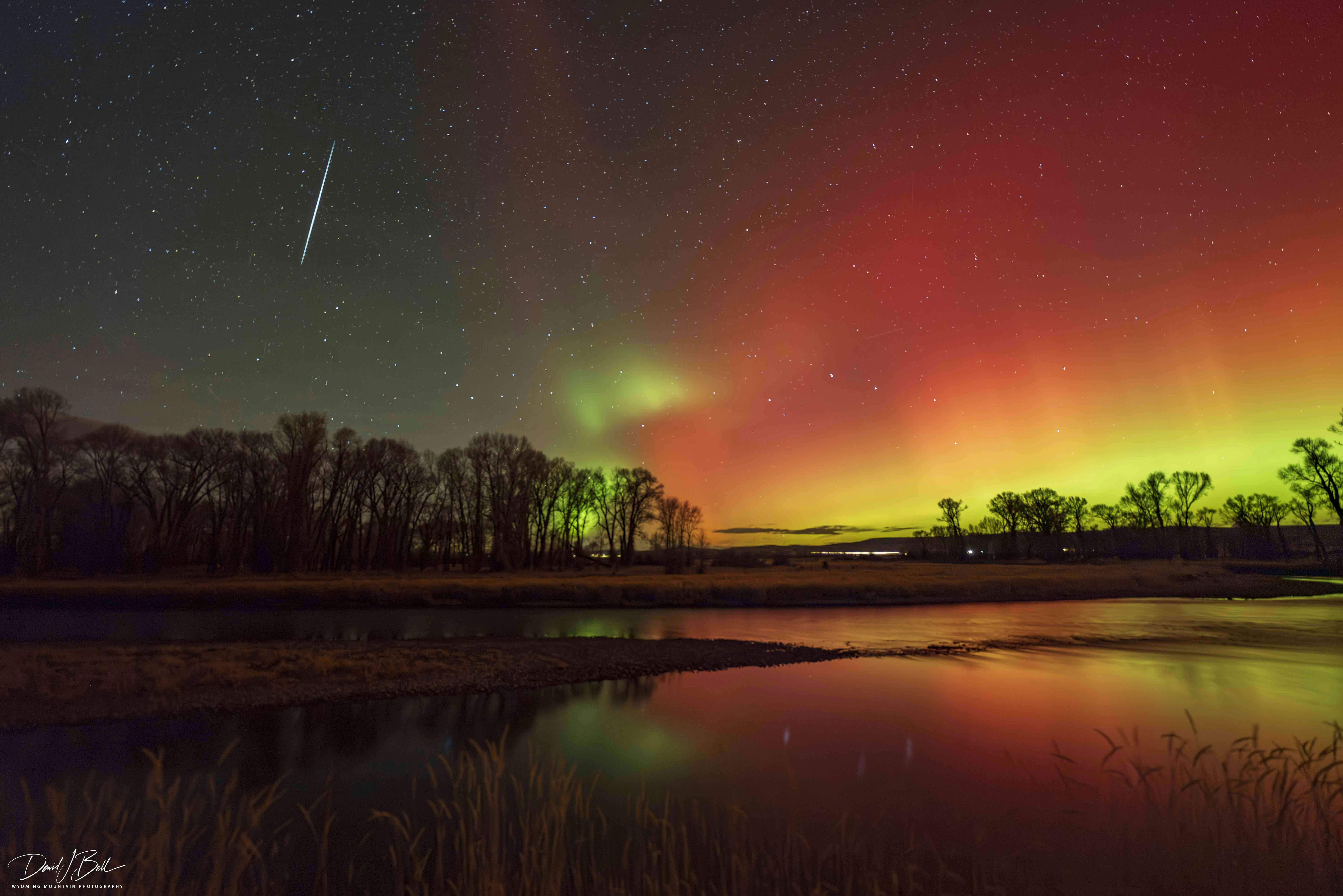
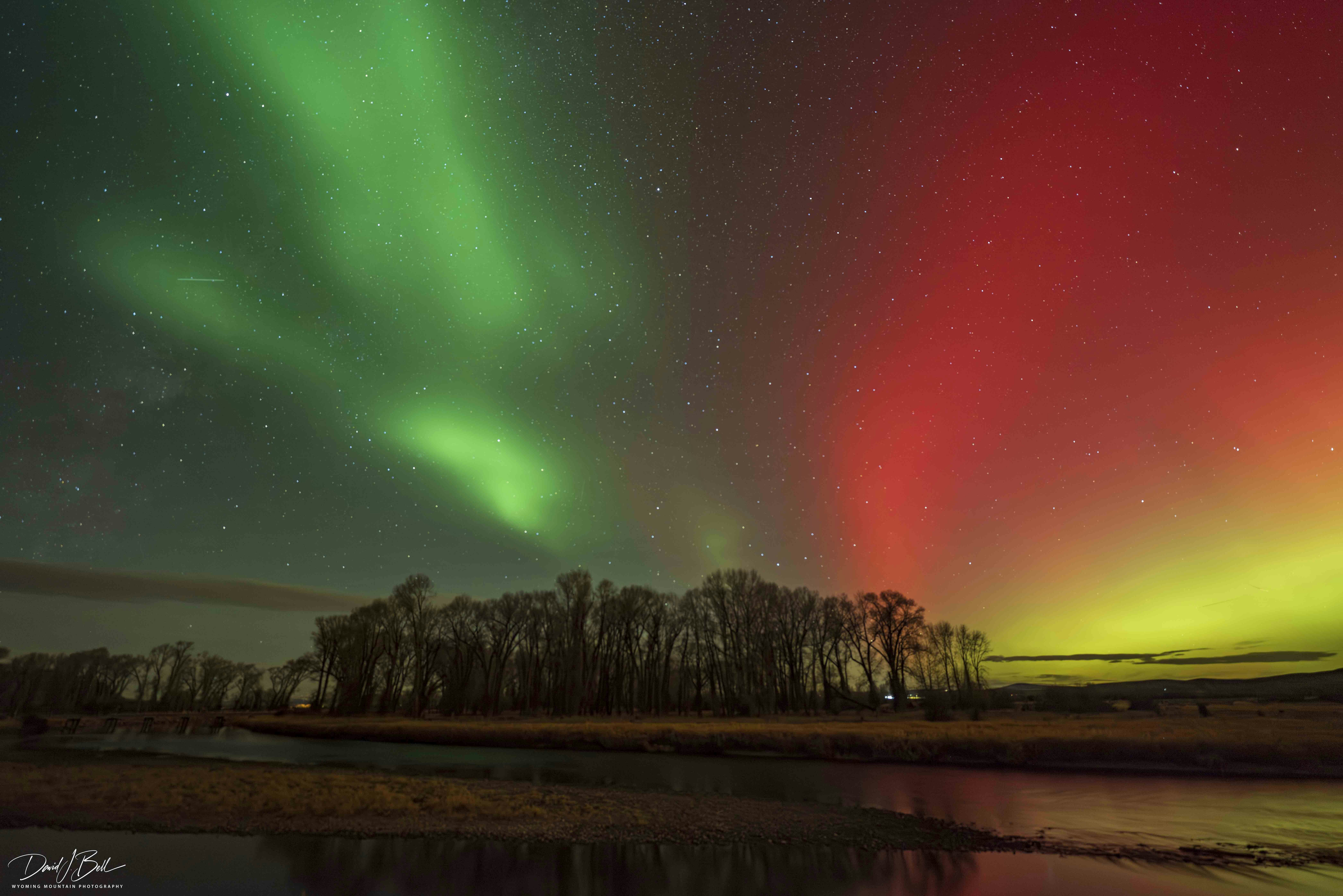
Photographers were captivated by the spectrum of colors seen over Wyoming on Nov. 11. As the night progressed, the skies were filled with columns of red, streaks of purple, and a horizon of green.
"There was a lot of red, which is very unique," photographer Laura Redmond told Cowboy State Daily. "You usually don't get a ton of red. It was pretty phenomenal."
There's science behind this spectrum.
The dazzling displays of auroras are determined not only by the intensity of the coronal mass ejections (CMEs) that create them, but also by where and how these solar flares interact with the content of Earth's atmosphere.
The Right Height
Auroras occur in the ionosphere, the layer of Earth's atmosphere that spans from 30 to 600 miles above the surface. The colors of auroras are determined by the interaction of a CME's electrons with the atoms and molecules in the ionosphere.
"There are different elements and molecules in the upper atmosphere," said Jan Curtis, retired meteorologist and former Wyoming State climatologist. "The lower elevations have molecules, and the upper elevations have atoms, and depending on whether they're a molecule or an atom, they will ionize at different colors."
The lowest-hanging auroras occur less than 60 miles above the Earth's surface. When they ionize the nitrogen at that height, energizing and exciting the atoms, the energy exuded creates a pink aurora, according to NASA.
Between 75 and 110 miles above the surface, there's a mix of oxygen and nitrogen. That's where, rarely, a CME generates an aurora that appears as a majestic blue.
Yellow-green auroras are the most common, also occurring between 75 and 110 miles above the surface. That comes from the rapid deexcitation of electrons in oxygen atoms.
According to Curtis, yellow-green auroras are most common because that's where most of a CME's particles collide with Earth's atmosphere. It's also a color the human eye can see more easily.
"Atomic oxygen is rare below this zone, so the green aurora fades," Curtis said. "When you see green, it's the oxygen."
Red is one of the rarest aurora colors, only occurring when a CME reacts to less concentrated oxygen atoms over 150 miles above the surface. When there's a lot of red in an aurora, it's a sign of how intense that particular CME has become.

In The Heights
When viewing an aurora, the color not only indicates the location and intensity of the CME interacting with the atmosphere. It can also reveal your location relative to the aurora.
Curtis said that the visibility of an aurora is determined by a phenomenon called the Auroral Oval. It's a circular region of solar energy that usually centers over the magnetic North Pole, but the center can shift depending on the intensity of the CME.
"The Auroral Oval determines the maximum likelihood and frequency of the Northern and Southern Lights," he said. "That's usually over Alaska, Greenland, and the Scandinavian countries, but last week, it moved further south into Canada."
That means last week's spectacular auroras weren't just the "very tops" of the aurora. The movement of the Auroral Oval meant that Wyomingites could see the entire spectrum of colors as the solar particles interacted with the atmosphere.
"At the mid-latitudes, we're usually seeing the very tops of the aurora," Curtis said. "When you're at the polar latitudes, you're seeing the bottom of the aurora. When you're right underneath (the Auroral Oval), you're seeing the entire aurora."
That explains why the Nov. 11 aurora was so incredible to behold. The Auroral Oval shifted just enough, and the CMEs were so intense that the entire color spectrum appeared over Wyoming.
There were actually two CMEs that reached Earth that evening, which added to the intensity of the auroras. Curtis said that when CMEs collide, they amplify their interactions in the atmosphere.
"It's not just one CME after another," he said. "The intensity of each CME actually doubles or triples because of the way they overlap and interact with each other."
The two CMEs created a Severe G4 geomagnetic storm between Nov. 11 and 12. It was the most intense geomagnetic storm of 2025, rivaling one of similar intensity in May 2024.
Case By Case
Many Wyoming photographers said the Nov. 11 aurora was one of the best they've ever seen in the Cowboy State. That's saying something, considering the frequency and intensity of auroras over the last few years.
"We've gotten some good shows in Wyoming, but that night was unique," Redmond said. "It's the best I've ever seen in Wyoming."
The sun is currently cycling out of its solar maximum, a period when there's an abundance of sunspots generating CMEs and increasing the chances of dazzling auroras over Earth. When the sun starts shifting into its solar minimum, the number of sunspots decreases, and the chances of seeing auroras over Wyoming will decrease significantly.
"The sun goes through an 11-to-22-year cycle when it goes from very active to very quiet," Curtis said. "I would say that we have a six-to-nine-month window before these types of events have a very low probability of occurring until the next maximum cycle."
The National Oceanic and Atmospheric Administration's Space Weather Prediction Center isn't anticipating any significant CMEs in the next few days. We typically only get around 72 hours' advanced notice when a sunspot generates a CME that will reach Earth.
The sun's active side is currently facing away from Earth, and it rotates every 28 days. When it turns towards Earth again, the same sunspots that generated the Nov. 11 CMEs could send more energy in our direction.
Curtis encouraged aurora enthusiasts not to let their guard down. Each aurora is different, but if the sun's still active, there's a chance all the right conditions will come together and cover Wyoming's skies with an entire rainbow of solar energy.
"If there's a lot of activity on the far side of the sun over the next two weeks, there is a very good likelihood for continuation of the Northern Lights," he said. "If we get another very active solar storm, we'll see another rainbow of colors."
Andrew Rossi can be reached at arossi@cowboystatedaily.com.