

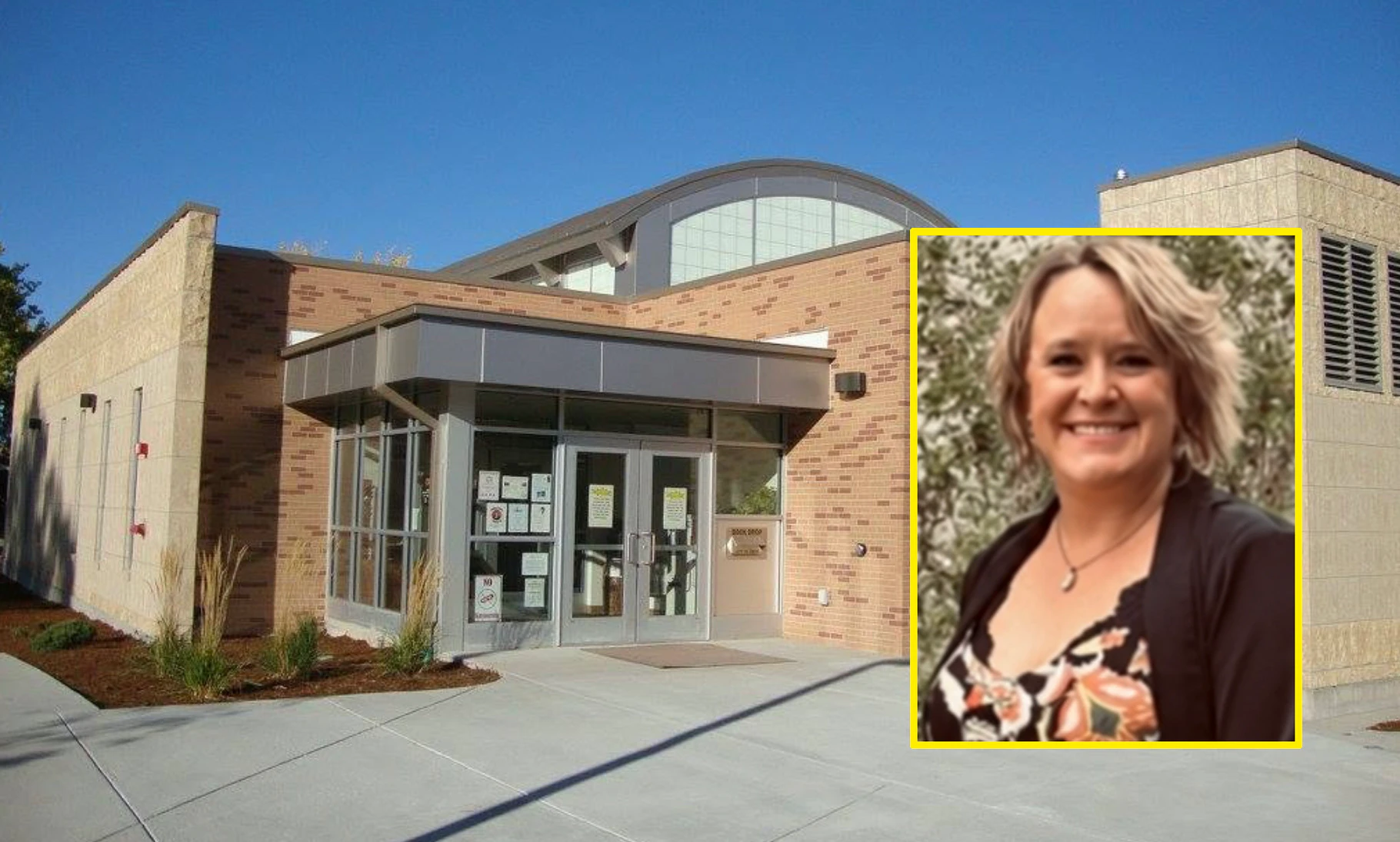
Saying she was fired because her daughter made a Facebook post out of concern for her severe working conditions, a former Glenrock librarian is suing the Converse County Library and its director.
Erin Wolfley’s lawsuit complaint, filed this week in the U.S. District Court for Wyoming, says Converse County Library Director Mary Lin Maner, as well as the library board and leadership, violated the First Amendment.
Wolfley said in a Friday interview that her complaint tries to highlight an irony, that libraries should be “bastions of the First Amendment.”
The complaint opens with the words, “This case arises from the cognitive dissonance of a library district, of all entities, firing a librarian in retaliation for her teen-age daughter’s protected use of First Amendment rights."
Wolfley is represented by attorneys Ian Ross of Wyoming, and Iris Halpern and Stephanie Wise of Colorado.
Halpern also represents the fired librarian Terri Lesley of Campbell County, who’s made headlines for years over whether highly controversial books can be removed from the children’s section in Gillette.
Wolfley’s case isn’t about controversial books. It’s about air conditioning.
Her lawsuit alleges that after she'd worked for days in library building temperatures around or above 90 degrees, her daughter authored a Facebook post questioning whether the employees should be allowed to go home; when they were instead told to use cold towels and stay hydrated.
After her daughter's post, Wolfley was fired.
To her, the lawsuit is also about the library’s identity.
“People shouldn’t be worried about saying things about anyone, but especially libraries, and shouldn’t have to worry there’s going to be some terrible fallout,” she said.
First, Air Conditioning
The complaint says the Glenrock branch had well-documented heating and air conditioning failures dating to its opening in 2015.
Wolfley was hired as circulation clerk in March 2019. Her attorneys say she “demonstrated unwavering dedication to saving her community from that role.”
The complaint says she developed community-serving programs and helped vitalize the library, spearheaded a food pantry program and a formal-wear closet providing free formal attire to teens, gave the Department of Family Services workers a family room for supervised visits, made a book donation and sale area, and built a “library of things,” among other services.
Meanwhile, The Heat
The Glenrock library closed or switched to alternate buildings due to heating and cooling malfunctions in August 2019, January-February 2021, and January 2024, the document says.
It says Converse County had spent more than $130,000 on repairs by 2021, and a complete $1.5 million replacement was slated for spring 2026.
In June 2025 the cooling system failed as a heat wave descended. Staffers worked in 85- to 90-degree heat and more-than 80-degree temperatures upstairs with no air conditioning for more than a month, the complaint alleges.
By June 9, 2025, staffers kept the lights off to help with the heat, the attorneys added.
“Everyone who walked into the Glenrock Library noticed the heat, and many complained to staff about it,” the document says.
By June 11, the Glenrock branch manager Jennifer Kofoed sought guidance from Maner about when to close the library for safety.
Maner said the conditions were “not dangerous” and told staff to stay hydrated and use cold towels, the complaint alleges.
Daughter Speaks
Wolfley asked her daughter Aspen, who was one week shy of her 18th birthday, to bring ice to the Glenrock library for her.
Wolfley sent Aspen a photo of the thermometer, showing 90.5 degrees inside the building.
Aspen later posted on the “Glenrock Rant and Rave” private Facebook page – which is not run by the library – the following message:
“I am not sure where to go with this but I want to express my concerns about the public library, I was in the library today the HVAC system is broke in the budling so it is ridiculously hot, and the librarians are currently working in a 90 degree building.”
Aspen added that “the ‘director’ sent the boss and librarians in the building a LIST of common-sense strategies to ‘staying chilled’ and told them that ‘it’s not dangerous, drink water!’ and ‘wrap cold towels around your neck.’”
Aspen wrote that the library ordered fans but they wouldn’t arrive for days.
“I believe that when it gets to the point of being told they need to wrap cold towels around their neck they should be able to go home and chill down correct?”
Wolfley’s lawyers say the post was factually accurate, sparked community discussion, and that Aspen was a “library patron exercising her own First Amendment rights.”
The girl didn’t mention any staffers by name in the post, the complaint adds.
Wolfley had no idea her daughter was going to post about the work conditions, says the document.
On June 13, Wolfley asked her daughter to remove the post, and Aspen did that afternoon, reportedly.
Why Take It Down?
Wolfley told Cowboy State Daily she asked her daughter to take down the post for two reasons:
The teen was interested in a janitor position at the library, and the mother considered Facebook a less-than ideal way to make a difference.
“I’d also talked to her about how, ‘I like that you’re passionate about your community, and you want to make things better, but maybe Facebook is not the way to go,’” Wolfley recalled.
After business hours that day, Kofoed texted Wolfley saying she should adjust her schedule for a mandatory meeting with Maner that next Monday.
Wolfley said she had a medical appointment scheduled for her daughter and couldn’t make it. She offered to coordinate alternate times.
Instead, and without notice, says the complaint, Maner and two library board members – Chair Michelle Moe and Secretary/Treasurer Connie Glenn – arrived at the library.
The meeting took Wolfley off-guard, and Maner accused Wolfley of violating the library’s confidentiality and representation policies, allegedly.
As rendered in the complaint, the confidentiality policy bars staffers from disclosing the library’s “confidential information” to others. The representation policy bars employees from acting as library spokespeople without permission and releasing “privileged” information about the library.
Wolfley’s lawyers say these policies don’t bar employees from telling their family how hot it is in the library.
Wolfley reportedly asked Maner if she’d be losing her job.
Maner said she didn’t know and she’d get back to her, the complaint says.
The document says Maner “separately interrogated Ms. Kofoed, asking whether she believed Ms. Wolfley had violated any policies and criticizing Ms. Kofoed for not investigating and reporting the post to her.”
Wolfley emailed the library board and county’s human resources director for guidance, and emphasized that she hadn’t made any public statements.
Neither responded, the complaint says.
Fired
Maner emailed Wolfley the next day, Wednesday, about a follow-up meeting.
Wolfley asked if Kofoed could come to the meeting as well.
At the start of the meeting, Maner “immediately” fired them both. The complaint alleges that “the sole stated reason” for their firing was the teen’s post.
Then Maner built a new media protocol telling employees to notify the library director or assistant director “if you see a post on social media public pages,” and not to comment on social media.
The library can’t lawfully adopt such a policy because it would chill First Amendment protected speech, the complaint says.
The Toll
The complaint says the library system and director have caused Wolfley distress, deprived her of money, cut short her career and impacted her future earning.
Plus, Wolfley cared about the mission of the public library, the complaint says.
Wolfley echoed that in her interview.
Seeking to get back to the library in any capacity, Wolfley applied for the part-time janitor job, says the document.
She hasn’t been able to recover “analogous employment” in the career field she loved, it says, adding that she’s “cobbled together enough part-time work to earn similar pay” in exchange for longer hours.
The firing also chilled mother and daughter’s willingness to speak freely and burdened their relationship, the complaint says.
The Ask
The complaint asks for declaratory relief, which means Wolfley wants the court to pronounce the library and director’s actions wrongful under the law.
It also asks for economic recompense, damages for suffering, punitive damages, interest, a tax offset, attorneys fees and costs, and other appropriate relief.
Wolfley said the asks aren’t the reason for the suit, though.
“It’s definitely not about the money,” she said. “I want to protect what the library stood for in our community.”
She spoke of libraries as a place where anyone could better themselves, people could learn things and question, and people could linger without the expectation of spending money.
“It doesn’t (exemplify that) right now,” she said. “And that’s a shame.”
Moe declined Friday to comment.
Maner did not respond by publication to a voicemail message.
Clair McFarland can be reached at clair@cowboystatedaily.com.


