
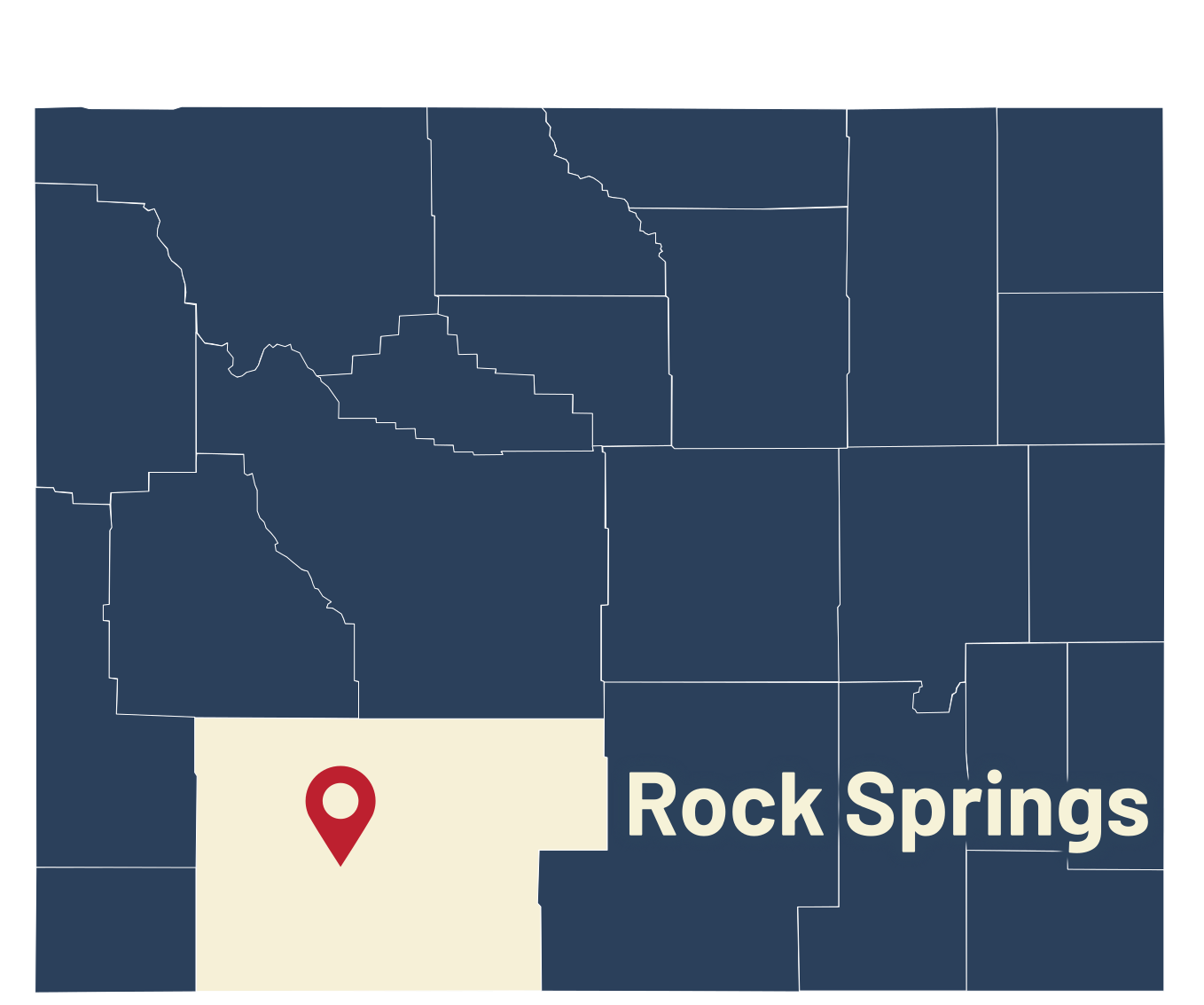
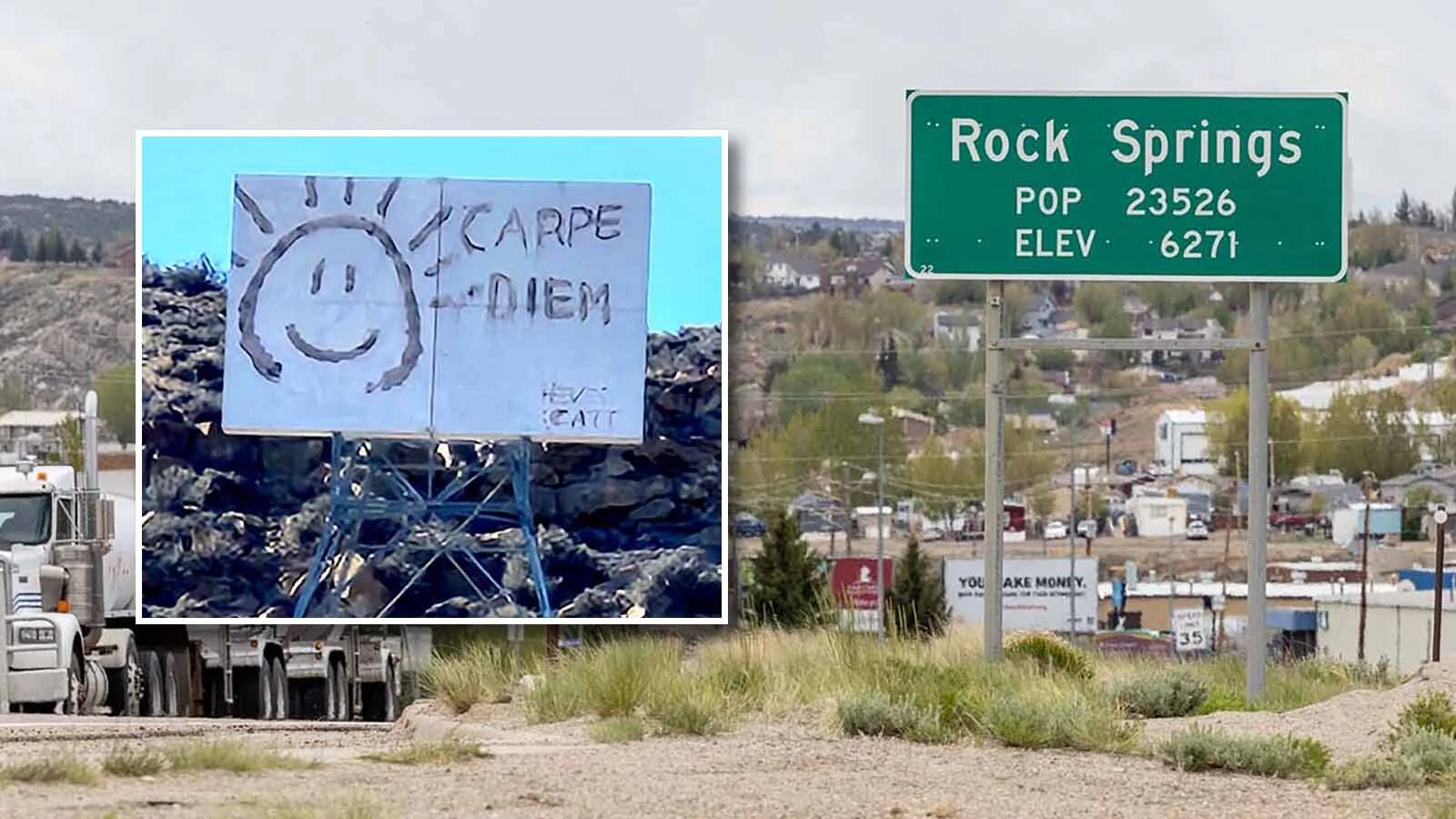
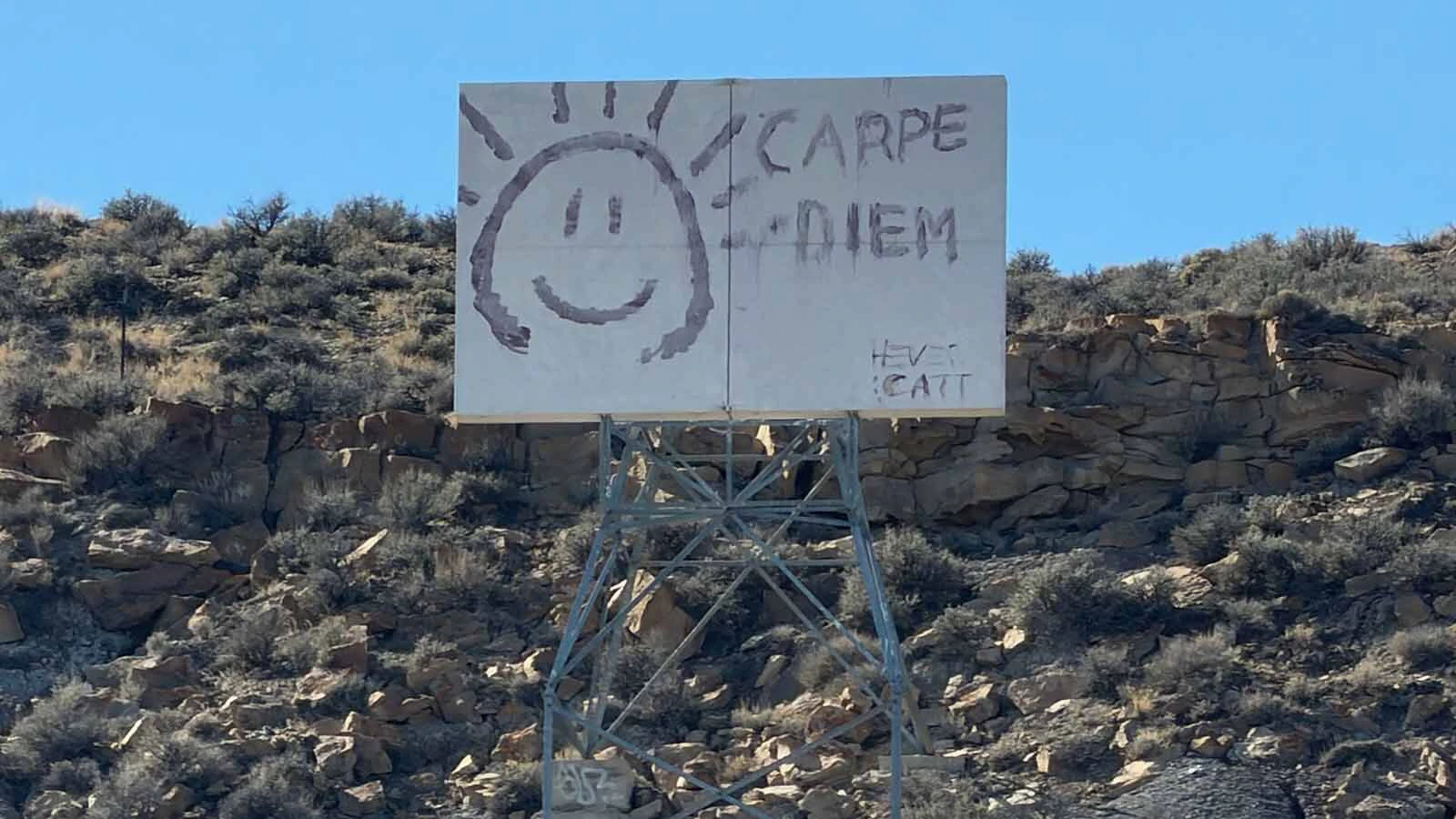
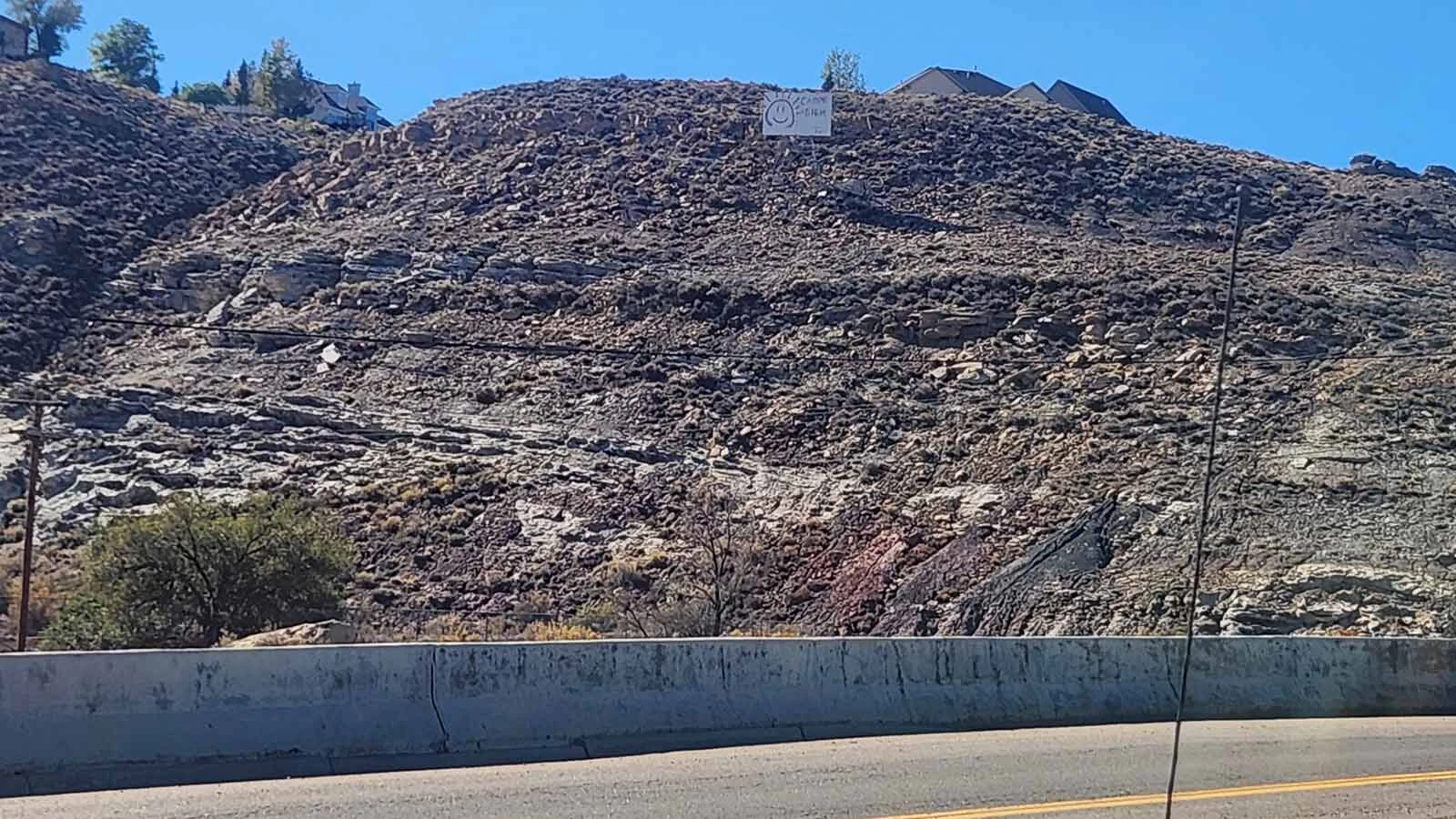
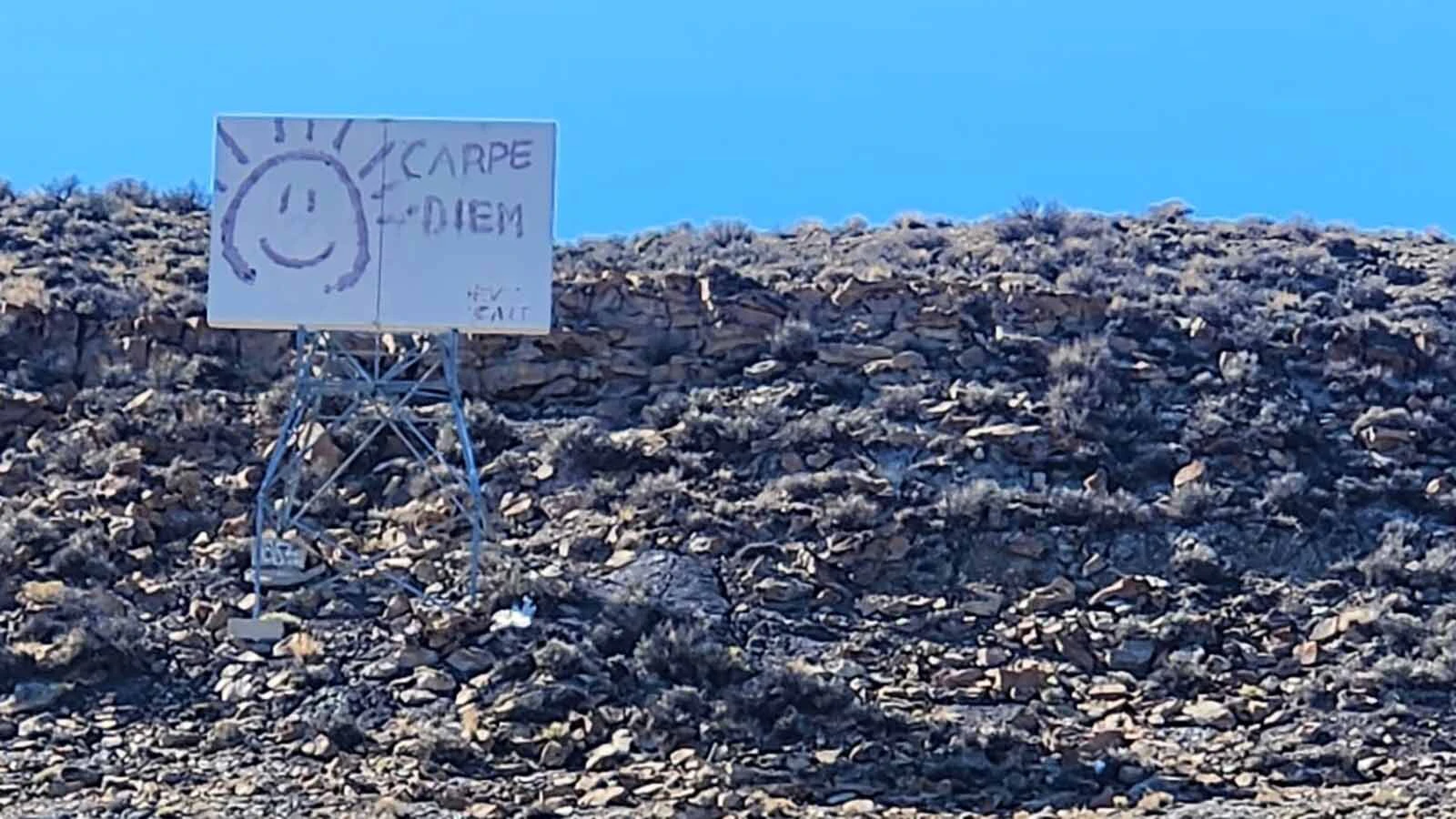
For decades, the words “Carpe Diem” and a crude smiley face have overlooked Rock Springs, graffiti painted across a large metal reflector panel and a mysterious message that has become a familiar part of the landscape.
Rock Springs resident Max Furman has often wondered who painted the words, Latin for “seize the day,” and why.
Furman got more than he bargained for when he asked about the graffiti on social media last week.
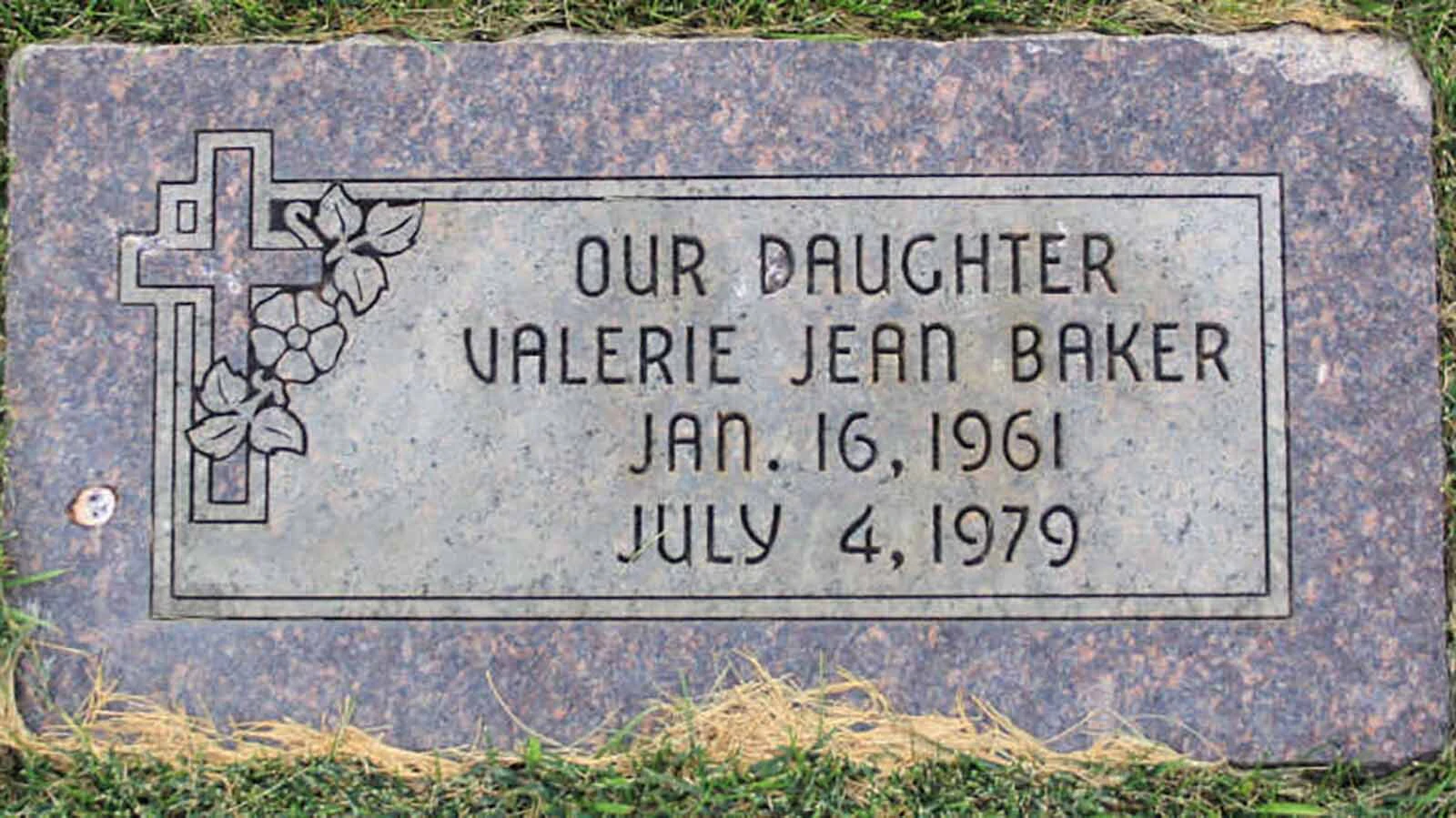
His seemingly innocent question about a decades-old message on College Hill stirred memories of a tragedy that unfolded nearby on July 4, 1979, when 18-year-old Rock Springs High School graduate Valerie Baker fell from a cliff while watching fireworks.
The graffiti had nothing to do with Baker's death. In fact, it wouldn't appear on the reflector panel until years later.
But for some longtime Rock Springs residents, the question about the landmark brought back memories of a young woman whose life ended just weeks after she graduated from high school.
And for Furman, the two unrelated stories have given new meaning to the words he's looked at for years.
“The graffiti has been there for as long as I can remember and I have always been curious about it,” Furman told Cowboy State Daily. “It has always made me smile. So honestly … I had no idea it would have such a sad story attached.”
A Fourth Of July Tragedy
On July 4, 1979, Baker was watching fireworks from the cliffs near her family's home in a relatively new subdivision atop College Hill in west Rock Springs.
She had graduated from Rock Springs High School just a couple of months earlier and was working as a secretary for Moss and Harris Refuse Company.
What should have been a festive summer evening ended in tragedy.
According to a Casper Star-Tribune report, Baker was near the edge of a cliff when she lost her footing and fell approximately 100 feet to a ledge below.
Police Lt. Robert Overy told the newspaper that Baker “just stood up and was turning on a rock when she fell over the edge.”
Another person who was with Baker that night offered a slightly different account.
“She was just sitting and popping fireworks and one landed next to her and when she moved to get away from it she went right off the edge,” the unidentified witness told the newspaper.
Baker suffered severe head and internal injuries and was rushed to Memorial Hospital of Sweetwater County.
She died approximately 30 minutes after arriving.
She was 18 years old.
At The Bottom Of The Hill
More than 47 years later, Sandy Seppie still remembers the emergency sirens that pierced the summer evening.
Seppie lived at the bottom of College Hill, below the subdivision where the Baker family lived.
She was home that Fourth of July when the commotion began.
“We didn't see anything right away,” Seppie told Cowboy State Daily. “We heard all the sirens and went out in our backyard.”
From her property, Seppie said she could see emergency vehicles responding to the scene.
“I didn't see her fall,” she said. “We just saw all the emergency vehicles and wondered what in the world was going on.”
Seppie said Baker was on her family's property, near the edge of the cliffs, when she fell.
At the time, the neighborhood was relatively new. According to Seppie, subdivision covenants prohibited homeowners from putting fences around the backs of their properties for aesthetic reasons.
That meant the backyards along the hill had no fences separating them from the steep dropoffs.
Seppie said she doesn't remember the lack of fencing being a topic of public concern before Baker's death.
Today, she said, many of those homes have backyard fences.
Cowboy State Daily reached out to Rock Springs Mayor Max Mickelson for information about the subdivision and its fencing restrictions but did not receive a response before publication.
For Seppie, Furman's social media question revived memories of an evening she hasn't forgotten.
“The sign brought it to light,” she said.
The Mystery On The Hill
The large, billboard-like metal structure that prompted Furman's question has its own history, entirely separate from Baker's death.
It is a passive microwave reflector, a piece of communications technology that once helped transmit signals across difficult terrain.
Before fiber-optic networks and modern communications systems became widespread, these large metal panels were installed on hillsides and mountaintops throughout Wyoming and the American West.
Unlike powered communications towers, passive reflectors required no electricity. Instead, they worked much like mirrors, redirecting microwave signals between transmission points that otherwise lacked a clear line of sight.
Developed in the 1950s, the technology became widely used by telephone companies, railroads and utilities in the following decades.
As communications technology advanced, many of the reflectors became obsolete.
But the structures themselves remained, leaving large metal landmarks scattered across the western landscape.
In Rock Springs, one of those landmarks eventually became a canvas for a message that has endured for roughly three decades: “Carpe Diem.”
Painting The Reflector
Who put it there?
According to Heather Blakely, who grew up in Rock Springs, the answer isn't quite as mysterious as some might think.
Blakely responded to Furman's social media post, identifying two friends, Joe Johnson and Steve McDonald, as the men who painted the words on the reflector about 30 years ago.
But after three decades, she said, the details aren't necessarily as important as the fact that the message remains.
“Memories get fuzzy, stories get taller and the truth has a way of becoming less interesting than the mystery,” Blakely told Cowboy State Daily in a social media message.
“The interesting thing isn't necessarily who painted it but that it's endured this long.”
What might have started as a couple of friends leaving their mark on an old piece of communications equipment has become a familiar feature of the Rock Springs skyline.
And for people who grew up seeing it, the message is now part of the town's identity.
“Maybe a little mystery is part of its charm,” said Blakely, who now lives in Cheyenne.
Two Unrelated Stories
Blakely was born a year before Baker died.
She said the graffiti was never intended as a memorial to the young woman, nor did the people responsible for painting it have any connection to her death.
“I don't think we even knew about her,” Blakely said.
The two stories are separated by years and circumstance.
One is the story of an 18-year-old whose life ended in a terrible accident on a summer holiday.
The other is the story of two friends who painted a Latin phrase on an aging metal structure overlooking their hometown.
Yet when Furman asked about the graffiti, the stories unexpectedly came together.
Seize The Day
For years, Furman had looked at the words “Carpe Diem” and smiled.
Now he knows about a young woman who died nearby long before those words appeared on the hill.
Baker was 18, fresh out of high school, with a life ahead of her that ended without warning on a Fourth of July evening.
The message on the reflector was never about her.
But after learning her story, Furman said the words carry a meaning that reaches beyond the mystery of who painted them.
Knowing what happened to Valerie Baker, he said, the sign gives him hope as “a reminder that life is unpredictable and I too need to seize the day.”
Kate Meadows can be reached at kate@cowboystatedaily.com.


