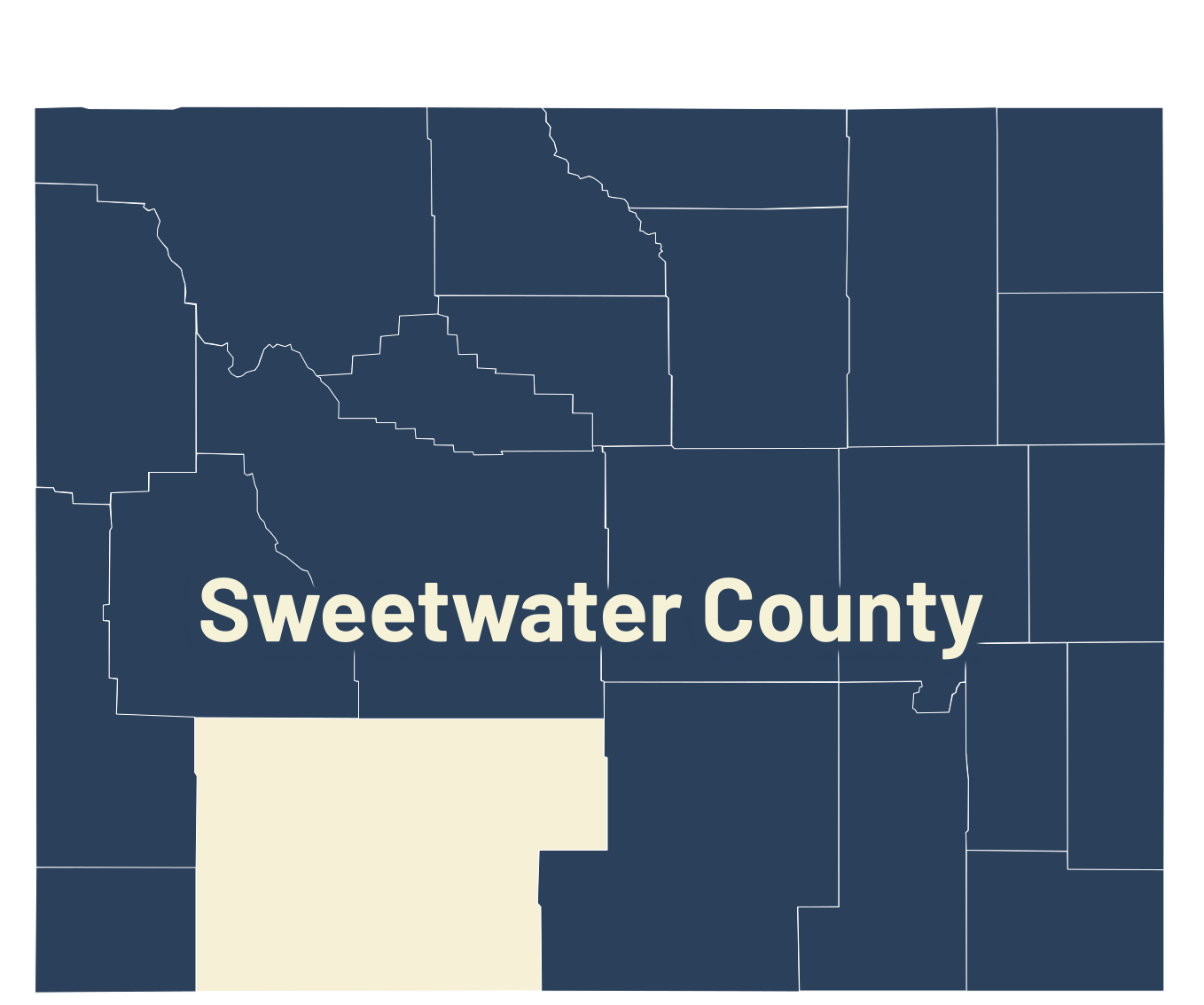
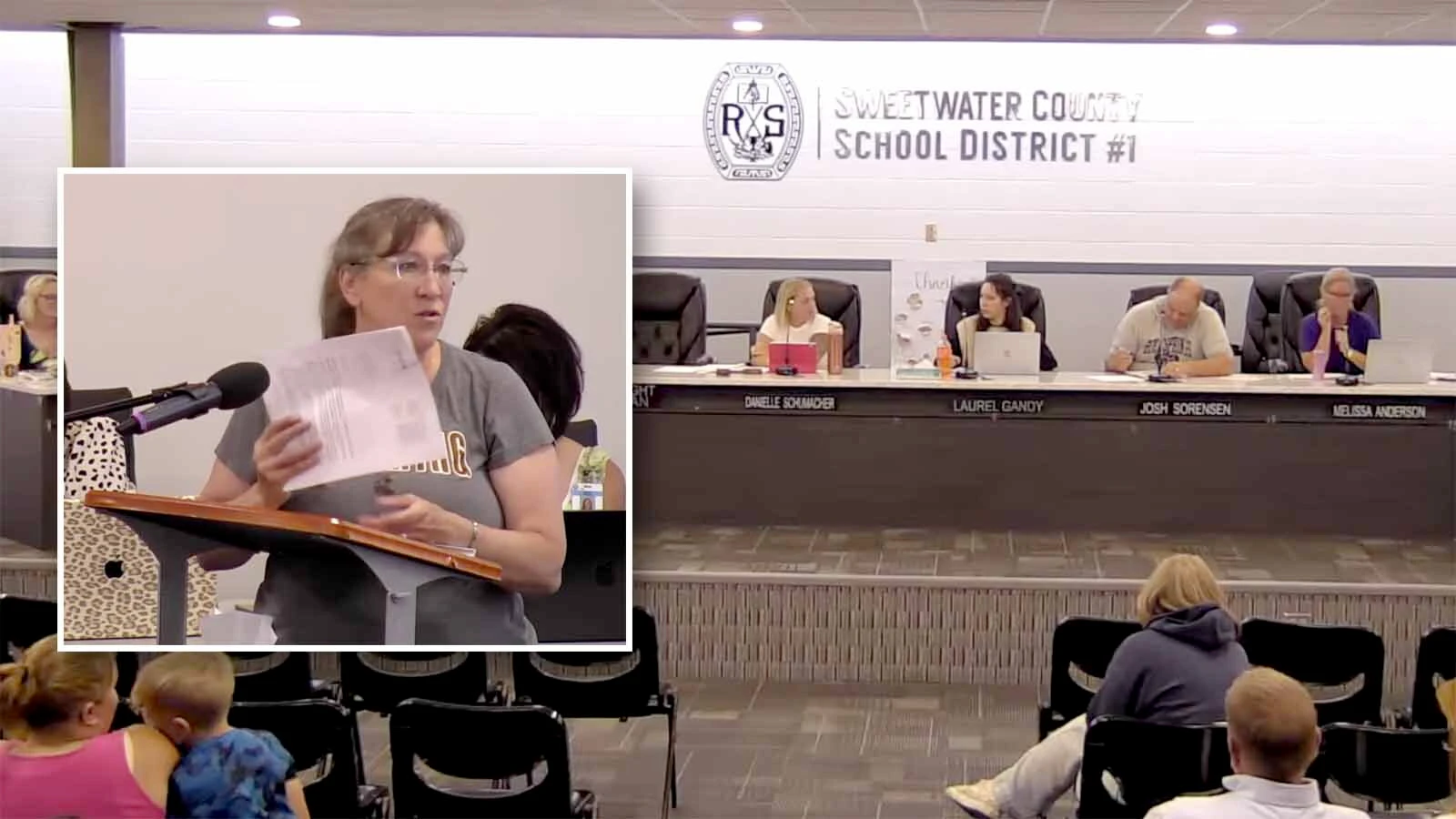
Sweetwater County School District No. 1 has temporarily shut down oral public comment at school board meetings while it revises a policy that a national legal organization says violates the First Amendment.
Curring school board policy allows people during public comment periods at meetings to praise school district employees, but not offer criticism.
The school board voted unanimously Sept. 14 to suspend its public-comment period after receiving notice that its existing policy could result in litigation.
“The district received a correspondence from a national organization written on behalf of a community member, questioning whether parts of our public-comment policy meet First Amendment standards,” trustee Danielle Schumacher said before the vote. “Based off that, the organization has indicated to the district that they are prepared to litigate.”
Schumacher did not identify the organization or community member.
But the Goldwater Institute, an Arizona-based conservative public policy and litigation organization, confirmed to Cowboy State Daily that it sent the district a letter in August on behalf of Sweetwater County parent Cherell O’Driscoll challenging the district’s public comment policy.
No lawsuit has been filed.
Board Chair Cole Wright told Cowboy State Daily in a text message the district will continue accepting written public comments while its policy committee works on revisions to the policy.
Interim Superintendent Paul Grube will schedule the committee’s next meeting based on his priorities, Wright said.
Wright did not respond to a question asking whether the potential litigation referenced at the Sept. 14 meeting involved the Goldwater Institute.
Calls and emails to Schumacher and Grube were not returned before publication.
Criticism Versus Praise
At the center of the dispute is Policy KD, which governs public participation at school board meetings.
The board began considering changes to the policy in August 2025. Wright said at the time comments regarding the employment or performance of individual staff members could not be addressed publicly because of employee privacy and due-process protections.
The board adopted revisions in October 2025 prohibiting public comments regarding “the performance or employment of individual district employees.”
The policy also directs confidential personnel issues involving such matters as appointment, evaluation, reassignment, discipline or dismissal to other district processes.
Nearly a year later, Goldwater Institute attorney Parker Jackson challenged both the policy and how the district has enforced it.
In an Aug. 5 letter to Wright viewed by Cowboy State Daily, Jackson argued on behalf of O’Driscoll that the district has allowed public comments praising individual employees while blocking comments critical of employees.
Goldwater contends that amounts to unconstitutional viewpoint discrimination.
The dispute stems in part from a written comment O’Driscoll submitted before the board’s April 13 meeting.
According to the district’s guidelines, “[a]ll written comments will be posted in the ‘Written Public Comment’ section of the agenda for review by all attendees, including Trustees.”
O’Driscoll's comment, however, was not included with the original public meeting materials because it criticized then-Assistant Superintendent Nicole Bolton and called for her removal or reassignment.
The district later amended its April meeting materials to acknowledge O’Driscoll had submitted a comment, but did not publish the comment itself, explaining that it requested disciplinary action against an individual employee.
O’Driscoll wrote that she wanted to see Bolton dismissed from her position and accused the administrator of mishandling interactions with parents, teachers and students.
Goldwater argues the district treated other comments differently when they praised employees.
During the same April meeting, according to Goldwater's letter, O’Driscoll was permitted to identify and praise two Rock Springs Junior High employees for helping her daughter.
That difference in treatment forms a central part of Goldwater's First Amendment challenge.
“The end result of Policy KD is that public comments praising public employees have been allowed, but public comments criticizing other public employees in the same contexts and mediums were censored,” Jackson wrote in the letter.
Goldwater characterized that as “viewpoint discrimination.”
Cut Off At May Meeting
O’Driscoll again attempted to criticize Bolton during the board's May 11 meeting as trustees considered administrative contracts.
“I would like to talk about agenda item number 10, administrative contracts, and ask that they go to a roll call vote,” O’Driscoll said. “I … also do not think that Assistant Superintendent Nicole Bolton should be renewed.”
Wright interrupted her.
“Hey Cherell, if you’ll please keep your comments to not specific individuals, I would appreciate that,” he said.
Goldwater argues that the district cannot permit favorable comments about named employees while prohibiting unfavorable ones.
“The end result of Policy KD is that public comments praising public employees have been allowed, but public comments criticizing other public employees in the same contexts and mediums were censored. That’s textbook viewpoint discrimination,” Jackson’s letter to Wright reads.
In a blog post published Aug. 6, Jackson accused the district of using its revised policy to “unconstitutionally silence critics,” saying the First Amendment prevents government officials from choosing which viewpoints members of the public may express during a public forum.
The institute also has a separate dispute with the district over public records.
According to Jackson's letter, Goldwater requested copies of all written public comments submitted to the board between July 1, 2025, and April 14, 2026.
Goldwater contends the district unlawfully withheld some of those records under the Wyoming Public Records Act. The public-records issue was addressed in a separate letter to then-superintendent Joseph Libby.
Sheridan Case Looms Large
Goldwater's warning is particularly significant because another Wyoming school district lost a federal First Amendment case two years ago involving remarkably similar circumstances.
Sheridan County resident Harry Pollak sued Sheridan County School District No. 2 after then-Board Chair Susan Wilson stopped him from criticizing Superintendent Scott Stults during a February 2022 board meeting.
Pollak had been criticizing Stults over the district's 2021 mask mandate and had called for his resignation.
Wilson told Pollak he could not discuss personnel matters under board policy.
“We do not talk about personnel unless it’s favorable things. We always like to hear those,” Wilson said, according to the federal court ruling.
In October 2024, U.S. District Judge Alan Johnson ruled that the district's personnel policy itself was constitutional, but the way it was enforced against Pollak was not.
The court found the board violated Pollak's First Amendment rights by preventing him from making critical comments about an employee while allowing other speakers to make positive comments about district employees.
Johnson also permanently prohibited the district from interpreting its personnel policy to prevent speakers from merely naming individual staff members.
Goldwater cited the Pollak case extensively in its letter to Sweetwater County School District No. 1, arguing that the circumstances are similar.
“The same constitutional defects present in Pollak are present here,” Jackson wrote.
Goldwater contends Sweetwater County's board similarly allowed O’Driscoll to identify and praise employees while preventing her from identifying and criticizing Bolton.
No Lawsuit — Yet
Despite the board's decision to suspend public comment, the Goldwater Institute has not filed a lawsuit.
Jackson said Thursday that litigation remains an option.
“The Goldwater Institute continues to monitor the public comment policy and practices in Sweetwater County School District #1,” Jackson said in a statement to Cowboy State Daily. “While litigation has not yet been initiated, all legal options remain on the table.”
“We hope that the Board will swiftly bring its public comment policy into compliance with the First Amendment and the overlapping protections of the Wyoming Constitution.”
Wyoming's Public Meetings Act requires meetings of governing bodies to be open to the public and requires official action to occur during properly noticed public meetings.
The law does not, however, expressly require governing bodies to provide a designated public-comment period. It says people seeking recognition at a public meeting may be required to provide their names and affiliations.
That leaves the district able to temporarily suspend its public-comment period while the board works through the constitutional questions surrounding its policy.
Schumacher said that's exactly what the board is trying to do.
While the district is not defending an active lawsuit, she said continuing to enforce a challenged policy could expose taxpayers to additional legal claims and costs.
“Given those circumstances, applying a challenged policy for further meetings invites further claims, potential awards of attorney fees, and months of distraction from work that the board here is trying to do and complete,” Schumacher said at the Sept. 14 board meeting.
During the same meeting, after a lengthy executive session, the school board unanimously voted to eliminate the assistant superintendent position and place Libby on paid administrative leave.
The board appointed Paul Grube as interim superintendent during a special meeting on Saturday.
It remains unclear whether Libby continues to be paid on administrative leave, why the assistant superintendent position was eliminated and whether Bolton has been or will be reassigned within the district.
Kate Meadows can be reached at kate@cowboystatedaily.com.