
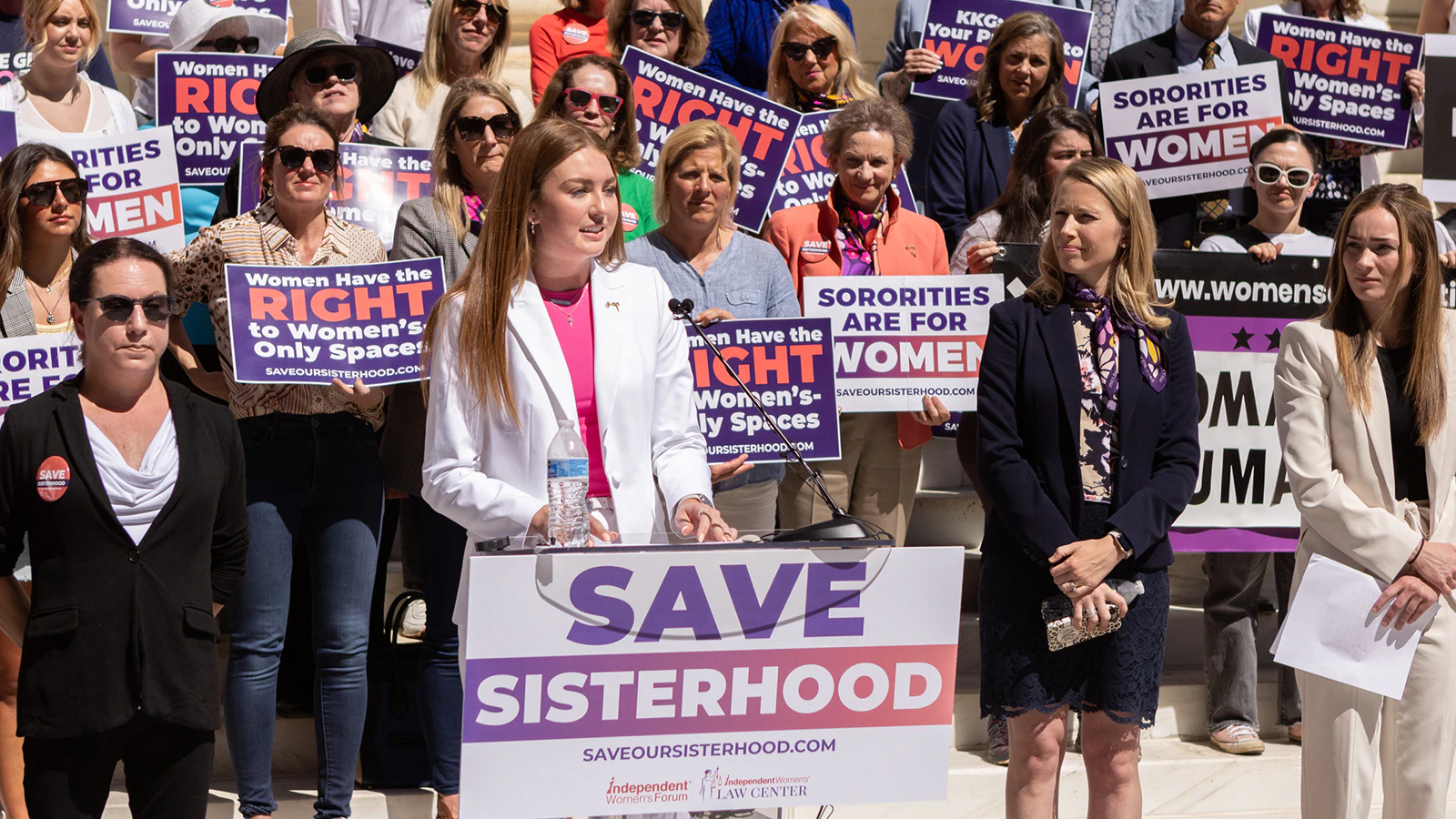
Three members of a Wyoming sorority chapter who say it was bad business dealing for the all-women organization to admit a transgender member in the fall of 2022 argued that point Monday morning to the 10th Circuit Court of Appeals in Denver.
The argument between the sorority sisters’ attorney Angela Lavin and Kappa Kappa Gamma’s attorney Natalie McLaughlin revolved around whether a sorority governing council could interpret the bylaws’ term “woman” to include transgender women.
On the one hand, McLaughlin argued, the council has the authority to interpret terms within the bylaws.
On the other hand, countered Lavin, the council can’t reinterpret a term that has been the key to the organization’s existence, purpose and membership for the past 150 years, in a way that means the opposite of the original term.
“It would be like if the Sierra Club’s internal board of directors suddenly interpreted ‘environment’ to include ‘any development on land,’” said Lavin.
Tenth Circuit Senior Judge Timothy Tymkovich and Judges Jerome Holmes and Nancy Moritz grilled both attorneys.
McLaughlin maintained that the case revolves around a private organization’s ability to govern itself, and she pointed to Ohio laws’ deference toward governors of private groups. Kappa is incorporated in Ohio, so that reference recurred.
“Kappa’s governing documents expressly assign fraternity council the duty of defining and interpreting its bylaws,” McLaughlin said, adding that interpreting “woman” to include people who identify as women was the council “reasonably” exercising that authority.
One of the male judges sparred with McLaughlin, noting that Ohio law still bars arbitrary and unreasonable interpretations of a group’s bylaws.
“If the council explicitly added the category of men … would that be a reasonable interpretation under Ohio law?” he asked.
McLaughlin answered no, saying, “The authority is not limitless.”
The judge countered:
“But the interstation you’re defending does allow biological men to join the sorority, right?”
“Individuals born as men, but who ID as women,” said McLaughlin.
She pointed to other sources, including at least one dictionary, that has defined “women” to include transgender women.
“You’re really saying the definition of ‘woman’ has evolved over the centuries,” said the judge. He noted that when the sorority was founded in the 1800s, Webster’s dictionary made it “pretty clear woman was a female adult.”
“Would it be reasonable for the board to basically discard the founding principle of the organization in favor of the new, expanded interpretation of the term?” asked the judge.
McLaughlin answered, “The historical meaning of what woman may have meant back then is not relevant.”
She emphasized that the bylaws left the term undefined. And under questioning by the other male judge, McLaughlin said the sorority’s members could have pushed for a definition of “woman,” could have crafted an amendment to define it in the bylaws themselves, or could vote in a new council that will interpret it as the members wish.
McLaughlin and Lavin disputed the timeline of this case.
Lavin said Kappa leaders – rather than simply reinterpret “woman” – added a whole new category of it by determining in 2015 that people who identify as women are welcome in the sorority.
McLaughlin said that was a mere reinterpretation.
And Lavin said the plaintiffs didn’t learn about the addition until 2022. McLaughlin said that information surfaced at least for members in 2018.
One male judge indicated that having “woman” as a membership criterion in the bylaws but not clearly defining that term to prospective new members is a ruse.
“One could reasonably argue this is a bait and switch though,” said the judge.
He asked if anyone tells new recruits that transgender women may be inducted.
“Certainly there’s no legal duty clarify every undefined legal term from every person,” countered McLaughlin.
Lavin in her rebuttal parried, “If it goes to the heart of the organization’s existence, that’s beyond just mere interpretation.”
At the end, the case was submitted for review.
Decisions from this court after oral argument can take weeks or months.
The Kappa Kappa Gamma case is a years-long saga and familiar to the Wyoming reader.
The sorority’s University of Wyoming chapter voted in the fall of 2022 to admit Artemis Langford, the sorority’s first known transgender member of its 150-year existence.
Outcry followed, including at least one protest at the university that became a First Amendment case of its own.
And in the spring of 2023, seven – later winnowed to six – sorority members sued Kappa, claiming breach of contract and other unfair dealings.
U.S. District Court Judge Alan B. Johnson dismissed the case that August, pointing to the rights voluntary associations have to dictate their own membership terms.
A new iteration of three sorority sisters sued again in June 2025. Johnson dismissed the case again, and the women appealed to the higher court, based in Denver.
The Disputed Election
The lawsuit complaint calls Kappa's processes unfair and irregular.
It alleges that “the student,” Langford, was not inducted into Kappa during the 2022 inductee-vetting “rush week,” but that chapter leaders, with the approval of headquarters, later conducted an ill-noticed and spontaneous vote about whether to induct Langford.
Though sorority rules call for the use of a voting application that uses secret ballots, this election required the women to post their email addresses with their votes, says the amended complaint.
Leaders at the chapter based on the University of Wyoming campus also urged women against voting down Langford’s membership, telling them they’d be considered bigots and they could face expulsion or suspension from the sorority if they didn’t have a “personality” focused reason for not voting Langford into the sorority, the complaint says.
When the plaintiffs Hannah Holtmeier and Maddie Ramar asked about the student’s application, the membership chair “downplayed any possibility that the student would become a Kappa member, claiming there was a ‘99.9% chance’ that he would not be offered membership,” says the complaint.
The lawsuit complaint calls the inductee “he” while Johnson, in his various orders, has called the inductee “she,” as have sorority leaders in their filings.
The complaint says the membership chair of that era “intentionally provided limited notice of the only opportunity to meet the student as part of a plan hatched by national (sorority) representatives to ensure that Wyoming chapter members would not have a basis to vote against the student’s membership.”
Ramar and another plaintiff, Grace Choate, weren’t allowed to vote because they weren’t present at the Sept. 19, 2022, chapter meeting where the vote was held, though their complaint says they should have been allowed to vote anyway, under the sorority’s rules.
There were two votes. Some women who felt pressured changed their votes to yes on the second vote, the complaint alleges. When enough votes were secured for “the student’s membership,” the voting stops, it adds.
The student was admitted by a narrow margin, the complaint says.
“Nothing about this voting process on Sept. 20, 2022, was normal,” says the complaint. “This irregular process violated Kappa’s Standing Rules and Policies in multiple ways.”
The women allege that Kappa stands in violation of its own bylaws and founding documents, which refer to expectations and induction procedures for Kappa “women” and “ladies.”
Kappas’ first, 1871 bylaws said “any lady may become a candidate for membership” if she has good moral character and above-average talent, and who goes to a college or seminary.
The group’s articles of incorporation say the sorority’s purpose is “to unite women,” the complaint adds.
Under Ohio law, notes the complaint, a corporation’s bylaws can’t conflict with its articles of incorporation.
The Guidance
The organization in 2022 dispatched a frequently asked question guidance document saying the sorority under National Panhellenic Conference rules could define “woman” for purposes of recruitment as someone who lives and self-identifies as a woman, and that Kappa was “comprised of women and individuals who identify as women.”
The guidance was provided to Kappa leaders less than 60 days before the sorority’s convention and didn’t alter the bylaws, the complaint alleges, adding that the document was never voted on.
Conversely, says the complaint, Kappa’s own policies prohibit men from participating in recruitment events, and call Kappa a “single-sex organization.”
Meanwhile…
Meanwhile, Langford sued two of the Kappa sisters’ original attorneys, Cassie Craven and John Knepper, in state-level court, alleging they abused the lawsuit process to humiliate Langford and make money.
Craven settled the case and Knepper was found not liable after a civil trial earlier this year.
Clair McFarland can be reached at clair@cowboystatedaily.com.


