
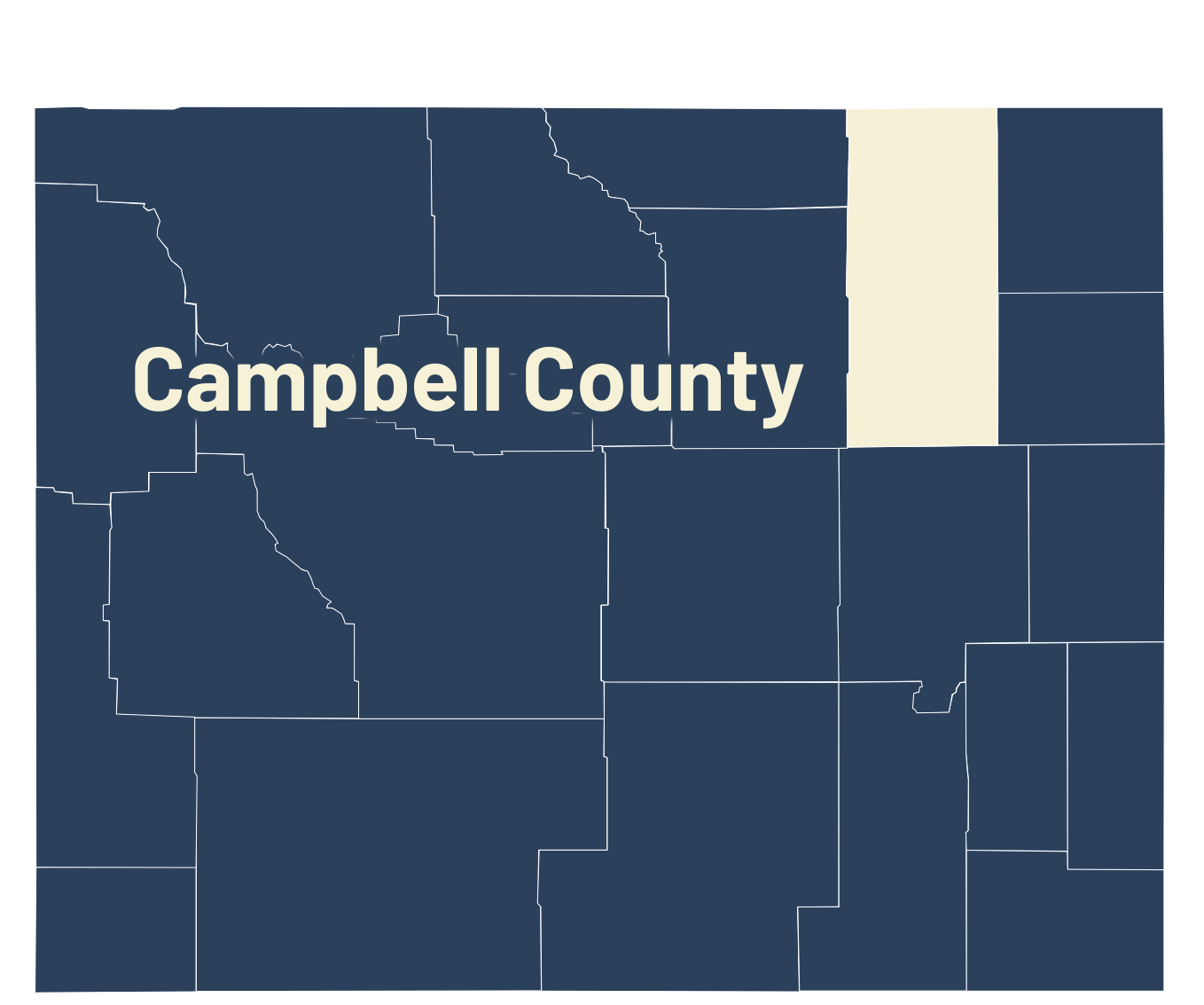
The family of a Campbell County jail inmate who died in a restraint chair nearly four years ago is suing the county, the sheriff and several deputies.
“Kenneth Durrah died as he sat strapped to a restraint chair, naked and alone in a holding cell, mere feet from the Campbell County Sheriff’s detention personnel who ignored his desperate pleas for help and cries of pain as his final minutes slipped agonizingly away,” alleges the complaint, filed Monday in U.S. District Court for Wyoming.
Through Denver-based attorney Darold Killmer, Kenneth Durrah’s brother Joshua leading the Durrah estate's "excessive force and deliberate indifference to medical needs" lawsuit against Campbell County and Sheriff Scott Matheny in his official capacity. The family is also suing Sgt. Mara Donathan, Cpl. Marlene Sharpe, and Deputies Ryan Wells, Rober Shirley, Jonathan Herman, Stephanie Quinones, Samuel Boyles and Mara Madrid, in their individual capacities.
That means Joshua and the estate are arguing the deputies don’t have qualified immunity to avoid being penalized personally.
The complaint recounts Durrah’s Dec. 1, 2022, jail stay, which ended with his death.
Durrah was arrested one week prior after a Gillette standoff in which he was reportedly found with a pistol, cocaine and marijuana. Gillette Police Department personnel, who are not sued in this case, believed Durrah may have ingested cocaine, and sent him to the hospital for evaluation.
Durrah was cleared and taken to the jail.
Starting half an hour after midnight as Dec. 1 began, Durrah asked Shirley and Herman if he could leave his cell for fresh air, and the deputies refused, says the complaint.
Durrah said he was suffering from anxiety in part because his son had been reported missing in South Dakota, says the complaint. It adds that Durrah weighed 142 pounds and reported to jail staff that he suffered from asthma.
At 1:20 a.m., other inmates flickered their lights to alert deputies to Durrah’s calls for medical attention. The inmates said Durrah was yelling that he couldn’t breathe and his heart suffered, the complaint says.
Durrah called for help and banged on his door. Shirley summoned other deputies, and Madrid, Herman, Wells, and Donathan all responded, the complaint says.
When they opened the door, Durrah collapsed and said his heart hurt. Shirley noted that Durrah’s fists and toes were clenching and un-clenching, repeatedly, the suit claims.
Shirley retrieved an automated external defibrillator and Madrid had Wells retrieve a blood-pressure cuff. They found Durrah’s heart rate elevated and blood pressure high, the complaint says.
The document adds that the county had not scheduled nurses or medical staff to work nights at the jail, and none were there that night.
Donathon told deputies to take Durrah to the booking area, and called for paramedics to evaluate him. Herman and Shirley took Durrah, who coughed continuously and clutched his chest, to the booking area, the complaint says.
Durrah vomited in the booking area, reportedly. Paramedics arrived, found Durrah’s heart rate high, and later cleared him to remain in the jail, the complaint says. It says the medical personnel left at 1:46 a.m.
Donathon called for Durrah to stay in one of the booking cells for monitoring. Durrah kept saying he struggled to breathe, and he asked for water repeatedly, the complaint says.
At about 2:15 a.m., Wells and Quinones noticed through a cell-door window a small white object in Durrah’s mouth.
Wells later described it as a square jeweler’s bag with a white substance inside.
Durrah ripped open the bag with his hands and teeth, swallowed at least some of its contents and swallowed the baggie, the complaint says.
The document lists some of the medical fallout from using meth, like overstimulation, muscle breakdown, low oxygen and kidney stress.
“Mr. Durrah would exhibit several of these symptoms over the course of the lengthy uses of force which the CCSO deputies would soon inflict upon him,” says the complaint.
Wells called for Durrah’s cell door to be opened, says the complaint, adding that Donathon suggested deputies get Narcan ready.
No one administered Narcan, the document says.
The complaint alleges that rather than call for medical help, Wells ran into the cell to start a “violent, reckless, and patently excessive use of force against Mr. Durrah.”
Wells tried using his fingers to remove the baggie from Durrah’s mouth, the complaint says. Quinones also entered the cell and “went hands on with Mr. Durrah,” who in turn huddled in a corner, then ran out into the jail’s booking area, the complaint says.
The document says the booking area isn’t a public or community area, and there weren’t members of the general public there at that time.
The Physical Incidents
The complaint says Wells tackled Durrah to the concrete floor and ordered him to roll onto his stomach. It says deputies leaned their knees and body weight onto the back side of Durrah’s body as he lay prone, “pushing him to a state of extreme physical exertion while substantially impairing his ability to respirate.”
Prone restraint, says the complaint, creates an extreme risk of acidosis, which happens when lactic acid and carbon dioxide build up amid physical exertion.
Conditions like asthma heighten that danger, the complaint says.
“The deputies could and should have physically controlled Mr. Durrah without use of this dangerous technique, as Mr. Durrah was a slight man weighing only 142 pounds,” the complaint says. “Instead, over the course of the next several minutes, CCSO deputies placed as much pressure on Mr. Durrah’s prone body as they could manage.”
The document says Wells put his right knee on Durrah’s upper left leg. Quinones put her left knee on his lower back and leaned her lower body weight onto him, while she also pinned his right hand to the floor with her own, and Wells used both hands to secure Durrah’s left arm behind his back.
The complaint alleges Donathan joined by putting her right knee on Durrah’s upper back and leaning on him with her full body weight.
“I can’t breathe!” yelled Durrah, according to the complaint. He begged deputies to stop while they held him in that position for 20 seconds, the document alleges.
The document says Wells climbed onto Durrah’s back and wrapped a forearm around his neck.
Durrah “screamed in pain and terror,” the complaint says. It says Wells’ arm then covered Durrah’s mouth.
The complaint says Donathon used nunchucks on Durrah’s right ankle.
Boyles arrived and “ran to join,” the document alleges.
Durrah cried in pain and begged deputies to stop, the document alleges. It claims that Wells ground Durrah’s head into the concrete floor with his knee, and remained under the deputies’ bodily pressure for one minute, 10 seconds, as they handcuffed him behind his back.
The complaint alleges that Durrah begged for Narcan and said “Don’t let me die.”
The complaint cites a 10th Circuit Case calling prone submission with significant pressure on a person’s back excessive force.
Once Durrah was handcuffed, Wells, Boyles, Shirley, and Quinones lifted him up, with Donathon supervising, and carried him into another holding cell, the complaint says.
They cut his clothing off with scissors in what the lawsuit complaint calls a “second, protracted use of force.
The complaint alleges Wells put both knees and his whole body weight on top of Durrah: Right knee on Durrah’s back and left knee on Durrah’s head and neck. It claims Boyles followed suit, and “crushed” Durrah, compromising his ability to breathe. It also claims two deputies wrenched Durrah into a “hog tie” position.
Durrah squirmed, the complaint says, “in a desperate bid to breathe.”
The complaint includes multiple photographs of the incidents described.
The complaint says Donathon watched the incident and didn’t issue any orders to reduce the pressure on Durrah. Instead, it says, she called for Durrah to be put in a restraint chair.
About Hidden Contraband
Campbell County Undersheriff Quentin Reynolds and other officials told the media later that defendants removed Durrah’s clothes to find any potential contraband, the complaint says.
The restraint chair would have prevented him from accessing contraband, and from using any clothing to hurt himself, the complaint counters.
Durrah cried out that he couldn’t breathe and a deputy shouted for him to “shut up,” says the document.
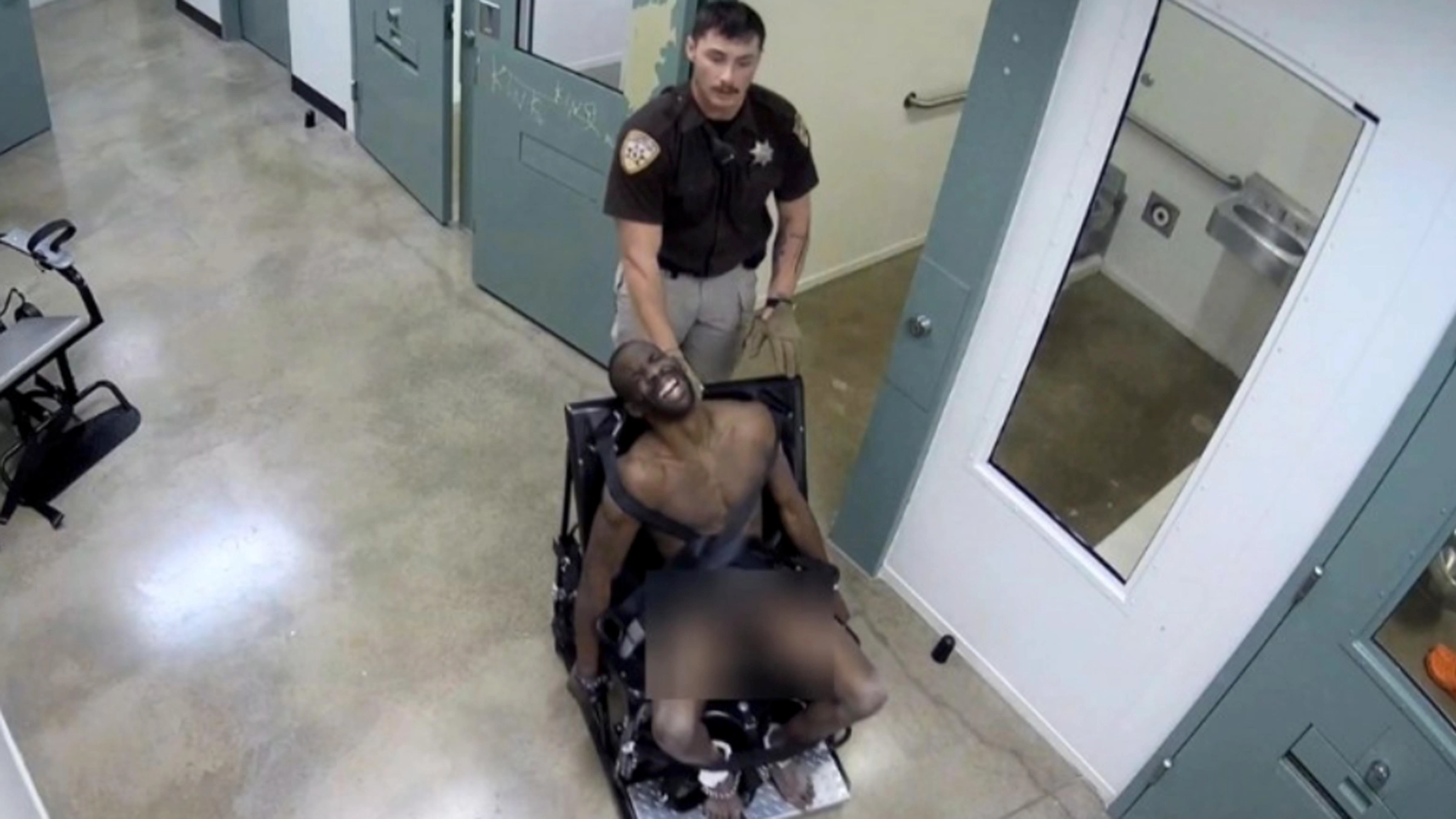
Deputies “hoisted the naked, handcuffed Mr. Durrah into the restraint chair.”
The complaint says Wells, Quinones, Boyles, Shirley, Madrid and Donathon worked to secure Durrah “very tightly” in the chair, and kept their knees on him during the effort.
Madrid kept a pain-compliance hold on a pressure point near his jaw, the complaint alleges. The complaint says that, with at least six deputies restraining Durrah, that gesture didn’t serve a penological purpose.
The complaint includes a photograph of one deputy behind the chair, and Durrah strapped to it, naked and seated, his face in an expression of agony.
Deputies didn’t summon medical responders at this time, the complaint says. They talked and laughed among themselves. Wells told the others that he’d seen Durah swallow suspected narcotics, and Durrah remained in the restraint chair for 36 minutes, says the complaint.
Durrah kept saying he was in dire condition and couldn’t breathe, it adds.
At 2:27 a.m., he said the restraint chair was too tight and deputies ignored him, the complaint alleges.
One minute later, he asked Madrid for Narcan and she “ignored” him, the document claims.
And two minutes after that, he reportedly shouted that he was “dying” and overdosing, “I swear!”
The document says Sharpe told her subordinates she’d just heard about “the naked black guy trying to escape.”
It alleges that Wells mocked Durrah’s pleas for help in a high-pitched voice, and that Quinones joined in the mocking.
Quinones said if a person can talk, he can breathe, the complaint relates. The document calls that an “incorrect belief.”
At 2:35 a.m., Wells shut the door, leaving it a crack open, “apparently … because he and the other Defendants did not want to continue to hear Mr. Durrah’s loud cries for help,” the complaint says.
At 2:44 a.m., Wells glanced into the cell window and walked away, the document adds. Seven minutes later Wells found Durrah unresponsive in the chair, it says.
“Predictably, the combination of lengthy, crushing uses of force and prone restraint, the unaddressed methamphetamine ingestion, and the impossibility of sufficient respiration in the overtightened restraint chair had overwhelmed Mr. Durrah’s system, leaving him acidotic,” the complaint says.
Wells gave Donathon a thumbs-up to signify Durrah was breathing.
This wasn’t enough to confirm that Durrah’s body was getting enough air, the complaint counters.
At 3:01 a.m. Wells returned to the cell and called Durrah’s name, then tried to wake him but could not, says the complaint.
Wells told Donathon to call for an ambulance. Herman contacted 911.
Wells tried to wake Durrah with a sternum rub, and Sharpe checked his pupils with a flashlight, finding them “fixed and dilated,” the complaint says.
Wells called for an AED; Shirley retrieved it. But Sharpe couldn’t find a pulse, reportedly. The AED didn’t advise delivering a shock to Durrah, the complaint says.
The complaint asserts that Boyles and Shirley weren’t familiar with the CPR technique, bungled their efforts and required direction from Sharpe to perform CPR.
Medical personnel arrived and rushed Durrah to Campbell County Memorial Hospital, where he was pronounced dead.
The Ask
Durrah’s brother alleges the defendants acted or failed to act “under color of state law.”
His complaint says Durrah’s Fourth, Eighth, and 14th Amendment rights were clearly established.
That turn of phrase commonly surfaces in litigation as an attempt to puncture an officer’s claims of qualified immunity, which keeps officers from being sued in their individual capacities. It does not apply if the officer violated a clearly established right.
The complaint alleges Durrah was “in obvious and serious need of immediate medical care at least from the moment of his ingestion of methamphetamine” in the booking area.
It calls the two physical incidents dangerous prone restraints. It accuses deputies of forcefully over-tightening the restraint chair, and creating an environment in which Durrah couldn’t breathe to recover from the clashes.
And the complaint accuses the deputies of deliberately and intentionally withholding medical care Durrah needed.
The jail captain Kevin Theis later told the public the jail sees people come into it under the influence in varying capacities, and people will often “put on big shows,” says the complaint.
Durrah’s brother asserts two claims for relief: One accusing all defendants of deliberate indifference to Durrah’s medical needs, and another accusing all defendants except Sharpe of excessive force, in violation of the man’s Fourth and 14th Amendment rights.
The complaint asks for declaratory relief (a judge saying the plaintiff is right), injunctive relief (a judge stopping some action), and compensation for economic losses, emotional distress and other life disadvantages, plus punitive (punishing) damages, attorney’s fees and costs.
Campbell County Sheriff Scott Matheny and Campbell County Attorney Nathan Henkes did not return requests for comment by publication.
Clair McFarland can be reached at clair@cowboystatedaily.com.


